|
Nature Observer by Jahla Brown, DCYF ESIT Partnership & Collaboration Specialist
“We are what we imagine. Our very existence consists in our imagination of ourselves. Our best destiny is to imagine, at least, completely, who and what, and that we are. The greatest tragedy that can befall us is to go unimagined.”
- N. Scott Momaday, Kiowa novelist, short story writer, essayist, and poet. His novel House Made of Dawn was awarded the Pulitzer Prize for Fiction in 1969 and is considered the first major work of the Native American Renaissance.

Excerpt from a longer speech by Onondaga Faithkeeper, Oren Lyons, given in 2003 to the Bioneers conference. Oren describes the history and importance of the Two Row Wampum Treaty (watch time 4:28):
|
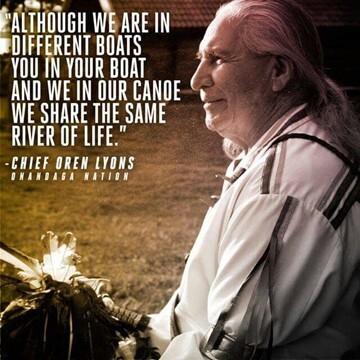
“Although we are in different boats, you in your boat and we in our canoe,
we share the same river of life.”
– Chief Oren Lyons, Onandaga Nation
Each week, DCYF ESIT Tribal Program Specialist, Brian Frisina, provides a key topic to help us get to know our Tribal Nation Partners better.
This week’s term is:
American Indian or Native American?
American Indian, Indian, Native American, or Native are acceptable and often used interchangeably in the United States; however, Native Peoples often have individual preferences on how they would like to be addressed. To find out which term is best, ask the person or group which term they prefer. When talking about Native groups or people, use the terminology the members of the community use to describe themselves collectively. There are also several terms used to refer to Native Peoples in other regions of the Western Hemisphere. The Inuit, Yup'ik, and Aleut Peoples in the Arctic see themselves as culturally separate from Indians. In Canada, people refer to themselves as First Nations, First Peoples, or Aboriginal. In Mexico, Central America, and South America,the direct translation for Indian can have negative connotations. As a result, they prefer the Spanish word indígena (Indigenous), comunidad (community), and pueblo (people).
Tribe or Nation, and Why So Many Names?
American Indian people describe their own cultures and the places they come from in many ways. The word tribe and nation are used interchangeably but hold very different meanings for many Native people. Tribes often have more than one name because when Europeans arrived in the Americas, they used inaccurate pronunciations of the tribal names or renamed the tribes with European names. Many tribal groups are known officially by names that include nation. Every community has a distinct perspective on how they describe themselves. Not all individuals from one community many agree on terminology. There is no single American Indian culture or language.
The best term is always what an individual person or tribal community uses to describe themselves. Replicate the terminology they use or ask what terms they prefer.
Sources
Image: Honor and Respect for Our Edlers - Indigenous Peoples Literature, posted to Wordpress by Glenn Welker, Jan. 2017.
Oren Lyons on the Two Row Wampum, uploaded to YouTube by Syracuse Peace Council, Oct 3, 2012.
The Impact of Words and Tips for Using Appropriate Terminology: Am I Using the Right Word? | Helpful Handout Educator Resource, © 2023 Smithsonian Institution.

HB 1676 - 2023-24
The website for the 2023-24 Washington State Legislature includes information pertaining to House Bill 1676 concerning special education early support for infants and toddlers.
Summary of Bill
The multiplier for the Early Support for Infants and Toddlers (ESIT) program funding formula is increased from 1.15 to 1.38. For purposes of funding, a child is considered to have received ESIT services if they received services within the same month as the monthly count day. The monthly count day for ESIT enrollment must fall on the last business day of the month to capture the total number of children served in that month.
|
Changes to the ESIT Training Page
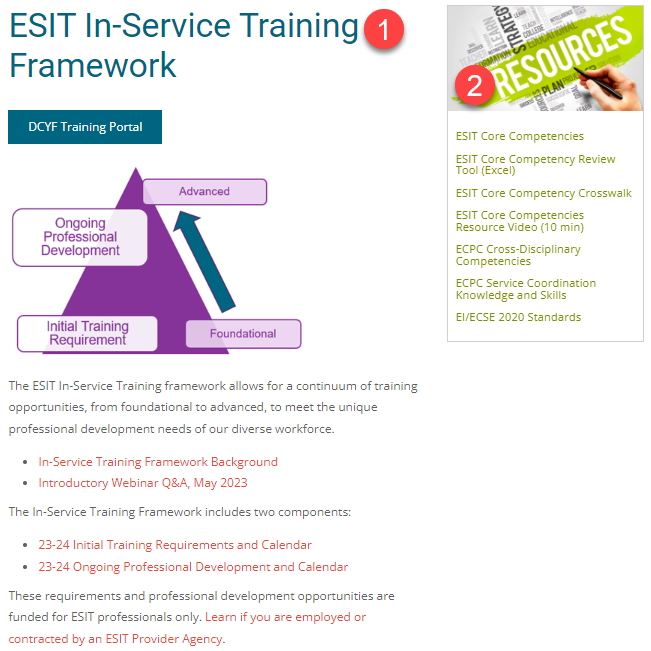
Information regarding the ESIT In-Service Training Framework and Qualified Personnel Guidelines is now organized under the umbrella of a new Professional Development page.
ESIT In-Service Training Framework
- On the ESIT In-Service Training Framework page, find valuable information including:
Competency Resources
- There are also resources on the right side of the page including:
For questions about these resources and training, contact dcyf.ESITtraining@dcyf.wa.gov.

The Family Guide to the Three-Pronged Approach is now available for providers to order full-color prints in multiple languages through MyPrint. This one-page informational flyer for families, describes the Three-Pronged Approach to vision and hearing screening. Please work with your designated public awareness contact to order materials for your agency.
|

ESIT is happy to announce that registration is open for the 2023-24 Live Seminar series, previously known as the Professional Learning Community (PLC) Cohorts.
The Live Seminars are Step 2 of the Initial Training for staff hired after July 1, 2021. The seminars are designed for new ESIT service providers and program administrators to explore the implementation of ESIT services. ESIT professionals hired prior to July 1, 2021, are encouraged to attend as a refresher and to get the most current statewide learning content. All ESIT professionals who register for the Live Seminars must complete all Step 1 self-paced modules prior to attending Seminar 1. Staff hired after July 1, 2021, who have already completed required training do not need to attend the Live Seminar series.
The Live Seminars are a series of three (3) live virtual sessions. The live seminars must be attended in order, but not necessarily within the same month. They will each be offered monthly over the next contract year. Please log in to the DCYF Training Portal to find Live Seminar session dates that work for your schedule. When registering, ESIT professionals will register for each of the seminars individually.
|

The ESIT Workforce Development Team has posted a new document to the ESIT In-Service Training Framework webpage.
The 23-24 Ongoing Professional Development and Calendar is a training catalogue, listing a number of DCYF sponsored trainings available to ESIT professionals at no cost. There are a wide range of topics offered from foundations in early childhood mental health to relationship-based teaming practices to reflective supervision for supervisors. The catalogue includes a calendar of available dates with registration links.
The ESIT Weekly will continue to highlight new additions to the catalogue and remind ESIT professionals of this new resource. However, this newsletter will no longer be the place to go to find all the information about available trainings.
ESIT-Sponsored Training Opportunities
Information regarding opportunities, such as Promoting First Relationships, Foundations of Infant and Early Childhood Mental Health, Foundations of Reflective Practice, Reflective Supervision, Reflective Consultation, and WA-AIMH endorsement information will now be available:
Newly Added Training Opportunities!
The following are new additions to the Calendar! Full description of each training including registration information is available in the 23-24 Ongoing Professional Development and Calendar.
Using Reflective Supervision Through a Multi-Cultural Lens to Honor Others in Relationship-based Work to Promote, Diversity, Equity, Inclusion and Belonging | October
This training will explore reflective supervision through a multicultural lens to gain a deeper understanding into who we are in relationships through intentional reflections to diversity awareness to develop a multicultural stance.
Engaging in Challenging Conversations | Fall 2023 and Winter 2024 dates available
Presented by Greg Abell, this series of four (4) *live* sessions held over Zoom is designed to increase individual capacity for engaging conflict and working collaboratively on a team.
Foundations of Effective Teaming | Fall 2023 and Spring 2024 dates available
In this series of two (2) seminars, presented by Greg Abell held over Zoom, learners will identify key challenges to effective teaming, explore a framework for creating shared expectations as a group, and focus on the core function of a team; shared learning.
Leading Through Change and Conflict – Spring 2023
In this series of four (4) seminar sessions presented by Greg Abell over Zoom, learners will explore the work of key thinkers in the field of leadership, conflict, and change, explore our personal relationship to conflict and change, and introduce a framework for identifying who you need to be and what you need to do as a leader engaging change and conflict.
This training is intended for administrators and supervisors.
For questions about training, contact dcyf.ESITtraining@dcyf.wa.gov.
|
 |

Masterclass: DIR® Principles in the Early Childhood Classroom
Review the principles of DIR® as we explore individual differences in our students. Discussions will center on how to infuse DIRFloortime® into the many activities and routines of an early childhood classroom. We will focus on arousal levels and behaviors and positive DIRFloortime® strategies to help each child feel comfortable and confident in the classroom setting. Video examples will be used to illustrate possibilities. Participants will be asked to contribute their experiences verbally and/or with some video examples of their work with students. As a group, we will detect possible sensory profiles and brainstorm how to help each child succeed socially, emotionally, and academically.
Susan Rindner, Early childhood Education/Special Education
4 Sessions |Weekly, Tuesdays
Nov. 7, 14, 21, 28 | 10 a.m. - 1 p.m.
Register by Tues., October 17
|

Presentation Spotlight: How to bring DIRFloortime® into your traditional school system (and get away with it!)
October 20 - 29 | Online
Conference Schedule
Click here for more important information about the presenters, registration prices and registration:
Register before September 15th and receive 25% off
|

Workshops offered by the Infant Early Childhood Mental Health (IECMH) Workforce Collaborative are free for professionals who serve or support children prenatal to five and their families enrolled in Apple Health (Medicaid).
- IECMH Clinical Workshops are designed for clinical professionals involved in mental health assessment and diagnosis for children birth to five.
-
IECMH Community Workshops are intended for all professionals who support the social-emotional well-being of babies, toddlers, preschoolers, and their families, as well as expecting families.
For more information visit:
CEUs and/or STARS hours are provided for most workshops.
Questions? Contact admin@wa-aimh.org.
|
Advanced Clinical Training (ACT) in Diversity-Informed Infant and Early Childhood Mental Health Registration for a virtual open house is now open.
Who they are...
A 15 month comprehensive, developmentally-grounded, relationship-based, diversity-informed foundational and specialized clinical professional development program in Infant and Early Childhood Mental Health (prenatal to 5 years).
Are you...?
A mental health professional who is:
- looking to specialize, enhance, advance or expand your clinical mental health services with families who are expecting or caring for infants, toddlers, and preschoolers
- interested in infant and early childhood mental health consultation
A mental/behavioral health agency that is:
- interested in enhancing and/or expanding clinical mental health services with families who are expecting or caring for infants, toddlers, and preschoolers
- interested in enhancing and/or expanding services in infant and early childhood mental health consultation
- interested in the Child-Parent Psychotherapy (CPP) Learning Collaborative
Aug. 30 | 12-1 p.m.
Register
Click Here for more Information on ACT Program
For more updates, subscribe directly to these great newsletters:
|