|
The Department of Health promotes lactation, breastfeeding, and chestfeeding. Learn more:
Measuring Performance
Please note that the language used in the name of the measure and the definition currently used nationally are not reflective of all birthing parents.
The breastfeeding measure reports the percent of infants (among caregivers who enrolled in home visiting prenatally or were pregnant during their enrollment) who were breastfed any amount at 6 months of age. Children need to have reached 6 to 12 months of age within the reporting year to be included in this measure. For detailed information on the measure, visit:
Need a refresher on how to enter breastfeeding surveys in Visit Tracker and NFP forms? Please follow the links for step-by-step instructions for Visit Tracker and NFP programs. Early Head Start or Outreach Doula can contact DOH for assistance if they need a refresher.
Many of you have likely heard that the authorization for the federal home visiting program, Maternal, Infant, and Early Childhood Home Visiting (MIECHV) Program expires on September 30, 2022. Many people across the country are working with Congress to support a timely reauthorization of the MIECHV program, including here in Washington – thank you! Timely reauthorization is important for the stability of MIECHV programs across the country. There is a possibility of MIECHV reauthorization through an end of year spending bill and work continues to ensure this will happen. If the MIECHV authorization for funding expires, programs in Washington will not have immediate impacts. DCYF will continue to provide updates about MIECHV reauthorization.
HVSA Office Hours will be taking place Sept. 15 from 3-4 p.m. We will be focusing on new websites and communications and take any of your questions.
Join Zoom Meeting
https://dcyf.zoom.us/j/83183457961?pwd=UHZyRC90ZnhuU2RMNmRNQlFzTk5uQT09
Meeting ID: 831 8345 7961
Passcode: 644977
One tap mobile
+12532158782,,83183457961#,,,,*644977# US (Tacoma)
+12133388477,,83183457961#,,,,*644977# US (Los Angeles)
This year, MIECHV-funded LIAs will participate in HRSA's Home Visiting Budget Assistance Tool (HV-BAT) data collection. We will have a webinar on Thursday, September 22, 2022 from 3- 4:15 p.m. to discuss this process. Keep an eye out for the meeting invitation and make sure to save the date in the meantime. Please note, this is a MIECHV requirement for all MIECHV funded programs and MIECHV programs must attend (non-MIECHV programs do not need to attend).
Our Fall All HVSA will take place virtually Nov. 8 & 9 from 9 a.m. to noon each day. Look for more information and registration links in the coming months.
It's back to school season for many families in the state. We've created a list of resources from around the state to help families find supplies and supports in their area. You can find that here.

Is living in a car to save money to move into a safe apartment what we want for families fleeing domestic violence? Survivors often have to break a lease early and move apartments when fleeing abusive partners. Washington has existing laws that allow tenants to terminate leases because of domestic violence, but survivors are often left with extensive damages to a unit caused by their abuser. Survivors often lose their deposit money leaving them unable to move into another living arrangement. These debts not only prevent survivors and their children from being able to safely leave, but it can also ruin their credit as the debts go to collections and become a major barrier to exiting homelessness.
Landlord Mitigation Fund – a new benefit for domestic violence survivors
Legislation that passed this past session specifically designated a portion of the Landlord Mitigation funds for survivors of domestic violence. The Landlord Mitigation fund is a program for landlords to access, if a tenant who is a survivor has damages to their unit or owes rent. Check with your County’s homelessness and housing serving providers to see if there is available funding for your communities.
Eviction Prevention Rental Assistance Funds available this summer, 2022
In 2021, Washington legislation passed to provide money to help people catch up on their owed rental payments and utility bills. The process to distribute these funds across the state should be finalized early summer of 2022. This is going to be an ongoing program funded by the state. Start checking with your County’s homelessness and housing serving providers, or Coordinated Entry for All program to find how to access all these funds for families you support.
|
MIECHV Reporting: Updates & Reminders
It is that time of the year when we ask all programs who receive MIECHV funding to ensure that reporting on all MIECHV-funded families is complete for the federal fiscal year (October 1, 2021 – September 30, 2022). There have been some updates by MIECHV to reporting requirements that we highlight below, as well as some requirements to keep in mind as you see families over the next few weeks.
Updates for annual reporting
-
New inclusive gender reporting for Caregivers and Children. You may have seen in your data system that gender reporting options have been expanded to be more inclusive of the families served. You may now record self-identified gender as follows:
-
New disaggregation of Caregivers and Children by period of enrollment. HRSA has requested that many of the demographic tables we complete are grouped by newly enrolled and continuing enrolled participants. This update does not require any changes on your part, other than to accurately record enrollment and exit dates for each participant in your data system. DOH will then use these dates to appropriately group participants by new or continuing enrollment status.
-
Home Visits by Service Modality. Previously we reported an annual count of all home visits for MIECHV-funded families. We are now asked to report by modality, as follows:
- In-Person Home Visits
- Virtual Home Visits
This data is already captured in the information you report in your data system.
-
Continuity of Health Insurance. This benchmark measure has changed. Where previously we asked about 6 months of continuous caregiver health insurance at any time during enrollment, now the measure asks for 6 months of coverage during the most recent 6 months of service. We encourage you to ask about caregiver insurance status at every visit if possible or at minimum quarterly. Please try to update this information as possible before the end of September.
Reminders for annual reporting
- Please review all of your reporting data for MIECHV families, including demographics, consent, service use, and benchmark measures. Make sure that all the data is recorded in your data system by end of September. For Consents, please make sure that information is updated and reported to DOH by the end of August.
- For those benchmark measures required annually, please be sure to complete the assessment before the end of September. Specifically, please complete:
-
Safe Sleep questions for children under 1 year of age;
-
Parent-Child Interaction assessment – at minimum 1 assessment per primary caregiver;
-
Early Language and Literacy questions for all children served;
-
Educational Attainment for the primary caregiver and Educational Status for primary caregivers that reported less than a high school degree or equivalent at enrollment;
-
Breastfeeding Status for all children who were between 6 and 12 months old between October 2021 and September 2022;
- A few measures require data collection over the reporting year to ensure that the most recent information is available at the end of the year. Specifically, please note:
-
Well Child Visit dates are one measure of the routine receipt of care from a primary care provider. Please report dates for well child visits routinely over the year, with a focus on collecting this information at minimum in April/May and Aug/Sept.
-
Continuity of Insurance Coverage, as noted above, please ask about the most recent 6 months of coverage.
- For key screening measures, be sure to document referrals given and completed as needed per the screening results, including:
-
Developmental Screenings – to be completed at minimum, at ages 9 or 10 months, 18 months, and 24 or 30 months. If a child has a positive screening result, please report services provided, referred to, and received.
-
Depression Screenings – to be completed with the primary caregiver within 3 months of enrollment or within 3 months of delivery if the caregiver enrolled pregnant. If the caregiver’s PHQ9 screening score is 10 or above, or notes suicidal ideation, then please record the referral made by the home visitor and completed by the caregiver.
-
Intimate Partner Violence Screenings – to be completed with the primary caregiver within 6 months of enrollment. If the screening result suggests a referral is needed, please record the referral made by the home visitor. Note that a referral given without a documented IPV screening will not be counted towards this benchmark measure.
- Keep an eye out for Measures QA reports to be released in the coming weeks. We hope these reports will be a valuable tool to focus your data cleanup efforts.
Thank you for your work serving families and reporting all the required data!
Registration for the Fall PICCOLO Training is Now Open!
To register, please visit https://events.eventzilla.net/e/fall-2022-piccolo-virtual-training-2138575641
July: PDSA Review and Webinar Series Introduction
In this webinar we reviewed guiding principles to beginning a PDSA cycle and explored what it’s like to track and build a PDSA through small group breakout rooms. Below are a few highlights. A full review and resources can be found on Basecamp.
What is Continuous Quality Improvement (CQI)?
CQI is a systematic and iterative process that connects programmatic data to practice and seeks to identify changes that result in significant improvement
How do we engage in CQI practices?
In using the Model for Improvement, we are able to touch on three key questions:
- What are we trying to accomplish?
- How will we know that a change is an improvement?
- What change can we make that will result in improvement?
These questions are a part of the PDSA cycle and continue to be reviewed and reflected through PDSA ramp-ups.
What is the difference between a PDSA cycle and ramp-up?
A PDSA cycle is considered as the first iteration of implementing a change for improvement. Broken down into four parts, a PDSA allows you to identify a change, put it into action, reflect on how it went through a quick assessment, and then using those reflections, decide on the next steps.
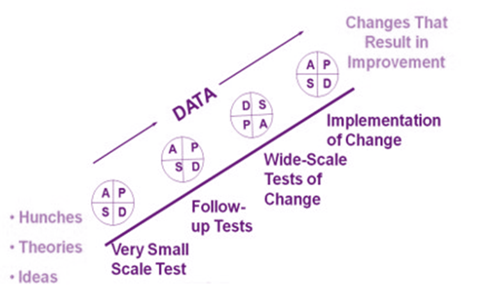
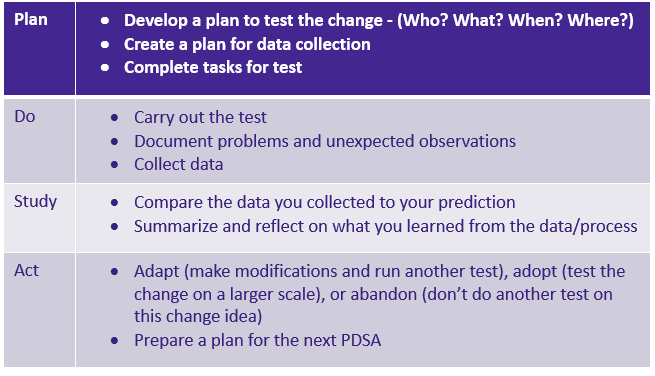 Often next steps of a PDSA cycle can lead to a ramp-up where the next PDSA is not completely new but rather building off the reflection, data and learned experience from the previous PDSA. These PDSA ramps adjust little by little, it may be the change idea has been tweaked, adaptions to new work conditions are needed or a there’s a scale up to try with the testing group.
 Breakout Group Discussion Summary
-
How do you select which change ideas to try?
- Discuss challenges and possible solutions with team
- Prioritizing a challenge that's already been identified and starting small with a change
-
How do you track your PDSA cycles? What works well? What is challenging?
- Using a form that we can track changes in as a team works well (ex: PDSA template provided by Start Early)
- Losing track of focus or updates is challenging
-
How do you communicate your PDSA cycles with staff/involve staff
- Having team meetings for input and feedback on how the change is going
- Opportunities for staff engagement, presenting or leading a change idea
-
What other topics might you pursue for your CQI work this year?
- Referral/ enrollment transition
- Recruitment and hiring staff
For full breakout notes and responses, visit
Resources
FY23 CQI Webinar Series Schedule
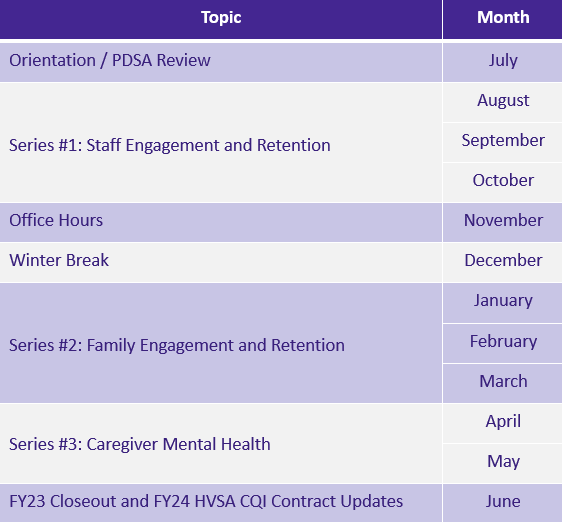
We are excited to release our FY23 CQI Webinar schedule! Each series will dive into one of the three FY23 HVSA CQI topics by building group understanding of the topic, creating root cause analysis, and sharing strategies and lessons learned by CQI teams engaged in PDSA cycles.
 Next CQI Webinar
Wednesday, August 24 from 1:30 – 2:30 p.m.
Introduction to Series #1: Staff Engagement and Retention
Each month, DCYF ESIT Tribal Program Consultant Brian Frisina will provide a key topic to help support us all in getting to know our Tribal Nations partners better.
This week’s topic is:
To understand Indigenous knowledges we must first understand their ties to land, and by extension, their multiplicities (Cajete, 91). Cosmologies (which encompass belief systems, worldviews, knowledge systems, and morality) are included in the realm of TEK because they too, are constructed relationally. Indigenous cosmologies are modes of sharing information, through storytelling and myth. Cultural knowledge moves between generations using stories about different places and species to convey the importance of relationships and of respecting all members of the broader community (Cajete, 82). Cosmologies are activated through community practices, rituals, and relationship building. People live in a community with the environment and landscape around them. Building relationships and respect through understanding, rather than extraction, allows for mutualistic, sustainable community growth of the landscape and all that live within it.
Learn more
Look To The Mountain: An Ecology Of Indigenous Education, written by Dr. Gregory Cajete, is an important contribution to the body of indigenous cultural knowledge and a way to secure its continuance:
Dr. Gregory Cajete is a Native American educator whose work is dedicated to honoring the foundations of indigenous knowledge in education. Dr. Cajete is a Tewa Indian from Santa Clara Pueblo, New Mexico. He has pioneered reconciling indigenous perspectives in sciences with a Western academic setting.
Watch interview below (watch time 51:38):
Sources
Listening to Traditional Ecological Knowledge to Reimagine Vassar’s Relationship with Land and Other Beings. Blog by ssantos, posted November 19, 2020. © 2012 Indigenous Environmental Activism, Designed by Wpshower.
Look To The Mountain: An Ecology Of Indigenous Education. © 2022 Goodreads, Inc.
Gregory Cajete: An Indigenous Ecology - The Green Interview. © 2009–2022 The Green Interview.
Applications open August 17: $75 million for Washington small businesses and nonprofits
Applications for the Working Washington Grants: Round 5 and new Convention Center Grants programs opened Aug. 17. Together, these programs will distribute $75 million in pandemic relief grants to eligible small businesses and nonprofits across Washington. The Department of Commerce manages the grants with support from the Washington State Arts Commission.
Applications must be submitted by 5:00 p.m. Sept. 9 through commercegrants.com. The online portal is live now with guidelines and more to help applicants get ready to submit applications.
Getting Ready for Resilience
The Northwest Center for Public Health Practice is launching a new self-paced e-learning series that focuses on a persistent challenge for many of today’s public health teams, especially in the wake of multiple, intersecting public health crises — building greater workforce resiliency.
The new three-part series, called Ready for Resilience, is a resource for individuals to understand the triggers of personal, team-wide, organizational, and community stress.
Together with the Resiliency Resources Toolkit, the series offers a variety of strategies that explore how public health organizations and their employees can counter the effects of stressors and practice intentional, research-backed acts of resilience.
This no-cost series can be accessed by creating an account in PH LearnLink.
Learn more >
What is the Affordable Connectivity Program (ACP)?
ACP provides help paying for internet service and connected devices through the Federal Communications Commission. Eligible households can receive:
- Up to a $30/month discount on your internet service
- Up to a $75/month discount if your household is on qualifying Tribal lands
- A one-time discount of up to $100 for a laptop, tablet, or desktop computer (with a co-payment of more than $10- $50)
Only one monthly service discount and one device discount is allowed per household.
Enhanced Tribal Benefit
ACP provides enhanced benefits for consumers living on qualifying Tribal lands. Learn more about the enhanced Tribal Benefit at acpbenefit.org/do-i-qualify/enhanced-tribal-benefit.
Am I eligible?
Your household may be eligible for ACP if any member in your household:
- Has household income 200% or less than the 2022 Federal Poverty Guidelines
- Participate in certain government assistance programs such as Apple Health (Medicaid), Supplemental Nutrition Assistance Program (SNAP), and other programs; or
- Are a Lifeline subscriber.
More eligibility information: acpbenefit.org/do-i-qualify.
How do I apply?
Eligible households can enroll through an approved broadband Washington provider or by visiting acpbenefit.org/how-to-apply.
Where can I get more information?
For more information about ACP visit acpbenefit.org or view the White House announcement.
Contact the Affordable Connectivity Program
Email: APCSupport@usac.org Phone: 1-877-384-2575
|