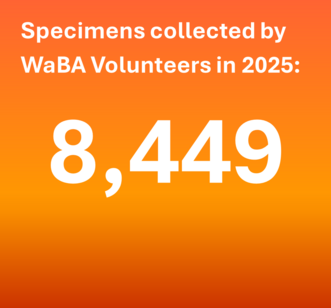
WA collection count
2,414 new labels printed for Washington this week - WOW! Keep those nets a-flyin' folks.
Last chance to register!
Last chance to register for the following field events:
- June 13-15 - Pullman - registration closes today!
Special reminder: Submit your May volunteer hours
May has come and gone! Don't forget to report your volunteer hours into PISCES. If this is your first time reporting your hours, check out this handy how-to-guide, also available in Box.
Writers wanted: June blog posts for Pollinator Month
Pollinator Week, June 15-21, will be here before we know it! To celebrate this important week, we will be releasing a blog post each Monday in June (5 total) to draw attention to the ongoing work of protecting pollinators. We would love for YOU, our stupendous volunteers, to be a part of this process by guest writing a blog post!
Below is a list of potential ideas to get those creative juices flowing:
- Why I Volunteer with WaBA...
- Are all bees social?
- Where do bees sleep?
- Where do bees go in winter?
- Different types of bee nests
- Pollinator Mug Shots/Bee "Class Yearbook" (headshots of cool bees)
- Bees of Unique Habitats (ex: dune bees)
- Cool bee/plant interactions
Two blog slots are still available. If you are interested in writing one of these posts, contact Caleb at caleb.lankford@agr.wa.gov for more details!
Seattle Bee Hang, June 22
Peter Abrahamsen will be hosting the next Seattle Bee Hang on Sunday, June 22nd from 3:00-5:00PM. Close out Pollinator Week by hanging with your fellow beeple!
Get some practice using keys, share tips, tricks, and trivia. Peter will have a few snacks, five microscopes, and small teaching collections. Bring any bees you’ve caught, and hard copies of keys if you have them. RSVP to Peter at rainhead@gmail.com.
Not in Seattle? No problem - drop your info in our Contact Form to let others know what area of the state you're in, then reach out to the folks near you for a get together!
Upcoming outreach opportunities
Looking for ways to share your passion for native pollinators? Check out these upcoming outreach opportunities:
Participation in these events can be applied as service points for your Master Melittologist certification. You can also earn service points by helping with data entry at the Yakima office - if interested, contact Caleb at caleb.lankford@agr.wa.gov to learn more.
What's blooming in June?
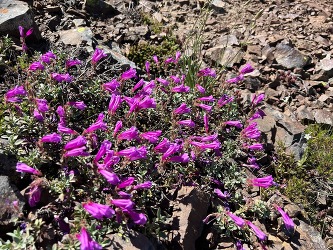
Penstemon rupicola (Cliff Beardtongue)
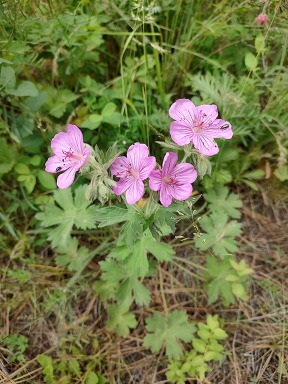
Geranium viscosissimum (Sticky Geranium)
New iNatrualist plant resource
Check out this new blooming plant resource, curated by WSDA's Karla Salp. This project shows you what's currently blooming and where. The plants included in the project's capture scope are known hosts for bees, including rare or specialist bees. Kudos to Karla for this helpful tool!
Taxonomy tip of the week
This week's foray into the Megachilidae family examines the genus Hoptlitis. This genus is a particularly tricky one to tie down - there are Hoplitis that look like Osmia, others that look like Ashmeadiella, and some that look like male Megachile.
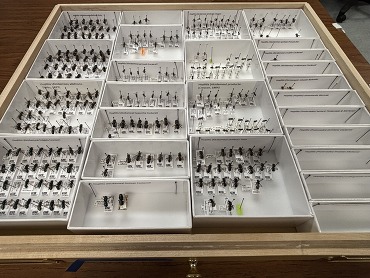
The Hoplitis reference drawer. This genus contains a wide range of diversity, with many species looking totally different from one another.
The best way to identify Hoplitis is to rule out their look-alike genera. So let's do a quick review of what we've learned so far and see how Hoplitis compares:
-
Megachile are black bees that a) usually have light hairs somewhere and b) don't have an arolium. Hoplitis may also appear black with white hairs, but they do have an arolium.
-
Osmia are metallic and have a punctiform parapsidal line. There are brilliant metallic Hoplitis species, but they will have a linear parapsidal line.
-
Heriades are small black bees that have square shaped pits behind their scutellum. There are small, black Hoplitis, but they don't have these special pits.
-
Ashmeadiella have a carina on their mesepisternum, with the region anterior to the carina appearing shiny. Though some Hoplitis look very similar to Ashmeadiella in size and shape, their mesepisternum is not carinate and instead has a smooth or rounded transition to the anterior-mesepisternal surface.
Feeling lost in the sauce? Don't worry - I, Caleb, feel your pain. To me, Hoplitis is like a kitchen junk drawer, housing all the bees that still belong in the kitchen (or in our case today, the bee family Megachilidae), but don't fit in nicely elsewhere. Not much of a helpful tip, huh? What can I say, that's taxonomy folks!
In an effort to be helpful, I'll leave you with some things to look for, rather and a list of features to rule out:
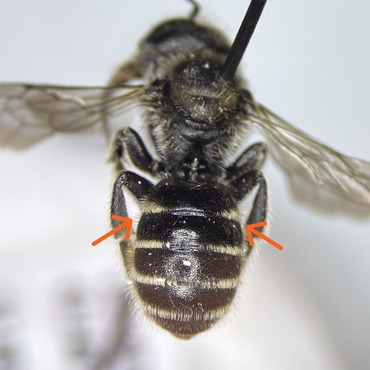
Many Hoplitis have incomplete hair bands on T1/T2. Instead of a full stripe of light hair across the apical rim, they'll have tufts of hair on either side and a gap in the middle (see below).
Many Hoplitis have incomplete hairbands.
This is NOT a unique feature of this group, but something to note if your Megachilidae bee isn't quite fitting in with other groups.
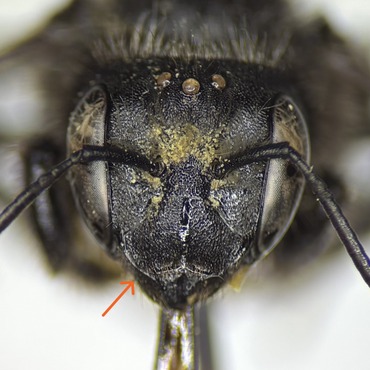
In a similar sense (read: ultimately not taxonomically reliable), Hoplitis tend have a long clypeus that extends a bit over their mandibles. This ~overbite~ helps steer me towards Hoplitis when I'm feeling stumped.
Some Hoplitis have an elongate clypeus that hangs over their mandibles like a shelf. While not a unique trait, this can be helpful in identifying the genus.
My parting advice - when in doubt, check "Bees of the Pacific Northwest: Key to Genera." :)
|