WA bee count surpasses 5K!
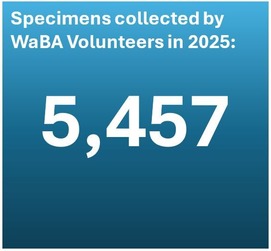
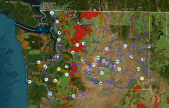
Our current collection count for 2025 is 5,457 specimens. Over 50% of the May 11th printing of labels were Washington records: 1,399 out of a total of 2,364 labels. Keep up the good work WaBA!
Last chance to register!
Registration for the Salt Creek/Olympic National Park Event closes Saturday, May 17th. This will be our first group collecting event under our new permit with ONP. Join WaBA for a weekend of camping or join us for the day!
Wildflowers in the high country at ONP.
Upcoming outreach opportunities
Looking for ways to share your passion for native pollinators? Check out these upcoming outreach opportunities:
Participation in these events can be applied as service points for your Master Melittologist certification. You can also earn service points by helping with data entry at the Yakima office - if interested, contact Caleb at caleb.lankford@agr.wa.gov to learn more.
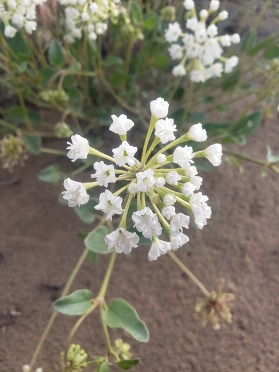
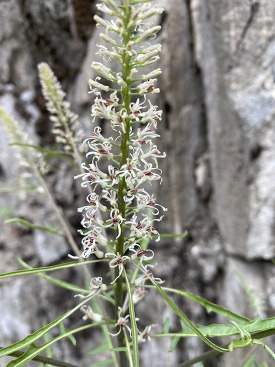
What's blooming in May?
Abronia mellifera (White Sand Verbena)
Thelypodium laciniatum (Cutleaf Thelypody)
Taxonomy tip of the week
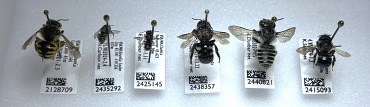
Samlpe of bees all belonging to the family Megachilidae. Genera represented in this image, from left to right: Anthidium, Ashmeadiella, Heriades, Hoplitis, Megachile, Osmia.
Megachilidae is a diverse family of bees that contains large genera like Megachile (leafcutter bees) and Osmia (mason bees). But there are a number of smaller genera that are also included in this family that may be misidentified as leafcutters or masons. For the next few weeks, we'll be outlining some tips to help you sort out these oft overlooked groups.
Before we dive in, let's cover how to sort out the true Megachile and Osmia from your collection.
Ruling out Megachile
Leafcutters are (usually) black bees with light hair bands on their abdomens. They come in a wide range of sizes, and females have abdominal scopal hairs. Their abdomens can be triangular in shape, or elongate and parallel-sided.
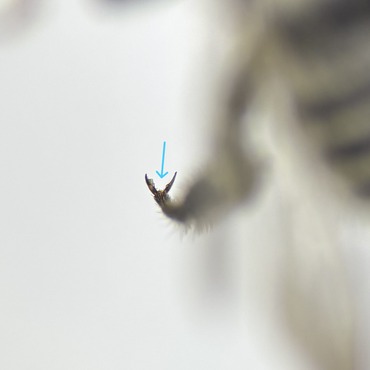
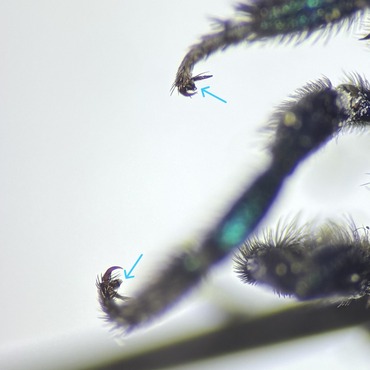
If you think you have a Megachile, take a look at the claws. Megachile lack a structure called the ariolum, a small pad-like projection found between the claws. If you see an ariolum, it's not a Megachile.
Megachile lack an arolium between their tarsal claws, shown here.
Other Megachilidae bees, like this Osmia pictured above, have an arolium between each set of tarsal claws.
Ruling out Osmia
Osmia are metallic bees, though their color can range from brilliant green to dark, blueish black. Compared to Megachile, they have a more pill-shaped body, sometimes with a tucked-in tail. To confirm that you've got Osmia, you're going to look on the bee's scutum for the presence or absence of linear parapsidal lines.
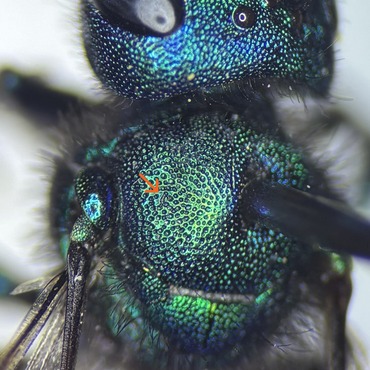
Most bees have parapsidal lines that are linear, appearing as two straight lines that extend longitudinally down the scutum. Osmia, however, have a punctiform parapsidal "line" that looks like one or two punctures mushed together.
The punctiform parapsidal markings of Osmia are sometimes easy to miss. These bees lack the linear parapsidal line that other Megachilidae have.
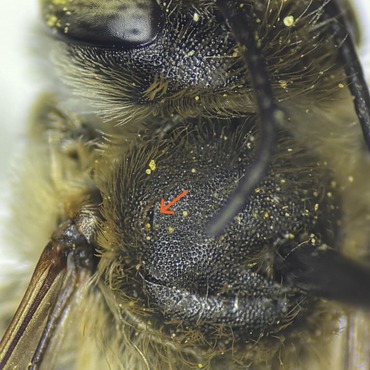
The left linear parapsidal line of this male leafcutter bee is visible beneath the hairs of the thorax.
These punctiform parapsidal indentations may be difficult to distinguish from pitting on the scutum, so if you don't see an obvious linear line, it's a good chance you've got Osmia.
Next week, we'll begin working on how to identify the other Megachilidae bees that have both a) an ariolum between their tarsal claws and b) linear parapsidal lines.
|