|
English | Español | አማርኛ | 中文 | 한국어 | Tiếng Việt | العربية | فارسی | اردو
Click or scan QR code to subscribe to The Dunne Dispatch.
School Boundaries: Why I Voted No - January 26, 2026
Dear Friends and Neighbors,
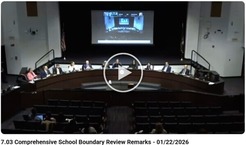
On Thursday, January 22, I voted “no” on the Superintendent’s final recommendation for changes to school boundaries. My vote was driven by my fundamental commitment to good government. (You can watch my remarks here.)
|
First, it was unclear what the School Board was being asked to approve. FCPS posted a white paper and slides to BoardDocs, but I expected a formal plan identifying particular actions with timelines for implementation. The casual nature of the planning documents, if they can be characterized as such, is consistent with the entire boundary process, which reflected more improvisation than careful planning.
Moreover, there are a number of questions that were not addressed in the final recommendation. For example, there has been discussion of expanding phasing and school bus transportation, but the final recommendation did not address these issues or provide any information on the potential costs and impacts.
The final recommendation also did not include any plans for the potential boundary changes for which the Superintendent proposed to deliver a recommendation in January 2027. I believe it is necessary to ensure accountability and transparency with respect to future boundary changes.
Second, the boundary process largely failed to achieve its stated objectives. While Policy 8130 identifies priority factors--proximity, transportation, enrollment/capacity, and access to programming--FCPS focused this boundary review on attendance islands and split feeders. When the boundary changes are implemented, FCPS will have the same number of attendance islands (22), a modest reduction in split feeders (35 instead of 42), and almost no change in the number of classrooms in modulars and trailers (813).
Third, the boundary review did nothing to resolve the middle school “experiment” begun 30 years ago. The first community meeting was held at Glasgow MS, which is one of three middle schools in the county (along with Holmes MS and Poe MS) that are Grades 6-8. By all accounts, the experiment was begun with the intent to transition all middle schools to Grades 6-8, but for reasons that are unclear, that effort was abandoned. The inchoate nature of the experiment has caused Glasgow MS to be overcrowded. The message from the Glasgow MS community was clear: end the experiment--either transition all middle schools to Grades 6-8, or return these middle schools to Grades 7-8. Studies suggest that Grades 6-8 middle schools have somewhat worse outcomes than Grades 7-8 middle schools, so it seems preferable to return Glasgow MS, Holmes MS, and Poe MS to Grades 7-8. (It is also easier to transition 3 middle schools to Grades 7-8 rather than transition 20 middle schools to Grades 6-8.)
Fourth, there were too many last-minute changes. The boundary process featured extensive community engagement: more than 2,300 people participated in the first round of 12 community meetings (Nov. 2024-Feb. 2025), over 1,500 in the second round of 8 community meetings (May-June 2025), and 2,750 in the third round of 16 community meetings (Sept.-Dec. 2025). Over 16,400 comments were submitted during the second round and 11,700 comments during the third round. Notwithstanding the extensive community engagement, hundreds of county residents testified at the public hearings that over a dozen boundary changes incorporated in the final recommendation were included at the last minute without any public notice (and were not included in the scenarios published in May and October). In response, FCPS amended the “final” recommendation at least twice, which made final the recommendation something of a moving target.
Fifth, the final recommendation lacked finality. There are many challenges and priorities that require the attention of the School Board and FCPS leadership. School boundaries is one of many, and it has its time and place. I supported a comprehensive boundary process to resolve potential issues in an efficient manner within 12-18 months. While I expected the boundary process to conclude, it is continuing in some ways indefinitely.
Notwithstanding my “no” vote, I believe the boundary process achieved some positive outcomes for the Mount Vernon District.
- Eliminated attendance islands at Fort Hunt ES and Groveton ES, which should reduce chronic absenteeism and facilitate greater family engagement.
- Reduced overcrowding at Riverside ES and Groveton ES.
- Eliminated a split feeder at Riverside ES to resolve an anomaly wherein students attended Riverside ES but were assigned to the West Potomac HS pyramid for middle school and high school.
- Increased capacity utilization at under-enrolled schools, to include Mount Vernon HS (from 75% to 77%), Saratoga ES (from 78% to 84%) Stratford Landing ES (from 79% to 83%), Washington Mill ES (from 81% to 84%), Whitman MS (from 84% to 87%), and Woodlawn ES (from 71% to 83%). With increased enrollment comes additional funding and staff.
- The boundary process highlighted the under-enrollment at Lewis HS and Mount Vernon HS, which is now a priority for the School Board and the Superintendent.
A summary of the approved changes to school boundaries was included in my newsletter on January 9, which is available here. In addition, the Superintendent will make a recommendation by January 2027 on:
- The potential reassignment of Bren Mar Park ES to a different pyramid, such as the Lewis HS pyramid.
- The school boundaries for Gunston ES, Halley ES, Laurel Hill ES, and Lorton Station ES (to include the Halley ES attendance island), which could affect pyramid assignments.
The Superintendent also intends to evaluate the potential relocation of the Riverside ES AAP Center to Woodley Hills ES.
To improve the boundary process going forward, I brought four motions on Thursday:
- Require a comprehensive project plan and timeline for future boundary reviews;
- Require a comprehensive after-action report on the 2024-2025 boundary review to capture best practices and lessons learned for future boundary reviews;
- Conduct an evaluation one year after the implementation of any boundary change to assess its impact and report on any findings, to include any recommendations for further changes; and
- Focus the next cyclical boundary review on reducing the number of classrooms in modulars and trailers in order to enhance school safety and security for students and staff.
I believe these common-sense changes would promote accountability and transparency while increasing public trust, but unfortunately, the School Board did not approve these motions. I will continue to work with my colleagues to build a consensus for improvements to the boundary process, which I believe are necessary given the continuing nature of the boundary process and the increased pace and volume of boundary changes.
In a similar vein, I would like to encourage you to apply to serve as a citizen member of the School Board’s Comprehensive Planning and Development Committee (CPDC). The Board will be appointing 5 citizens to staggered terms. The CPDC plays an important role in advising the School Board on school construction and renovation, maintenance and infrastructure, energy management, and construction financing and management. Click here for the application, which must be submitted to kevin.jackson2@fcps.edu by 11:59 PM on Friday, January 30.
Very Respectfully,
 Mateo Dunne, Mount Vernon District Representative
The views contained within this newsletter reflect the views of the individual school board member who is the publisher of this newsletter and may not reflect the views of the Fairfax County School Board.
© Fairfax County Public Schools, Fairfax County, Virginia
|