May 2026
The Organization of Scientific Area Committees (OSAC) for Forensic Science's Standards Bulletin provides a monthly update on forensic science standards moving through the OSAC Registry approval process and the development process at standards developing organizations (SDOs).
OSAC Registry Updates
New Standards Added to the Registry
The following three SDO-published standards have been added to the OSAC Registry (effective May 5, 2026):
- ANSI/ASB Standard 133, Standard for Age Estimation in Forensic Anthropology, 2024, 1st Ed.
- ANSI/ASB Standard 147, Standard for Analyzing Skeletal Trauma in Forensic Anthropology, 2024, 1st Ed.
- ANSI/ASTM E2916-19e2, Standard Terminology for Digital and Multimedia Evidence Examination
- NOTE: This will replace ANSI/ASTM E2916-19e1 on the Registry. The -19e1 version will be moved to the Registry archive.
Visit the OSAC Registry to view the 247 forensic science standards currently available.
Standards Open for Comment
Open for Comment at OSAC
There are no standards currently open for comment at OSAC.
Open for Comment at SDOs and Other Organizations
The following SDOs and other standards setting organizations are accepting public comments on documents:
-
Academy Standards Board (ASB) has nine documents open for public comment in the areas of biology/DNA (comment deadlines May 11, 2026 and June 15, 2026), forensic anthropology (comment deadlines May 18 and June 8), forensic toxicology (comment deadline May 25), and friction ridge (comment deadline June 8).
-
ASTM has four documents open for comment in the areas of facial identification, video/imaging technology and analysis, and interdisciplinary standards for testimony and developing methodology for ACE-V (all with a comment deadline of May 18).
-
Facial Identification Scientific Working Group (FISWG) is accepting public comments until May 8, 2026 on 10 documents.
Visit OSAC's Standards Open for Comment webpage to access these documents, as well as the instructions and deadlines for comment submissions.
SDO Updates
New Published Standards
The following standards have recently been published by an SDO:
ASB:
- ANSI/ASB Standard 076, Standard for Training and Certification of Canine Detection of Human Remains: Human Remains on Land, 2026, 1st Ed.
- ANSI/ASB Standard 207, Standard for Collection and Preservation of Document Evidence, 2026, 1st Ed.
ASTM:
- ANSI/ASTM E2548-26 Standard Guide for Sampling Seized Drugs for Qualitative and Quantitative Analysis (revision of ANSI/ASTM E2548-16).
- NOTE: The 2016 version of this document is currently on the OSAC Registry.
SWGDE:
- 2026-03-19 Guidelines for Low Light Crime Scene Photography (21-P-001-1.1).
- 2026-03-19 Guideline for the Use of Infrared Radiation (IR) in Forensic Science (19-P-002-1.1).
- 2026-03-19 Guidelines for the Use of Reflected Ultraviolet Radiation in Forensic Photography (19-P-001-1.1)
Work Proposals for New or Revised Standards
A Project Initiation Notification (PINS) was published in the April 24, 2026 ANSI Standards Action for the following standards and will begin ASB's and ASTM's work on them.
ASB:
- ASB Standard 106-202x, Standard for Protein Serology for Taxonomic Identification in Wildlife Forensics (revision of ANSI/ASB Standard 106-2020). This document provides the protocols required for general protein serology methods for taxonomic identification routinely used in the laboratory. These protocols include Serology methods and taxonomic comparison of serology results generated in the laboratory for identification. This document covers the use of quality controls. This document explains how differences in expressed proteins can be used to identify animals at family, genus, and/or species level using serology methods.
- ASB Best Practice Recommendation 118-202x, Best Practice Recommendations for Breath Alcohol Instrument Specifications (new standard). This document provides recommendations for the technical capability of breath alcohol instruments used in evidential testing. These devices are also known as Evidential Breath Analyzers (EBA). The document addresses design features and analytical performance. It is not intended for instruments used for preliminary/screening, ignition interlock, or federally regulated workplace testing.
- ASB Standard 119-202x, Standard for the Analytical Scope and Sensitivity of Forensic Toxicological Testing in Medicolegal Death Investigations (revision of ANSI/ASB Standard 119-2021). This document delineates the minimum requirements for target analytes and analytical sensitivity in forensic toxicology testing when analyzing blood, tissue (e.g., liver, brain, muscle), vitreous humor, or urine specimens obtained during the course of a medicolegal death investigation. This document does not address which specimens must be tested nor the analysis of any other specimens that may be obtained in medicolegal death investigations.
- ASB Standard 120-202x, Standard for the Analytical Scope and Sensitivity of Forensic Toxicological Testing of Blood in Impaired Driving Investigations (revision of ANSI/ASB Standard 120-2021). This document delineates the minimum requirements for target analytes and analytical sensitivity for the forensic toxicological testing of blood specimens collected from suspected impaired drivers. This document does not cover the analysis of breath, oral fluid, urine, or other specimen types collected in impaired driving investigations.
- ASB Standard 121-202x, Standard for the Analytical Scope and Sensitivity of Forensic Toxicological Testing of Urine and Blood in Drug-Facilitated Crime Investigations (revision of ANSI/ASB Standard 121-2021). This document delineates the minimum requirements for target analytes and analytical sensitivity in forensic toxicology testing of urine specimens collected from individuals associated with drug-facilitated crimes (DFC). It also provides requirements and recommendations for the testing of blood specimens from these individuals. The document does not address the analysis of other evidence collected in DFC cases.
ASTM:
- ASTM WK98793-202x, Specification for Hardware Requirements in Forensic Digital Imaging Acquisition (new standard). This standard will establish minimum performance requirements for digital camera systems used in forensic imaging applications. The scope will include specifications for optical performance, data storage redundancy, and sensor fidelity necessary to produce images suitable for scientific analysis, engineering measurement, and evidentiary presentation. (1) This standard will address three critical areas of forensic imaging hardware capability: (1.1) Optical Performance: Lenses will provide rectilinear geometric accuracy with specified limits on distortion and edge-to-edge resolution, (1.2) Data Integrity: Camera bodies will provide concurrent dual-media recording capability, (1.3) Sensor Performance: Sensors will support minimum 14-bit RAW capture with defined dynamic range performance. This standard will apply to forensic imaging conducted for criminal investigation (E30), engineering failure analysis (E58), construction defect documentation, and related scientific measurement applications. This standard will not address image processing procedures (covered by ASTM E2825) or field documentation protocols.
- ASTM WK98799-202x, Standard Guide for Forensic Digital Image File Naming and Temporal Organization (new standard). This standard will provide guidance for a standardized file naming convention and temporal organization protocol for digital images captured in forensic applications. The protocol will enable interoperability across multiple imaging devices, agencies, technicians, and jurisdictions while maintaining spatial-temporal relationships critical for evidentiary reconstruction.
Other Forensic Science Standards-Related News & Events
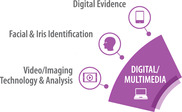
OSAC's Digital/Multimedia SAC Visits NIST for In-Person Meetings
OSAC recently hosted its second in-person meeting for 2026. During April 21-23, members of OSAC's Digital/Multimedia Scientific Area Committee (SAC) and its three subcommittees gathered at NIST to continue their work drafting and reviewing standards. These experts are helping to push the needle forward on critical standards for digital evidence, facial & iris identification, and video/imaging technology & analysis.
|
RaDAR Program
NIST’s Rapid Drug Analysis and Research (RaDAR) lab provides near real-time insight into the nation’s illicit drug landscape. By analyzing drug samples sent from local, state, and federal partners, the lab identifies new compounds appearing in the illegal drug supply that may pose a health and safety threat to users, public health workers and law enforcement.
Check out the March 2026 RaDAR Newsletter to see the recent findings.
|
Upcoming Standards-Related Events
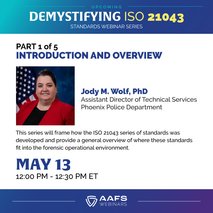
Join the Upcoming Webinar Series: "Demystifying ISO 21043"
The forensic science landscape is evolving, and staying ahead of international standards is more critical than ever. The United States Technical Advisory Group (U.S. TAG) to ISO/Technical Committee (TC) 272, in collaboration with American Academy of Forensic Sciences, is hosting an informative series of webinars, “Demystifying ISO 21043”.
Webinar 1 kicks off on May 13! During this first webinar, hear from Jody Wolf, Assistant Director of Technical Services, Phoenix Police Department, who will introduce the operations of ISO/ TC 272 and the affiliated U.S. TAG with the goal of framing how the ISO 21043 series of standards was developed and providing a general overview of where these standards fit into the forensic operational environment.
Mark your calendar for all Parts in the Demystifying ISO 21043 webinar series:
-
May 13: Register for Webinar 1: Introduction and Overview
-
June 18: Webinar 2: 21043 Parts 1 and 2 - Vocabulary/Recognition, recording, collecting, transport and storage of items
-
July 16: Webinar 3: 21043 Part 3 - Analysis
-
August 13: Webinar 4: 21043 Part 4 - Interpretation
Additional information and registration information will be available on the AAFS Webinars webpage.
|
Upcoming Events.
-
OSAC Medicine SAC and Subcommittee Meetings, May 5-7, 2026, Gaithersburg, MD.
-
SWGDE Meeting, May 11-14, 2026, Richmond, VA.
-
ASCLD Symposium, May 17-21, 2026, Grand Rapids, MI. Stop by booth #409 to learn more about NIST’s Forensic Science Program, including our foundational studies, research, and standards efforts.
-
OSAC Trace Evidence SAC and Subcommittee Meetings, June 2-4, 2026, Gaithersburg, MD.
-
OSAC Biology SAC and Subcommittee Meetings, June 16-18, 2026, Austin, TX.
Missed any of our previous issues? Check them out here:
|