Sample Totals for March 2026:
Qualitative Results: 661 (West), 615 (East), 1276 (All)
Quantitative Results: 219 (Total)
Samples analyzed and included in these counts are voluntarily submitted samples that were collected and provided by public health, harm reduction, or law enforcement agencies from across the country. The trends observed in these samples may not be representative of broader trends within the United States drug supply.
Prevalence & Three Month Trends
Samples Collected in March 2026
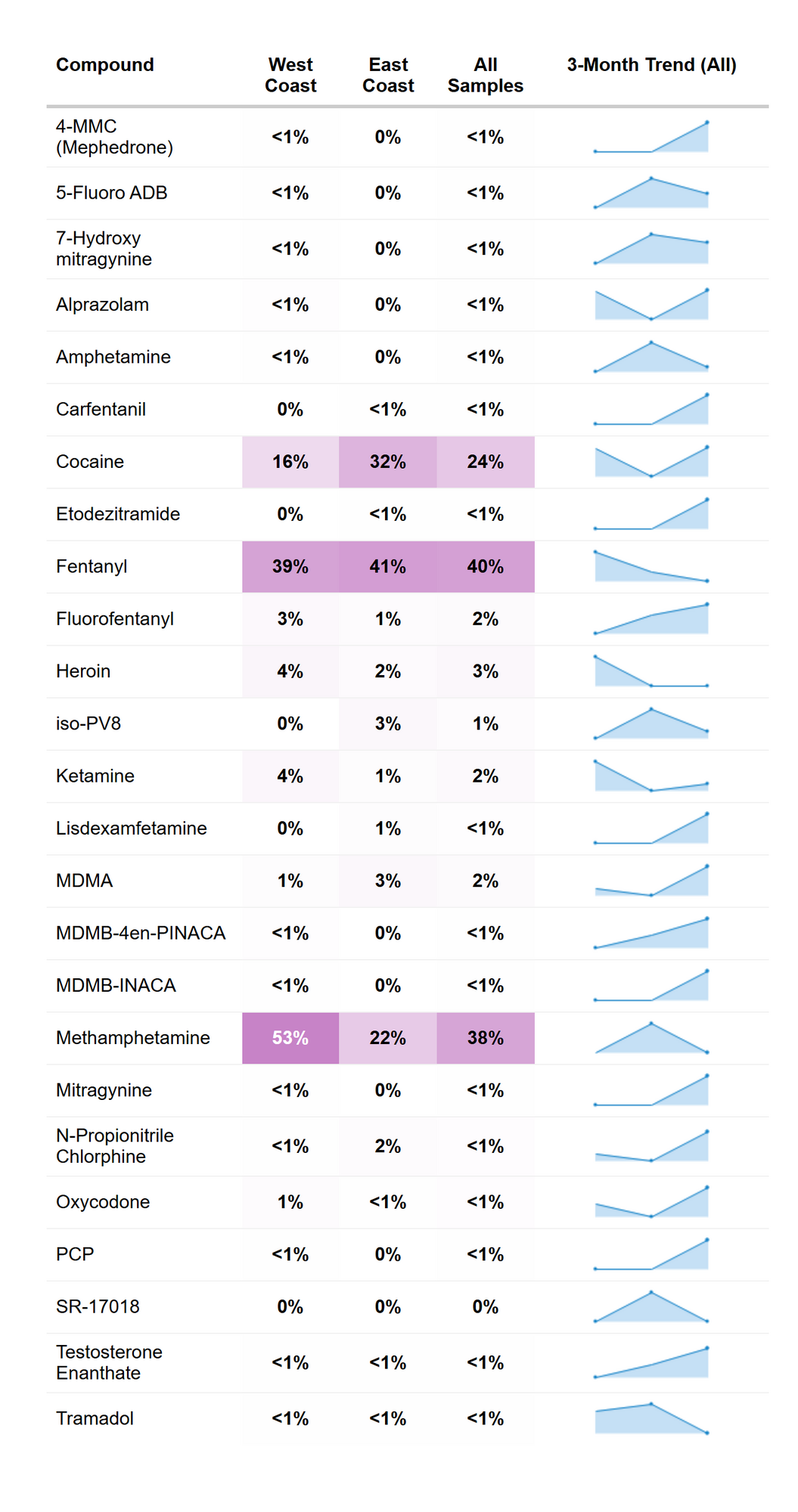
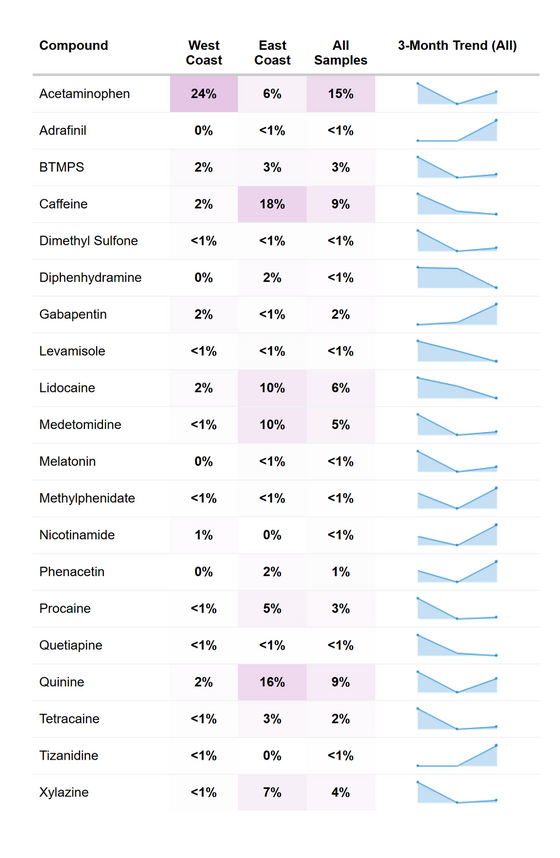
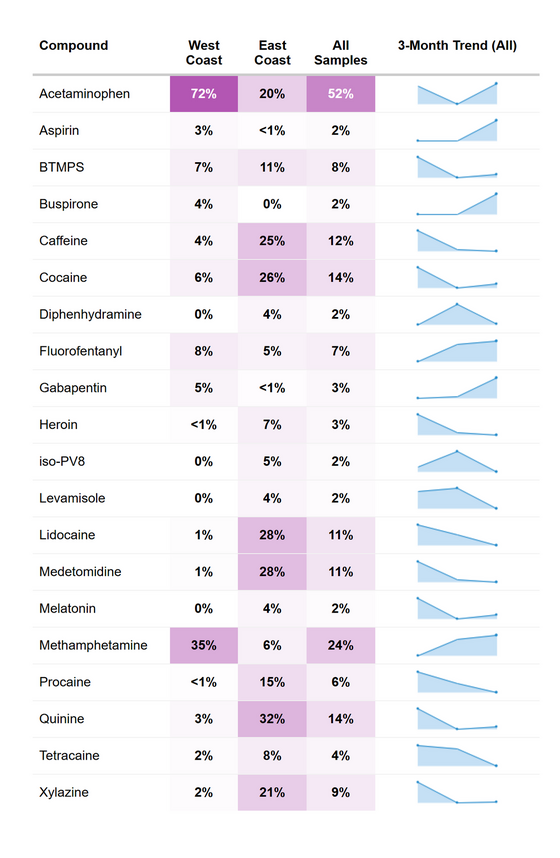
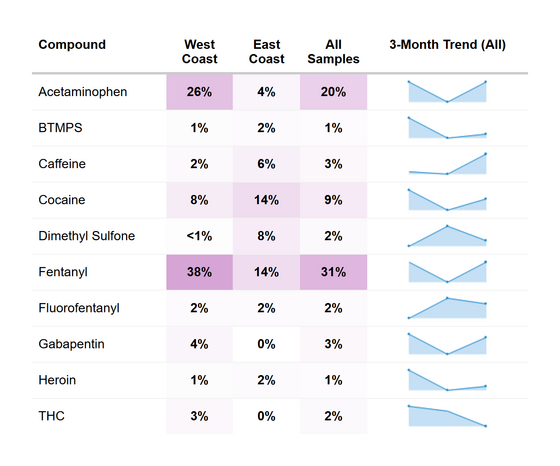
The tables below show the percent of samples containing select drugs (top) and adulterants (bottom). Percentages for West Coast samples, East Coast samples, and all samples are provided. A darker purple cell indicates a higher percentage.
The 3-Month Trend column has sparkline plots showing the percentage of samples containing the compound over the last three months. The right-most point on the plot corresponds to the percentage in the All Samples column. The center and left points are the percentages for February and January 2026, respectively.
Important Notes:
- Determination of salt form or distinction between salt and free base was not completed.
- For some compounds, such as fluorofentanyl, isomer determination was not completed. For instances where isomer determination was completed, the specific isomer is listed.
- Many samples contain multiple substances therefore summed percentages may exceed 100%.
Drug Prevalence
Adulterant Prevalence
 Compound Abbreviations
- BTMPS: Bis(2,2,6,6-tetramethyl-4-piperidyl) sebacate
- iso-PV8: α-Pyrrolidinoisoheptanophenone
- MDMA: Methylenedioxymethamphetamine
- PCP: Phencyclidine
Co-Detection for Cocaine, Fentanyl, & Methamphetamine
Samples Collected in March 2026
The following tables provide information on compounds commonly co-detected with cocaine (top), fentanyl (center), and methamphetamine (bottom). In each table, the listed values reflect the percentage of cocaine, fentanyl, or methamphetamine containing samples that also contained the listed compound. The top ten co-detected compounds are provided for cocaine and methamphetamine while up to the top twenty co-detected compounds are provided for fentanyl.
Important Notes:
- Samples collected from drug use paraphernalia (e.g. syringe, cooker, straw, pipe) have been excluded from these counts due to the high probability of co-use with multiple substances.
- It is possible that the listed drug is a contaminant or minor component in a substance with a different main drug. For instance, cocaine may be present as a contaminant in a fentanyl sample but included in the cocaine co-detection count.
- Byproducts and precursors are not included in the tables below.
- Many samples contain multiple substances therefore summed percentages may exceed 100%.
Cocaine Co-Detection (170 Samples)
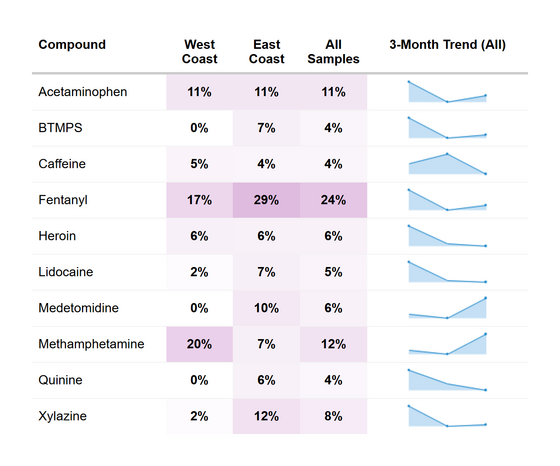 Fentanyl Co-Detection (297 Samples)
 Methamphetamine Co-Detection (225 Samples)
New Compounds Identified
Samples Collected in March 2026
In March, six new compounds were detected for the first time in RaDAR samples.
Important Notes:
- Compounds discussed here are those that have been newly detected in RaDAR samples. This does not mean that it is the first identification of the compound in the drug supply.
- Determination of salt form or distinction between salt and free base was not completed.
 |
|
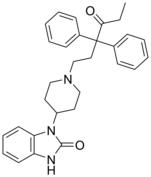
Etodezitramide, a synthetic opioid, was found in multiple East Coast samples that also contained medetomidine and N-propionitrile chlorphine.
|
|
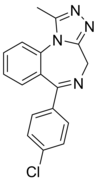
4'-Chloro deschloroalprazolam, a benzodiazepine, was found in a single West Coast sample that also contained methylclonazepam and phenazolam.
|
|
 |
 |
|
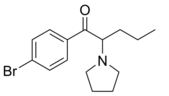
Bromo-α-PVP, a synthetic cathinone, was found in a single East Coast sample that contained no other compounds.
Note: The exact isomer in the sample was not determined.
|
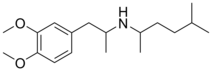
N-(1,4-dimethylpentyl)-3,4-DMA, an amphetamine, was found in a single East Coast sample that also contained amantadine, chlorphenamine, cyproheptadine, and promethazine. |
|
 |
 |
|
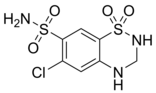
Hydrochlorothiazide, a diuretic, was found in a single West Coast sample that also contained methamphetamine. |
|
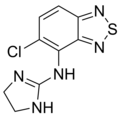
Tizanidine, an α2-agonist, was found in multiple West Coast samples that also contained methamphetamine and/or alprazolam.
|
|
 |
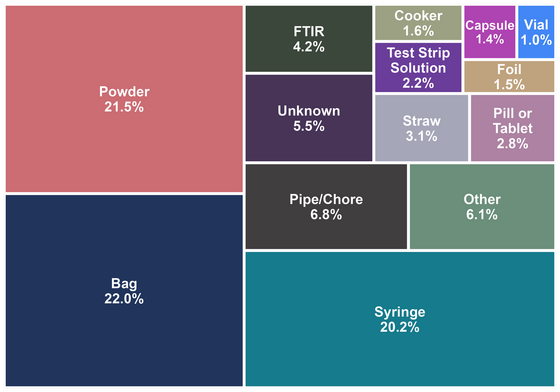
Sample Type Breakdown
Samples Collected in March 2026
The plot below provides a breakdown of the types of items from which samples were collected.
Important Notes:
- Item types with a <1% contribution have been grouped into the "Other" category.
Drug Product Quantitation Summary
Samples Collected in March 2026
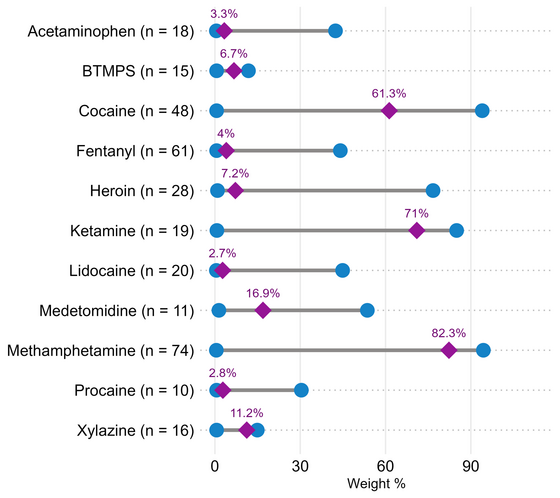
The plot below provides information on the quantitative testing of select drug product samples. Blue dots indicate the minimum and maximum weight percentages across all samples. The purple diamond represents the median weight percentage for all samples containing the compound.
Important Notes:
- Quantitative values less than 0.5% by weight have been omitted.
- Listed values are reported as the free base of the compound. Correction factors for salt form have not been applied.
Recent Publications
Impact of lab-based drug checking services on syringe service program engagement in Maryland, USA
The introduction of synthetic substances into the unregulated drug supply has driven a surge in overdose deaths, posing significant public health challenges in timely substance identification, engagement with people who use drugs (PWUD), and access to treatment. Maryland’s rapid analysis of drugs (RAD) program, piloted through syringe service programs (SSPs), provides a proactive harm reduction strategy by integrating mail-in, laboratory based drug checking with broader public health services to enhance surveillance and improve engagement with PWUD. Read More.
Chromatography-free triple quadrupole mass spectrometry for illicit drug identification and quantification
Drug mixture composition and compound identifications provide public health, first responder, and law enforcement communities with critical and actionable data, guiding emergency response and interdiction, informing the public, and targeting overdose prevention. The advent of novel synthetic opioids, nitazenes, and benzodiazepines, along with the spread of strong veterinary tranquilizer adulterants (e.g., xylazine and medetomidine), have created an ever-changing drug landscape. Read More.
Comparison of Anticipated and Detected Drug Contents in Samples Submitted to a Statewide Drug Checking Program in Maryland, USA
We analyzed data from Maryland’s statewide drug checking program, Rapid Analysis of Drugs (RAD), from October 2021 to May 2024 (N = 792). Clients of participating RAD syringe service programs voluntarily provide drug samples and information about samples, including what they intended to buy. Samples were tested at the National Institute of Standards and Technology using DART-MS. We calculated prevalence of drug classes across different categories of what participants indicated they intended to use. Read More.
In the News
How the Federal Government is Tracking Changes in the Supply of Street Drugs.
"The National Institute of Standards and Technology's new harm reduction initiative is helping prevent needless deaths." Read More.
|