What's New
Service Area Competition Notice of Funding Opportunity Released for February 1 Starts
HRSA released the fiscal year (FY) 2024 Service Area Competition (SAC) Notice of Funding Opportunity (NOFO) for service areas with a period of performance start date of February 1, 2024 (HRSA-24-067). Find details for each of the announced service areas on the Service Area Announcement Table (SAAT).
Applications are due in Grants.gov by 11:59 p.m. ET on Monday, July 24, and in HRSA's Electronic Handbooks (EHBs) by 5:00 p.m. ET on Wednesday, August 23. TA materials are available on the SAC TA webpage.
SAC Funding Change for Three Service Areas
The total funding for three announced service areas under SAC NOFO HRSA-24-066 has decreased due to the completion of supplemental funding. The service areas affected are Phoenix, Arizona; Philadelphia, Pennsylvania; and Washington, DC. Check the Total Funding column in the SAAT prior to submitting your application in EHBs to confirm the final funding amount for development of an accurate budget request.
Steps to Take to Operate a Syringe Services Program within Your Health Center Program Scope of Project
In order to operate a Syringe Services Program (SSP) within your Health Center Program scope of project and use new or existing Health Center Program funds, your health center must request prior approval from HRSA via EHBs. HRSA must review and approve the prior approval request before Health Center Program funding can be used to support proposed SSP costs, as allowable. Your health center’s state or local health department, in conjunction with CDC, must also have determined that the jurisdiction your health center is located within “is experiencing, or is at risk for, a significant increase in hepatitis infections or an HIV outbreak due to injection drug use.”
For full information, see the Health Center Program Compliance FAQs webpage.
Further federal guidance on SSPs is available at:
2023 Uniform Data System Reporting
For 2023 reporting, health centers will submit aggregated Uniform Data System (UDS) data via EHBs using the traditional submission method. Health centers that are ready to submit patient-level data (UDS+) are encouraged to do so.
We’ll discuss UDS+, as well as proposed changes for 2023 UDS reporting, at a webinar next week:
Calendar Year 2023 UDS Reporting Changes
Tuesday, June 6
1:00-2:30 p.m. ET
Registration page
Visit the UDS Training and TA website to access technical resources. Submit UDS reporting questions through the BPHC Contact Form (Uniform Data System (UDS) > UDS Reporting).
|
HRSA Strategy to Address Intimate Partner Violence
HRSA’s Office of Women’s Health recently launched the 2023-2025 HRSA Strategy to Address Intimate Partner Violence (IPV). Visit HRSA’s website to learn how HRSA prevents and responds to IPV.

HRSA Releases Health Care and Service Delivery Sites Dashboard
Use HRSA’s new Health Care and Service Delivery Sites Dashboard to visualize the distribution of health care services funded by or participating in HRSA-related programs. This tool is intended to strengthen and promote innovation, data sharing, accountability, and equity, making more health data information available to the public on the meaningful programs HRSA supports.
|
CDC Director’s Call for Action on Mpox
Dr. Rochelle Walensky published a letter (PDF) highlighting CDC’s concerns about the possible resurgence of mpox. We shared relevant resources in last week’s Digest.
Community Project Funding/Congressionally Directed Spending Construction Grants
Next month, HRSA's Office of Federal Assistance Management will transfer post-award monitoring and oversight of FY 2022 Community Project Funding/Congressionally Directed Spending construction grants to BPHC. Health centers that receive this funding will receive detailed instructions about this transfer of their grant folder in EHBs. Your health center’s funded activities will not change, but it will require specific administrative actions to ensure minimal disruption during this transfer.
Awardees may submit questions to the BPHC Contact Form (Community Project Funding > Congressionally Directed Spending). We anticipate sharing information on FY 2023 awards after those are made later this year.

Policy Tip: Clinical Staffing
A health center determines how to assess and document fitness for duty for the purposes of privileging staff to provide clinical care. Fitness for duty is the ability to perform the duties of the job in a safe, secure, productive, and effective manner. Learn more and find answers to other questions on HRSA’s Health Center Program Compliance FAQs.
|
Mental Health Awareness Month
May is ending, but that doesn’t mean mental health should drift from focus. These SAMHSA resources will remain relevant:
- Their Digital Toolkit website includes graphics and messaging you can use year-round (like the graphic shown here).
-
FindSupport.gov is a new site designed to help people answer questions and find support for issues with mental health, drugs, or alcohol.
|
COVID-19
FDA Approves First Oral Antiviral for Treatment of COVID-19 in Adults
Last week, the FDA approved the oral antiviral Paxlovid for the treatment of mild-to-moderate COVID-19 in adults who are at high risk for progression to severe COVID-19, including hospitalization or death. Paxlovid is the fourth drug – and first oral antiviral pill – approved by the FDA to treat COVID-19 in adults. Read the press release on FDA’s website.
Behavioral Health
Addressing Suicidality in Men Within a Primary Care Setting
Suicide is a leading cause of death among men in the U.S. Approximately 45% of those who commit suicide see a primary care doctor in the month before death, while only 20% see a mental health professional. This HRSA webinar will address suicide care management in practice and evidence-based treatment for suicidal ideation among adult male patients in a primary care setting.
Thursday, June 1
1:00-2:00 p.m. ET
Registration page
Behavioral Health Equity Challenge: Outreach and Engagement Strategies for Underserved Racial and Ethnic Communities
SAMHSA will use this challenge to directly engage with a larger and more diverse number of community-based organizations providing services and supports throughout the continuum of care for behavioral health. Visit their website to learn more.
Workforce
National Health Service Corps New Site Application Open
Eligible health care facilities can apply for approval as a National Health Service Corps (NHSC) site. NHSC-approved sites with an inactive status may also re-apply for approval. Visit HRSA’s website to learn about eligibility or apply by 11:59 p.m. ET on Thursday, June 22.
NTTAP Learning Collaboratives
The National LGBTQIA+ Health Education Center invites health center staff to these upcoming opportunities. Visit the registration pages for dates, times, and more information:
-
Optimizing Health and Well-Being for Black and African American Transgender and Gender Diverse Communities
Focus on culturally inclusive and affirming approaches designed to help health centers meet the needs of Black and African American transgender and gender diverse people. Participants will learn strategies for mitigating risk by identifying and amplifying individual and community-level protective factors and strengths. Registration page.
-
Why Weight? Creating Affirming Spaces and Well-Being for Queer Bodies
This is an opportunity for health center teams to work together using a social justice framework to build inclusive and affirming care for all bodies, particularly for delivering diabetes-related care for queer patients. Registration page.
Oral Health
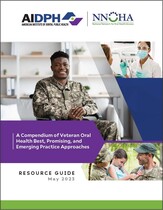
Publication: Compendium of Veteran Oral Health Best, Promising, and Emerging Practice Approaches
The National Network for Oral Health Access partnered with the American Institute for Dental Public Health to collect current practices to increase access to oral health care for veterans. This guide describes strategies to engage and serve veterans in the community for oral health care.
|
Additional Resources
Climate Change, Air Quality, and Health Equity
Ongoing emissions, smoke from more frequent wildfires, ozone from extreme heat, and indoor air contamination all have immediate impacts on patients’ health. For example, they can cause or increase respiratory, cardiovascular, and mental health issues. Join HRSA for a panel discussion on these impacts on health center patients. Panelists will also review resources to support patients and communities.
Tuesday, June 20
1:00-2:00 p.m. ET
Registration page
Issue Brief: Policies and Strategies to Address Food Insecurity in Agricultural Worker Communities
A new issue brief from Farmworker Justice examines the policies that impact food security in agricultural worker communities. It provides an overview of federal and state programs as well as strategies to address food insecurity. Visit the Health Center Resource Clearinghouse to access the brief, and look in our sidebar for the related webinar on Tuesday, June 13.
In case you missed it:
Visit the Primary Health Care Digest archive.
Do you forward the Digest to others?
Encourage them to subscribe.
|