|
Safely Increasing Efficiency at Airports
MARS aims to ease congestion at adjacent airports
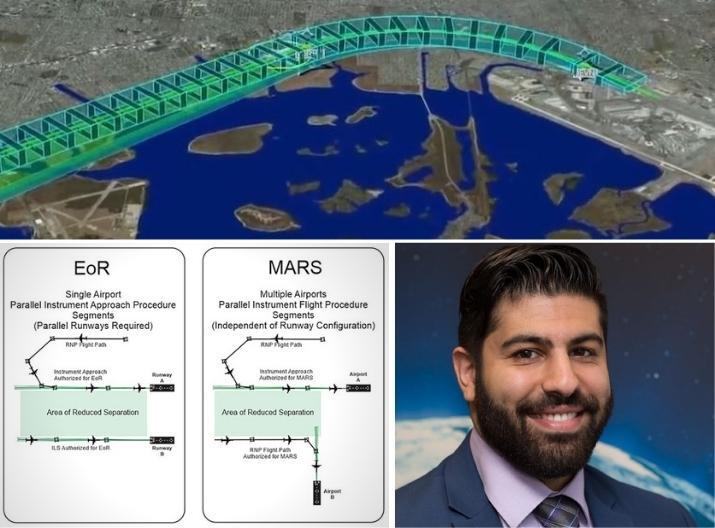
Multiple Airport Route Separation (MARS) is a NextGen concept that aims to ease congestion at adjacent airports by deconflicting arrivals and departures, resulting in increased efficiency, reduced controller and pilot workloads, fuel and time savings, and predictable, repeatable flight paths.
Long-standing FAA regulations require a minimum separation distance of 1,000 feet vertically or three nautical miles laterally between planes. Maintaining this separation amid the courses of many planes departing and arriving can produce delays at just one airport. The bottlenecks are even greater when the adjoining airspaces overlap. “Today’s air traffic and its future growth require the implementation of an evolving NextGen modernization to manage the flow of aircraft,” said Vartan Tenkerian, MARS program manager in the Navigation Branch of the NextGen Technology Development and Prototyping Division. “A MARS-type solution will support this effort.”
MARS is a system of authorized instrument flight procedures, air traffic control procedures, communication requirements, and surveillance that permit aircraft to safely fly with reduced separation criteria. The MARS team completed the initial concept exploration phase and developed a concept of operations (ConOps) in 2019. In 2020, the team met with several candidate air traffic control facilities and operators to gather feedback on the ConOps.
“The feedback indicated that MARS implementations would not be homogeneous,” said Ted Goodlin, an air traffic control subject matter expert. “Instead, each MARS implementation will have to accommodate several local site-specific factors, including the types of instrument procedures and the varying rates of operator equipage and participation.”
MARS is a high priority with the NextGen Advisory Committee and Northeast Corridor stakeholders. Once the MARS concept is determined to be safe, the FAA will work to complete a national safety risk management process and modify the national standards in the air traffic control handbook. As early as 2024, MARS research could become a reality at concept validation launch sites.
Read more about MARS on FocusFAA.
|
|
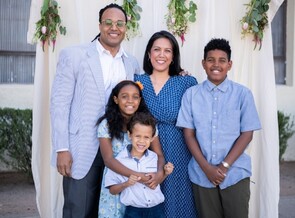
Kristina Harris' FAAmily
Kristina Harris came to the FAA as a Minority Serving Institutions (MSI) intern and never looked back. As a communications strategist in the Office of Communications (AOC) and mother of three children, she describes how the FAA has provided support while building her family by offering things like EAP services. "The FAA has really become a family for me. My involvement on the National Board of the National Hispanic Coalition of Federal Aviation Employees (NHCFAE) created networking and growth opportunities.” She adds that “work is a part of life and it’s nice to have balance.”
|
Camille Baker is Living Her Dream
Camille Baker, safety case lead in AJI, has been in love with aviation since she was a little girl. She attended Florida Memorial University, an HBCU (Historically Black Colleges and Universities), and studied aeronautical science and got her pilot’s license, opening the door to the FAA. “I’m living my dream at this point,” Baker said. “In my mind, before I came to the agency, everyone was an aviation buff like me…And while they may be living their dream, it’s not necessarily an aviation dream... Regardless of what your background is, there’s an opportunity within the FAA for you.”
|
|
 The Power of Hello: Use the OHNO Approach - Observe, Initiate a Hello, Navigate the Risk and Obtain Help - to evaluate and report suspicious behaviors.
|
|
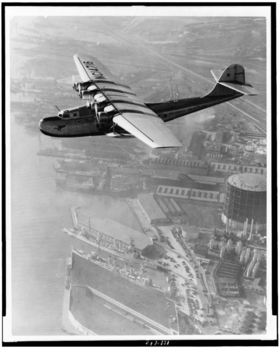
Transpacific Flight by a Commercial Passenger Airliner
April 28, 1937: The first transpacific flight by a commercial passenger airliner is completed when Pan American Airways’ Martin M-130, China Clipper, arrived at Hong Kong. The flight departed from San Francisco Bay, California with seven revenue passengers and then proceeded across the Pacific Ocean by way of Hawaii, Midway Island, Wake Island, Guam, Manila, Macau, and finally Hong Kong. The craft also brought 2,500 pounds of American cargo, including 100,000 letters and newspapers from the United States only six days old.
|
|
|
|
|