Upcoming Deadlines
-
Aug. 28, 2024, is the deadline to submit concept papers for the Water Power Innovation Network funding opportunity.
-
Aug. 30, 2024, is the deadline to respond to a request for information (RFI) on barriers to investing in marine energy technologies.
-
Oct. 4, 2024, is the deadline for the Testing Expertise and Access for Marine Energy Research (TEAMER) program's latest request for technical support.
-
Oct. 9, 2024, is the deadline for applicants to apply to the National Science Foundation's (NSF's) Engineering Research Initiation (ERI), which includes marine energy and hydropower topic areas.
-
Oct. 18, 2024, is the deadline to submit proposals for the Ocean Energy Safety Institute's (OESI's) Request for Proposals II (RFP-II), which seeks projects from the marine energy sector.
-
Rolling: Applications to be a fellow embedded in Alaska working with WPTO and the Arctic Energy Office (AE) will be reviewed on a rolling basis.
Looking for more detailed information on the latest funding opportunities and events related to water power? Make sure you subscribe to The Water Wire! Find the next issue in your inbox on Sept. 12, 2024.
Announcements
WPTO recently announced plans to provide up to $112.5 million in funding to advance the commercial readiness of wave energy technologies through open water testing and system validation. The proposed opportunity is designed to reduce risks for deployments, increase the potential for commercial adoption through longer-duration demonstrations, and offer additional benefits to help quickly advance wave energy converters (WECs). DOE anticipates opening this funding opportunity in or around September 2024.
WPTO announced the 15 winning teams in Phase II of the American-Made Innovating Distributed Embedded Energy Prize (InDEEP). Each team was awarded $80,000 in cash prizes for showcasing the performance capabilities and characteristics of their distributed embedded energy converter technology (DEEC-Tec) concepts to harness and convert the power of ocean waves into usable types of energy. The winning teams will advance to Phase III of InDEEP, where they will integrate their individual DEEC-Tec prototypes into a larger metamaterial. The competition will culminate at an in-person event in January 2025.
The National Renewable Energy Laboratory (NREL), on behalf of WPTO, issued an RFI to gather feedback on barriers to investing in marine energy technologies. The RFI seeks input from public and private investors, nonprofits, and other stakeholders. The goal is to identify obstacles and better enable the transition from public to private funding, supporting the commercial readiness and long-term success of marine energy developers. Responses are due Aug. 30, 2024.
NSF opened applications for its ERI program, which aims to enhance engineering research capacity by supporting new academic investigators who have not received significant federal funding. Working with WPTO, NSF included two special topics focused on water power: Marine Energy and the Blue Economy and Hydropower and Climate Change Impacts. Funding recipients are eligible to receive up to $200,000 over 24 months and should submit applications by Oct. 9, 2024.
OESI seeks proposals focused on marine energy through its RFP-II funding opportunity. Projects may involve small-scale marine energy solutions that enhance the safety, security, and sustainability of offshore wind and oil and gas operations, as well as utility-scale marine energy solutions that leverage experience from wind energy and oil and gas. Proposals are due Oct. 18, 2024.
WPTO and AE are accepting applications for a new fellowship, based in either Anchorage or Fairbanks, Alaska, focused on learning how WPTO and AE carry out work on water power-related topics in the state. The selected applicant will also gain hands-on experience by applying their knowledge and expertise aligned with the offices' work areas and pertaining to Alaska's energy challenges and needs. Applications for this opportunity will be accepted on a rolling basis until the role is filled.
Project Updates and Stories
WPTO recently invested more than $41 million in the four university-led National Marine Energy Centers (NMECs). This funding, which includes $36 million from the Bipartisan Infrastructure Law, will help strengthen and expand marine energy research and development and bolster marine energy testing infrastructure at the NMECs. The Bipartisan Infrastructure Law investment will fund more than 30 research and development projects for the nine universities and nearly 60 graduate students that function as teams at the centers.
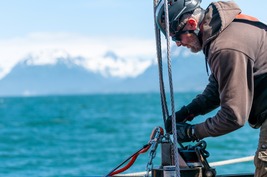
In a recent study, NREL researchers quantify, for the first time, the important role tidal energy could play in Alaska’s largest power grid, the Railbelt. The authors determined that tidal energy could contribute to decarbonizing Alaska’s Railbelt by 2035 and help generate clean fuels like hydrogen, which could boost the state’s economy. This study can help Alaska accurately plan for how to incorporate the state’s significant tidal energy resources into its decarbonization goals, current and future grid systems, and even economy.
|
Over the course of five rounds of technical support, TEAMER, along with funding from the Small Business Technology Transfer program, helped E-Wave Technologies develop a wave energy converter (WEC) from concept to test-validated device. The E-Wave WEC is designed to power offshore aquaculture farms with clean and affordable energy, and the company is now advancing it toward commercialization.
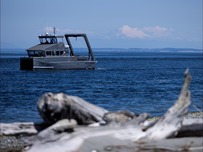
DOE’s new hybrid electric-diesel research vessel, RV Resilience, recently arrived at PNNL in Sequim, Washington. The 50-foot vessel is partially electrified and equipped with a 113-kilowatt battery, allowing quiet, eco-friendly operations. With a large deck and advanced capabilities, RV Resilience will support research on marine energy, ocean-based carbon dioxide removal, coastal ecosystems, and more.
|
A high school essay assignment, combined with a lifelong love for the natural world, inspired Tina Ortega to study environmental resources engineering as an undergrad and advanced energy systems as a grad student. Today, she is an NREL marine energy research engineer, where she and her team work to drive down the costs and standardize the economic modeling of marine energy systems, making them more competitive with other renewable energy technologies.
Aquaculture is expanding rapidly, with a projected 22% increase in production by 2030. Marine energy technologies, including wave and tidal devices, are scalable and adaptable, making them suitable for various aquaculture needs. Integrating these technologies could help the industry reduce its reliance on fossil fuels and cut greenhouse gas emissions. Ongoing research and partnerships are crucial to overcoming challenges and making this co-location feasible.
WPTO Events
TOMORROW, Aug. 22, 2024, 12:30–2 p.m. ET, Webinar
Join experts from WPTO for a discussion on artificial intelligence and machine learning. Hear about where they see potential benefits and uses of these tools in the hydropower and marine energy sectors and where they may already be in use!
Aug. 29, 2024, 12–1 p.m. ET
Join DOE’s Advanced Materials and Manufacturing Technologies Office for a webinar on the Lab-Embedded Entrepreneurship Program (LEEP). The webinar will present information on the LEEP RFI, encourage audience members to respond, and provide an opportunity for questions.
Sept. 4, 2024, 1–2 p.m. ET
Join EERE for a webinar on the LEEP fellowship, a two-year program that supports early-stage clean energy startups and/or emerging technologies with the support needed to develop and transition their ideas into the market. Participants receive entrepreneurial training and access to top facilities at U.S. national laboratories. The webinar will offer details for potential applicants to the 2025 cohort, which opens to applications on Sept. 4.
Sept. 5, 2024, 11 a.m. –12 p.m. ET
PNNL is investigating the feasibility of co-locating marine energy and offshore aquaculture. Over the past two years, PNNL has focused its research on wave energy and offshore integrated multi-trophic aquaculture in Puerto Rico to assess the technical and social feasibility of co-location. This webinar will provide an update on this research study including the spatial analysis, environmental fieldwork, and outreach and engagement.
Feb. 10–14, 2025
Registration will open in the fall for WPTO's 2025 Peer Review. The purpose of peer review is to evaluate WPTO-funded projects based on their contributions to the office’s mission and goals, track progress made against stated objectives, and assess the office’s overall management and performance.
See WPTO at These Events
Sept. 17–19, 2024, Melbourne, Australia
Join WPTO staff at the International Conference on Ocean Energy 2024 in Melbourne, Australia! Be sure to catch Allison Johnson, the office's engagement and outreach lead, during the first day of the conference as she discusses the opportunity for marine energy research and development in the United States.
In Case You Missed It
DOE and the National Oceanic Atmospheric Administration (NOAA) signed a memorandum of agreement on future collaborations regarding marine carbon dioxide removal (CDR) research and development. This agreement will formalize collaboration between DOE and NOAA to share expertise on research and technology development, as well as avoid duplicative work. The agreement makes clear that combining the ocean science expertise of NOAA with the CDR and energy science and technology expertise of DOE will be a powerful way to advance the state of marine CDR science and strengthen the existing relationship between the agencies.
Follow along on the Office of Energy Efficiency and Renewable Energy's Twitter, LinkedIn, and Facebook channels for more water power content each week.
Making a Splash in the News
Clean Energy Champion Spotlight: Charles Scaife
—DOE Office of Energy Efficiency and Renewable Energy, Sarah Brown, July 25, 2025
Webinar Details How Industry Can Qualify for the Domestic Content Tax Credit Bonus
—U.S. Department of Energy, Staff Writer, July 25, 2024
DOE's First Hybrid Research Vessel, Resilience, Arrives
—Mirage News, Staff Writer, July 23, 2024
Construction Slated for Coastal Wave Energy Testing Facility
—Columbia Gorge News, Michelle Klampe, July 22, 2024
Startup Receives Grant for Floating Power Generators: 'To Create a Sustainable and Economically Beneficial Energy Solution'
—The Cool Down via Yahoo Tech, Rick Kazmer, July 21, 2024
|