|
Welcome to the July edition of The Clean Energy Careers Chronicle,
your source for all things EERE careers! |
|
|
Department of Energy (DOE) Early Career Program Virtual Information Session: July 31, 2024, 1–2:15 p.m ET.
At this webinar, the DOE will provide information on federal and non-federal internships, fellowships, and early career programs including the Federal Pathways Programs, stipend-based programs, the DOE Student Experience Program, and programs at the DOE National Laboratories. Learn more and register here.
Philadelphia Veterans Job Fair: August 1, 2024, 11 a.m. – 3 p.m. ET in Philadelphia, PA
At this event, job seekers with military experience can meet with recruiters from local and national companies. These events are free for U.S veterans, military spouses, transitioning military, and members of the Guard and Reserve. Learn more and register here.
Transitioning Army & Spouse Virtual Career Fair: August 6, 2024, 11 a.m. – 3 p.m. ET
This virtual career fair offers you a direct online connection to employers, career opportunities, and educational options. This event is free for U.S veterans, military spouses, transitioning military, and members of the Guard and Reserve. Learn more and register here.
University of Alabama in Huntsville Fall Career Fair: August 28, 2024, 8 a.m. – 1 p.m. CT in Huntsville, AL
This career fair is open exclusively to currently enrolled UAH students and alumni in all majors. It's a great opportunity for students and alumni to meet top employers. Learn more here.
DOE Careers in Contracting and Grants Management Virtual Information Session: August 28, 2024, 1–2 p.m. ET
This virtual information session will showcase the rewarding careers DOE has for Contracting and Grants Management Specialists. Learn more and register here.
For questions about upcoming events or how to join the clean energy revolution, reach out to eere_outreach@ee.doe.gov.
|
|
Come Work With Us
Calling all general engineers!
|
|
EERE is looking for general engineers to support a variety of roles throughout its offices. Roles range from GS-11 through GS-15 grade levels and are filled through the DOE's Direct Hire Authority, which allows a quicker hiring process than the traditional government hiring process. In using this authority, DOE still abides by the Merit System Principles and all Federal and DOE regulations for hiring. |
|
SALARY: $72,553–$191,900 per year
PAY SCALE & GRADE: GS 11–15
|
|
As a General Engineer, you will:
- Use sound technical judgment and initiative to resolve the challenges of changing conditions and other problems relative to the assigned projects and programs.
- Use physics or mechanical, nuclear, electrical, chemical, civil, or industrial engineering theories, principles, and practices.
- Analyze situations, identify problems, probe causes, and recommends courses of action or solutions.
- Work closely with a team, perform assessments, clearly and concisely document assessment results, and present findings orally and in writing to the approval authority.
|
|
|
You don’t have to be a clean energy expert to start your career in clean energy. DOE also has Direct Hire Authority for Physical Scientists and Interdisciplinary General Engineers/Physical Scientists.
See more about these roles below and apply to be a clean energy champion! 💪 ⚡
|
|
|
As a Physical Scientist, you may:
- Provide scientific advice and guidance to officials, managers, scientists, and engineer.
- Serve as an expert for a significant segment of a specific area in one or more of the following: advanced scientific computing research; basic energy sciences; biological and environmental research; fusion energy sciences; high energy physics; nuclear physics; and workforce development.
- Provide technical guidance on proposed research projects and programs of interest.
- And more!
|
|
|
As an Interdisciplinary General Engineer/Physical Scientist, you may:
- Manage RD&D projects focused on grid modernization, ensuring reliable, efficient, and accessible integration of renewable energy sources.
- Use physics or mechanical, nuclear, electrical, chemical, civil, or industrial engineering theories, principles, and practices.
- Collaborate with stakeholders from industry, academia, national laboratories and government.
- And more!
|
|
|
If you’re interested in any of the roles above, please email us and include your name, the best way you can be reached, the position, and the EERE office (Solar, Geothermal, Vehicles, Buildings, etc.) that interests you. Please also attach your resume that provides an overview of your work history and accomplishments as well as your educational background.
|
|
ORISE Residential Buildings Decarbonization Fellow
Join the DOE Building Technologies Office!

Within the Building Technologies Office (BTO), the Residential Buildings Integration (RBI) team is seeking Fellows to engage with its dynamic work to enable better housing through widespread access to energy efficiency technologies and resources. Under the guidance of a mentor, you willparticipate in technical reviews of proposed research and development plans, assess state-of-the-art scientific literature and practice in relevant technologies, identify new opportunities for further advancement in the field and the industry, and more. You can learn more and apply here.
|
|
|
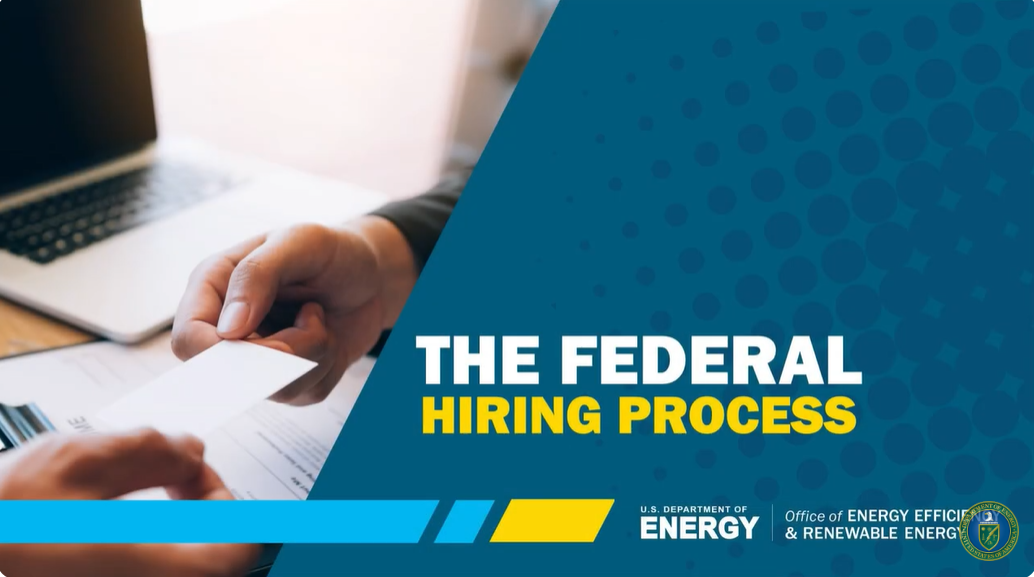
Learn how to interpret a position description, understand the GS pay scale, and understand the process from applying to a vacancy to accepting an official job offer from the federal government in this video.
Pro tip: Make sure your USAJobs profile and resume are searchable so recruiters can easily discover you. 🌍🔍
|
|
Clean Energy Champion Spotlight |
|
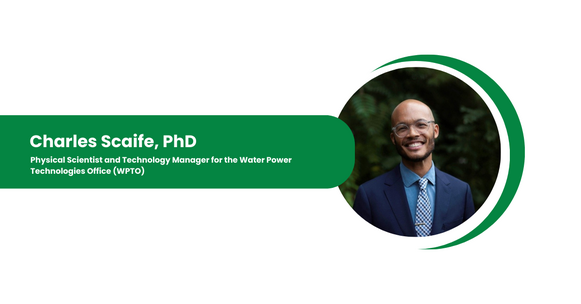 A clean energy champion is someone who takes action to support or join the transition to a renewable energy economy, with the knowledge that reducing carbon emissions provides daily benefits to every American so they can live happy and healthy lives.
This month, we’re highlighting Charles Scaife, PhD. As a Physical Scientist and Technology Manager for the Water Power Technologies Office (WPTO), Dr. Scaife focuses on understanding the impacts of climate change on energy systems.
What drew you to EERE, and what about EERE inspires you?
I joined EERE as a John A. Knauss Marine Policy Fellow in 2020. Prior to joining EERE’s WPTO, I was not aware of the breadth of career possibilities in renewable energy for a young environmental scientist. During the grueling interview process for a Knauss Fellowship placement, I was immediately drawn to EERE’s culture of innovation, creativity, and impact. The leadership clearly valued mentorship and professional development, and I was inspired by the possibilities of contributing to the agency’s priorities of decarbonization. Today, that inspiration continues in new forms as I mentor newly minted graduates, create new research priorities and programs, and ultimately contribute to the clean energy revolution.
What do you do in your job, and what do you love most about it?
My primary work in EERE is focused on understanding the impacts of climate change on energy systems and, in particular, on hydroelectric generation. This research area seeks to advance 1) data collection and access to critical environmental variables, 2) metrics and analytics to enhance resilient decision-making, and 3) water resource modeling to support future hydropower operations and planning. Creating actionable science used by scientists, energy and water utilities, and even other federal agencies is one of the things I love most about my job. More recently, this role has expanded beyond energy systems to also include water systems. In this expanded role, my colleagues and I are seeking to build a new research program focused on the integrated challenges at the nexus of both energy and water systems. Finally, I am also the acting team lead for a large WPTO initiative called HydroWIRES, which focuses on understanding, enabling, and improving hydropower’s contributions to grid reliability, resilience, and integration. The HydroWIRES team supports exciting new research including technical assistance projects aimed at helping the hydropower industry reveal new value streams and technology solutions.
How do you feel your role at EERE makes an impact in the world?
Our research in climate change, energy-water nexus, and grid reliability and resilience is critical for the energy (and water) systems of tomorrow. As the nation further decarbonizes the grid and as climate change continues to alter the environment we rely on for many forms of renewable energy, the research we conduct will become increasingly important for enhancing energy and water security in communities across the nation.
What advice would you give to someone interested in a career in STEM or clean energy?
Before I started my career at EERE, I wish I had an appreciation for the vastness of career possibilities for STEM majors. When you’re in a research science program, those career pathways can feel limited and well-worn. Taking a leap of faith from those well-worn career pathways and exploring something new in EERE was one of my proudest moments. STEM fields prepare you for a career in innovation, so why not take a leap of faith and create something new and fulfilling to you?

|
|
|
|
|