|
Under the direction of the United States Secretary of Homeland Security Kristi Noem, FEMA is actively coordinating with states across a large portion of the country to support state-led, locally executed response efforts to severe winter weather. Residents and visitors should continue following instructions from local officials and monitor local weather.
What Emergency Declarations Include
President Trump approved 12 federal emergency disaster declarations for Arkansas, Georgia, Indiana, Kentucky, Louisiana, Maryland, Mississippi, North Carolina, South Carolina, Tennessee, Virginia and West Virginia – enabling states to access critical federal resources to supplement their response efforts, if needed.
Federal emergency declarations allow states to tap into federal support through FEMA to provide lifesaving, life-sustaining resources. These declarations help the state-led efforts of getting the power back on, clearing roads for emergency services and keeping communities safe. The support for this disaster will be provided at 75% federal funding.
For updates on federal assistance and FEMA’s role during this disaster, visit FEMA.gov | Press Releases.
Safety Tips
-
Stay off the roads if local officials ask you to do so. This will help keep you safe and allow emergency response personnel to do their job. Those who need to drive should check local weather and traffic reports before leaving. Consider postponing non-essential travel.
-
Never use generators indoors. Keep generators at least 20 feet from windows, doors and garages. Using generators indoors can cause carbon monoxide poisoning.
-
Do not use a gas stove, propane heater or oven to heat your home. If you are using a kerosene heater, use only water-clear 1-K grade kerosene. Never use gasoline.
-
Call 211 or visit your local emergency management agency or community’s website for the location of warming shelters. You can also find shelters by visiting the American Red Cross shelter locator or calling 800-RED CROSS.
-
Download the FEMA App to receive real-time weather and emergency alerts, send notifications to loved ones, locate emergency shelters in your area, get preparedness strategies and more.
Find more winter safety tips at Ready.gov.
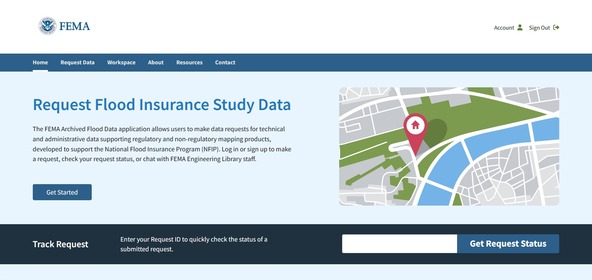 FEMA has made it easier to request technical data and information for Flood Insurance Studies and flood maps by launching the new Archived Flood Data website.
Previously, requests were submitted through a paper mail-in process. Now, requests can be made online, helping to avoid delays, reduce manual data entry, and improve accessibility, accuracy and security.
Through this website, users can request Flood Insurance Studies. These studies include data about watercourses, lakes and coastal flood hazard areas, such as hydraulics, hydrology, levees and topography.
Users can also request other important flood information, including Letters of Map Changes, Letters of Map Revisions, Letters of Map Amendments, elevation certificates and final map products.
The website can be accessed at Archived Flood Data | FEMA.gov. Users with Risk Analysis & Management Access Portal accounts may also access Archived Flood Data through this website.
In 2025, FEMA Individual Assistance (IA) Voluntary Agency Liaisons (VALs) launched the Disaster Collaboratives initiative to leverage FEMA’s power to bring together public-private partners, address resource gaps and support long-term recovery.
These collaboratives intentionally connect nonprofits, academia, government agencies, private sector leaders and philanthropic organizations. By fostering trusted relationships before, during and after disasters, VALs ensure communities are prepared, response efforts are efficient and long-term recovery is streamlined.
One of the first Disaster Collaboratives convened focused on donations management. FEMA Individual Assistance Voluntary Agency Liaisons called together the public-private partners of the IA Donations Collaborative following the disaster declaration to support the Crow Tribe of Montana.
Members of the collaborative—including faith-based and non-governmental partners with donations and logistics expertise—coordinated the delivery of critical winterization support to the Crow Tribe. While the FEMA Permanent Housing Construction moved forward, these partners provided essential household items, such as blankets, hygiene supplies, cleaning materials and beds for shelter facilities. The coordination helped ensure that tribal members remained safe and stable during recovery in the winter months.
Donations Collaborative Members include the following:
- Matthew 25: Ministries
- Convoy of Hope
- United Cajun Navy
- Sleep in Heavenly Peace
- Sister Corps
- The Cincinnati Bengals
To read more stories like this one, visit the full January 2026 VAL Snapshot Report.
As communities across the United States experience the impacts of the major winter storm, hazardous freezing temperatures continue into this week.
Now is the time to make sure you and your loved ones are safe by:
- Staying indoors.
- Avoiding icy roads.
- Dressing warmly.
- Knowing what to do during a power outage.
- Keeping critical local and state information and resources on hand for emergencies.
- Following guidance and monitoring updates from local and state officials.
For detailed tips and resources, read the blog at FEMA.gov.
Although last weekend’s winter storm may be over, the risks are still present. Your area may be experiencing extreme cold and power outages.
Keeping warm is critical and can be challenging for community members who live alone, older adults, people with disabilities and those without access to shelter. If it’s safe to do so, check on your neighbors. Even a quick check-in can save a life.
Read the blog to find ways you can help at FEMA.gov.
Attend DHS Human Trafficking Webinars Today and Tomorrow
On January 6, President Donald J. Trump issued a presidential message renewing the commitment to end human trafficking, protect the most innocent and ensure that every trafficker faces the full force of American justice.
DHS's Blue Campaign will host two public Human Trafficking 101 webinars—one in English today, January 28, and one in Spanish, tomorrow, January 29. Register to attend and invite others to learn how to recognize and report suspected human trafficking cases.
Follow @DHSBlueCampaign on X, Facebook and Instagram for more information on anti-human trafficking efforts in January and throughout the year.
....................................................................................................................................................
Award Acceptance Extended to January 31 for Select Grant Programs
The Department of Homeland Security and FEMA recently announced an extension of the award acceptance deadlines for nearly all Fiscal Year 2025 Non-Disaster Grant Programs and the Fiscal Year 2024 Assistance to Firefighters trio of grant programs. The new deadline to accept these awards is January 31, or the deadline specified in the grant award, whichever is later. This revised deadline is now reflected in your award file in the FEMA GO system.
The January 31 deadline does not apply to the Homeland Security Grant Program or the Emergency Management Performance Grant. The new award acceptance deadline for those programs is February 27.
For more information, please refer to the Grant Programs Directorate Information Bulletin page.
....................................................................................................................................................
Deadline to Apply for FEMA Assistance Extended to February 20 for Individuals Affected by October 2025 Alaska Severe Storms
The state of Alaska and FEMA have extended the application deadlines for Individual Assistance to February 20 for Alaskans impacted by severe storms, flooding and remnants of Typhoon Halong from October 8-13, 2025.
Survivors are encouraged to register for both state and FEMA Individual Assistance programs to maximize their recovery benefits.
The fastest way to apply is online at DisasterAssistance.gov or the Spanish language site at DisasterAssistance.gov/es.
If you need more information or additional help:
- Download the FEMA App.
- Call the FEMA Helpline at 1-800-621-3362 for assistance in multiple languages. If you use a relay service—such as video relay service (VRS), captioned telephone service or others—provide FEMA the number for that service.
- Find in-person FEMA support at fema.gov/drc.
To view an accessible video on how to apply, visit What to Expect Before Applying for FEMA Assistance.
For more information, visit FEMA.gov.
....................................................................................................................................................
|


