Kentucky FSA Newsletter - December 16, 2024
In This Issue:
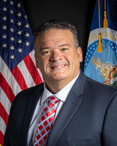
Greetings and happy holidays! It’s the time of year to pause for just a little while to count our blessings and give thanks for what we’ve be given. The things for which we are thankful mean a lot of different things to different people. But when we gather around the table with family and friends, all of us are thankful for the food that has been prepared for us. And for that food to be there, we must remember the farmers who tended their fields and cared for their livestock.
And I'd like to acknowledge our community partners, sister agencies, county and state committeepersons, and our state and county office staff who work to assist our farmers with their operations. Thank you for your service.
Whatever your business is with FSA, know that we value your work in agriculture. We strive to equitably serve all farmers and agricultural partners throughout Kentucky. We are committed to delivering effective and efficient agricultural programs to all our Kentucky farmers and producers. A big part of this commitment is reaching out and connecting with our communities. You may have visited with us at a local outreach event or attended a local agricultural meeting where FSA presented program and loan information. We're out in our communities regularly, working to increase program awareness, education and participation, often times with the help of agricultural partners located throughout the state. We're out there because we appreciate all you do and are eager to assist you in all the ways we can.
From all of us at Kentucky FSA, we wish you good fortune and happiness this season. And may your holidays be joyful and bright, lasting well into the new year.
Dean Schamore
State Executive Director for FSA
Kentucky State Office
|
 |
The U.S. Department of Agriculture (USDA) is expanding the Food Safety Certification for Specialty Crops (FSCSC) program to now include medium-sized businesses in addition to small businesses. Eligible specialty crop growers can apply for assistance for expenses related to obtaining or renewing a food safety certification. The program has also been expanded to include assistance for 2024 and 2025 expenses. Producers can apply for assistance on their calendar year 2024 expenses through Jan. 31, 2025. For program year 2025, the application period will be Jan. 1, 2025, through Jan. 31, 2026.
Program Details
FSCSC assists specialty crop operations that incurred eligible on-farm food safety certification and expenses related to obtaining or renewing a food safety. FSCSC covers a percentage of the specialty crop operation’s cost of obtaining or renewing its certification, as well as a portion of related expenses.
Eligible FSCSC applicants must be a specialty crop operation; meet the definition of a small or medium-size business and have paid eligible expenses related to certification.
- A small business has an average annual monetary value of specialty crops sold by the applicant during the three-year period preceding the program year of no more than $500,000.
- A medium size business has an average annual monetary value of specialty crops the applicant sold during the three-year period preceding the program year of at least $500,001 but no more than $1,000,000.
Specialty crop operations can receive the following cost assistance:
- Developing a food safety plan for first-time food safety certification.
- Maintaining or updating an existing food safety plan.
- Food safety certification.
- Certification upload fees.
- Microbiological testing for products, soil amendments and water.
- Training.
FSCSC payments are calculated separately for each eligible cost category. Details about payment rates and limitations are available at farmers.gov/food-safety.
Applying for Assistance
Interested applicants have until Jan. 31, 2025, to apply for assistance for 2024 eligible expenses. FSA will issue payments as applications are processed and approved. For program year 2025, the application period will be January 1, 2025, through January 31, 2026. FSA will issue 50% of the calculated payment for program year 2025 following application approval, with the remaining amount to be paid after the application deadline. If calculated payments exceed the amount of available funding, payments will be prorated.
Specialty crop producers can apply by completing the FSA-888-1, Food Safety Certification for Specialty Crops Program (FSCSC) for Program Years 2024 and 2025 application. The application, along with the AD-2047, Customer Data Worksheet and SF-3881, ACH Vendor/Miscellaneous Payment Enrollment Form, if not already on file with FSA, can be submitted to the FSA office at any USDA Service Center nationwide by mail, fax, hand delivery or via electronic means. Alternatively, producers with an eAuthentication account can apply for FSCSC online. Producers interested in creating an eAuthentication account should visit farmers.gov/sign-in.
Specialty crop producers can also call 877-508-8364 to speak directly with a FSA employee ready to assist. Visit farmers.gov/food-safety for additional program details, eligibility information and forms needed to apply.
More Information
To learn more about FSA programs, producers can contact their local USDA Service Center. Producers can also prepare maps for acreage reporting as well as manage farm loans and view other farm records data and customer information by logging into their farmers.gov account. Producers without an account can sign up today.
Top of page
The U.S. Department of Agriculture’s Farm Service Agency (FSA) reminds agricultural producers that Farm Loan Programs can be used to support a variety of climate-smart agriculture practices, which build on many practices that farmers and ranchers already use, like cover cropping, nutrient management and conservation tillage.
Climate-smart agricultural practices generate significant environmental benefits by capturing and sequestering carbon, improving water management, restoring soil health and more. Farm loan funding complements other tools to help producers adopt climate-smart practices, such as FSA’s Conservation Reserve Program, crop insurance options that support conservation, and conservation programs offered by USDA’s Natural Resources Conservation Service (NRCS).
FSA offers multiple types of loans to help farmers and ranchers start, expand or maintain a family agricultural operation. These loans can provide the capital needed to invest in climate-smart practices and equipment including the establishment of rotational grazing systems, precision agriculture equipment or machinery for conversion to no-till residue management. Additionally, for programs like Conservation Reserve Program and NRCS conservation programs where USDA and the producer share the implementation cost, a farm loan could be used for the producer’s share, if consistent with the authorized loan purpose.
Some additional ways farm loans can be leveraged to invest in climate-smart agriculture practices or equipment include:
-
Precision Agriculture Equipment - Eligible producers could use a Term Operating Loan to purchase equipment like GPS globes, monitors, or strip till fertilizer equipment.
-
Cover Crops - Eligible producers could use an Annual Operating Loan for seed costs.
-
No/Reduced Till - Eligible producers could use a Term Operating Loan to purchase equipment.
-
Livestock Facility Air Scrubber or Waste Treatment - Eligible producers could use a Farm Ownership Loan for capital improvements to livestock facilities.
-
Cross Fencing - Eligible producers could use an Annual or Term Operating Loan to purchase fencing and installation equipment.
Visit the Climate-Smart Agriculture and Forestry webpage on farmers.gov to learn more and see detailed examples of how an FSA farm loan can support climate-smart agriculture practices.
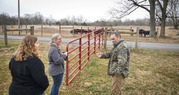
Farm loan borrowers who have pledged real estate as security for their Farm Service Agency (FSA) direct or guaranteed loans are responsible for maintaining loan collateral. Borrowers must obtain prior consent or approval from FSA or the guaranteed lender for any transaction that affects real estate security. These transactions include, but are not limited to:
- Leases of any kind
- Easements of any kind
- Subordinations
- Partial releases
- Sales
Failure to meet or follow the requirements in the loan agreement, promissory note, and other security instruments could lead to nonmonetary default which could jeopardize your current and future loans.
It is critical that borrowers keep an open line of communication with their FSA loan staff or guaranteed lender when it comes to changes in their operation. For more information on borrower responsibilities, read Your FSA Farm Loan Compass.
|
Agricultural producers of perishable commodities including fruits, vegetables and floriculture can now get funding for controlled atmosphere storage through Farm Storage Facility Loans (FSFL) offered by the U.S. Department of Agriculture’s (USDA) Farm Service Agency (FSA). Controlled atmosphere storage regulates the concentrations of oxygen, carbon dioxide and nitrogen in a storage room to increase the shelf life of crops.
In addition to now supporting controlled atmosphere storage, FSFLs also provide low-interest financing to help producers build or upgrade storage facilities and to purchase portable (new or used) structures, equipment and storage and handling trucks.
The low-interest funds can also be used for controlled atmosphere storage monitoring equipment, designed to notify facility owners immediately if potential atmospheric concerns are detected. Producers may renovate existing storage facilities to include controlled atmosphere storage monitoring equipment. Authorized loan terms for FSFL renovations are three and five years only.
To assist with monitoring gases and particle concentrations for controlled atmosphere storage, the following equipment, but not limited to, is eligible for an FSFL:
- Optical oxygen sensor.
- Low power CO2 sensor.
- Air quality sensor.
- Gas detection devices.
- Air temperature and relative humidity sensor.
- Water activity meter.
- Temperature stabilized water activity analyzer.
- Precision and performance humidity and temperature transmitter.
Loans of up to $50,000 can be secured by a promissory note/security agreement, loans between $50,000 and $100,000 may require additional security and loans exceeding $100,000 require additional security.
FSFL borrowers do not need to demonstrate lack of commercial credit availability to apply. The loans are designed to assist a diverse range of agricultural operations, including small and mid-sized businesses, new farmers and ranchers, operations supplying local food and farmers markets, non-traditional farm products and underserved producers.
For more information, see the FSFL fact sheet and contact FSA at your local USDA Service Center.

The U.S. Department of Agriculture (USDA) Farm Service Agency (FSA) reminds foreign investors with an interest in agricultural land in the United States that they are required to report their land holdings and transactions to USDA.
The Agricultural Foreign Investment Disclosure Act (AFIDA) requires foreign investors who buy, sell or hold an interest in U.S. agricultural land to report their holdings and transactions to the USDA. Foreign investors must file AFIDA Report Form FSA-153 with the FSA county office in the county where the land is located. Large or complex filings may be handled by AFIDA headquarters staff in Washington, D.C.
According to CFR Title 7 Part 781, any foreign person who holds an interest in U.S. agricultural land is required to report their holdings no later than 90 days after the date of the transaction.
Foreign investors should report holdings of agricultural land totaling 10 acres or more used for farming, ranching or timber production, and leaseholds on agricultural land of 10 or more years. Tracts totaling 10 acres or less in the aggregate, and which produce annual gross receipts in excess of $1,000 from the sale of farm, ranch, forestry or timber products, must also be reported. AFIDA reports are also required when there are changes in land use, such as from agricultural to nonagricultural use. Foreign investors must also file a report when there is a change in the status of ownership.
The information from AFIDA reports is used to prepare an annual report to Congress. These annual reports to Congress, as well as more information, are available on the FSA AFIDA webpage.
Assistance in completing the FSA-153 report may be obtained from the local FSA office. For more information regarding AFIDA or FSA programs, contact your local County USDA Service Center or visit farmers.gov.
Top of page
|
Agricultural producers in State should make an appointment with their local Farm Service Agency (FSA) office to complete crop acreage reports before the applicable deadline after planting is complete.
An acreage report documents a crop grown on a farm or ranch, its intended use and location. Filing an accurate and timely acreage report for all crops and land uses, including failed acreage and prevented planted acreage, can prevent the loss of benefits.
How to File a Report
The following acreage reporting dates are applicable in Kentucky:
-
December 15, 2024: Fall seeded small grains. Example: Barley, Oats, Rye, Wheat (Preceding Year (Report 2023 for 2024)).
-
January 15, 2024: Peaches, Canola.
-
January 2, 2025: Honey, Maple Sap (Same Crop Year).
To file a crop acreage report, producers need to provide:
- Crop and crop type or variety
- Intended crop use
- Number of crop acres
- Map with approximate crop boundaries
- Planting date(s)
- Planting pattern, when applicable
- Producer shares
- Irrigation practice(s)
- Acreage prevented from planting, when applicable
- Other required information
Acreage Reporting Details
The following exceptions apply to acreage reporting dates:
- If the crop has not been planted by the acreage reporting date, then the acreage must be reported no later than 15 calendar days after planting is completed.
- If a producer acquires additional acreage after the acreage reporting date, then the acreage must be reported no later than 30 calendar days after purchase or acquiring the lease. Appropriate documentation must be provided to the county office.
Noninsured Crop Disaster Assistance Program (NAP) policy holders should note that the acreage reporting date for NAP-covered crops is the earlier of the dates listed above or 15 calendar days before grazing or crop harvesting begins.
Prevented Planted Acreage
Producers should also report crop acreage they intended to plant but were unable to because of a natural disaster, including drought. Prevented planted acreage must be reported on form CCC-576, Notice of Loss, no later than 15 calendar days after the final planting date as established by FSA and USDA’s Risk Management Agency (RMA).
FSA recently updated policy that applies to prevented planted acreage due to drought. To certify prevented planted acreage due to drought, all of the following must apply:
- The area that is prevented from being planted has insufficient soil moisture for seed germination on the final planting date for non-irrigated acreage.
- Prolonged precipitation deficiencies that meet the D3 or D4 drought intensity level as determined by the U.S. Drought Monitor.
- Verifiable information must be collected from sources whose business or purpose is recording weather conditions as determined by FSA.
Continuous Certification Option for Perennial Forage
Agricultural producers with perennial forage crops have the option to report their acreage once, without having to report that acreage in subsequent years, as long as there are no applicable changes on the farm. Interested producers can select the continuous certification option after FSA certifies their acreage report. Examples of perennial forage include mixed forage, birdsfoot trefoil, chicory/radicchio, kochia (prostrata), lespedeza, perennial peanuts and perennial grass varieties.
Once the continuous certification option is selected, the certified acreage will roll forward annually with no additional action required by the producer in subsequent years unless the acreage report changes.
Farmers.gov Portal
Producers can access their FSA farm records, maps, and common land units through the farmers.gov customer portal. The portal allows producers to export field boundaries as shapefiles and import and view other shapefiles, such as precision agriculture boundaries within farm records mapping. Producers can view, print and label their maps for acreage reporting purposes. Level 2 eAuthentication or login.gov access that is linked to a USDA Business Partner customer record is required to use the portal.
Producers can visit farmers.gov/account to learn more about creating an account. Producers who have authority to act on behalf of another customer as a grantee via an FSA-211 Power of Attorney form, Business Partner Signature Authority or as a member of a business can now access information for the business in the farmers.gov portal.
More Information
For questions, producers should call their FSA county office. To find their FSA county office, visit farmers.gov/service-center-locator.
Top of page

The USDA Farm Service Agency’s (FSA) Direct Farm Ownership loans can help farmers and ranchers become owner-operators of family farms, improve and expand current operations, increase agricultural productivity, and assist with land tenure to save farmland for future generations.
There are three types of Direct Farm Ownership Loans: regular, down payment and joint financing. FSA also offers a Direct Farm Ownership Microloan option for smaller financial needs up to $50,000.
Joint financing allows FSA to provide more farmers and ranchers with access to capital. FSA lends up to 50 percent of the total amount financed. A commercial lender, a State program or the seller of the property being purchased, provides the balance of loan funds, with or without an FSA guarantee. The maximum loan amount for a joint financing loan is $600,000, and the repayment period for the loan is up to 40 years.
The operation must be an eligible farm enterprise. Farm Ownership loan funds cannot be used to finance nonfarm enterprises and all applicants must be able to meet general eligibility requirements. Loan applicants are also required to have participated in the business operations of a farm or ranch for at least three years out of the 10 years prior to the date the application is submitted. The applicant must show documentation that their participation in the business operation of the farm or ranch was not solely as a laborer.
For more information about farm loans, contact your local County USDA Service Center or visit fsa.usda.gov.
|
 |
If you’re interested in starting a career with USDA, subscribe to receive free email alerts on select positions within the USDA Farm Service Agency, Natural Resources Conservation Service, Risk Management Agency and Farm Production and Conservation Business Center.
All federal job vacancies within USDA are posted on usajobs.gov. In order to further promote employment opportunities, we are going to start sending emails that highlight select positions.
If you want to keep up with vacancy announcements via email, you can subscribe to “Careers” by visiting farmers.gov/subscribe and completing the following steps.
- Select “email” as your subscription type
- Enter your email address
- Click “submit”
- Select the “Careers” topic under “Connect with us”
- Click “submit” to verify your subscription topic choice at the bottom of the page
Not all job vacancy announcements will be shared via email, but you can view a current list of all job openings at any time by visiting usajobs.gov.
For additional information or assistance with your subscription, contact your local USDA Service Center by visiting farmers.gov/service-center-locator.
USDA is an equal opportunity provider, employer, and lender.
Top of page
Farm Loan Programs
|
Farm Programs
|
| 90-Day Treasury Bill |
4.750%
|
Farm Storage Facility Loans |
3 Year
|
4.125%
|
|
Farm Operating Loans - Direct
|
4.750%
|
Farm Storage Facility Loans |
5 Year
|
4.125%
|
|
Farm Ownership Loans - Direct
|
5.250%
|
Farm Storage Facility Loans |
7 Year
|
4.250%
|
|
Limited Resource Loans
|
5.000%
|
Farm Storage Facility Loans |
10 Year
|
4.375%
|
|
Farm Ownership Loans - Direct FO Down Payment
|
1.500%
|
Farm Storage Facility Loans |
12 Year
|
4.375%
|
|
Emergency Loans
|
3.750%
|
Commodity Loans
|
5.250%
|
|
|
|
CCC Borrowing Rate |
4.250%
|
Other Publications:
Kentucky FSA State Office
771 Corporate Dr., Ste 205
Lexington, KY 40503
Phone: 859-224-7601
State Webpage
|
|
Contact your local USDA Service Center for assistance with FSA loans or programs
|
Kentucky FSA State Committee
- John McCauley (Committee Chair) - Lexington
- Carrie Divine - Morganfield
- Pat Henderson - Irvington
- James Kay, Sr. - Versailles
- Roger Thomas - Smiths Grove
|
|