Integrated Data Service – Call for User Researchers
The research team building the Integrated Data Service (IDS) are looking for volunteers to join their research panel. The ONS needs data users to help test and build the IDS, which will enable faster and more efficient analysis through streamlined data access processes and departmental collaboration – but we need your help!
If you would like to be involved in our research panel please complete the following survey
Being part of the research panel will give you opportunity to try early prototypes and put them to the test.
We won’t bombard you with emails, but you may invited to take part in research every few months, and you may get sent the odd survey. Participation is entirely voluntary and any research you do take part in will be totally confidential. You can leave the panel at any time if you find it’s not for you.
If you want to find out more you can email IDP.User.Research@ons.gov.uk
Annual User Experience Survey – thank you for your support
A huge thank you to everyone who has taken the time to feed back to us through our annual user experience survey this year. The results are used to measure trends in service satisfaction and gain insights into areas that are working well and where improvements could be made around ONS secure data provision.
We will be sharing some key highlights over the next few months, and in future updates will share the details of any changes made due to your feedback.
We asked you about your data needs by theme as categorised in the Digital Economy Act (DEA). We had excellent uptake in answering this question, and have shown the results below:
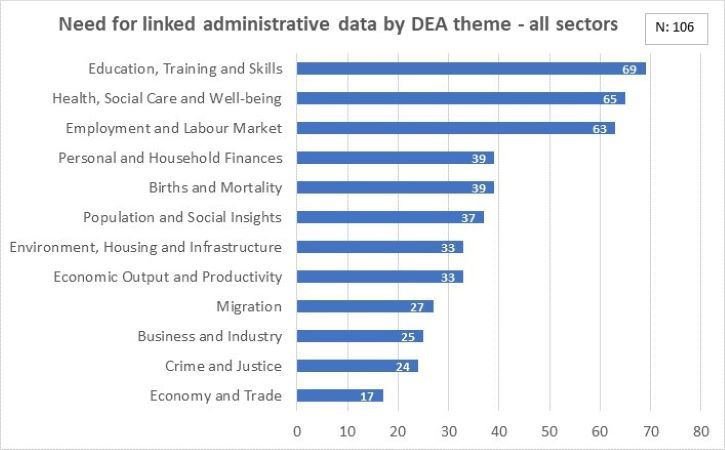 Alongside these themes, you also told us you are looking forward to Census 2021 data and how important data from the Department for Work and Pensions (DWP) and HM Revenue & Customs (HMRC) are to you. Please see the link to the HMRC Data Community consultation below.
New SRS Ingest Form and Transfer Form reminder
A brief reminder that as of 18th July, the new and updated SRS Ingest Form and Transfer Forms are now Live and will be available on the website soon.
Please refer to our previous email for additional information.

ADR UK Fellows Research
The ADR UK Research Fellows have certain commitments during their Fellow journey of researching and conducting analysis on a specific dataset. Following a webpage and a blog about their project, the Fellows write a Data Insight – a summary of their research findings and why they matter – and a Data Explained document. These documents will give a new researcher the opportunity to understand the data better, how it can be used and what the dataset consists of, if they wish to apply for access.
ADR UK Research Fellow Angela Sorsby has written a Data Explained document for the Crown Court and Magistrates' Court datasets. This is now available the on ONS Metadata Catalogue.
Fellows will also present their findings via presentations and engagement events.
Funding opportunity – SAIL/MoJ/Cafcass
ADR UK is accepting applications for funding to conduct research using the newly available Ministry of Justice (MoJ) Data First family court –Cafcass linked dataset (Cafcass stands for Children and Family Court Advisory and Support Service). Grants will be available for up to £145,000 for up to 15 months.
To find out more, please visit the ADR UK website.
ADR UK will soon announce funding for ESRC Doctoral Training Partnerships to host PhD studentships focused on quantitative research using linked administrative data.
Longitudinal Education Outcomes (LEO) SRS Research Community open
We are pleased to confirm that the LEO via SRS Research Community has now opened for researchers to join, in conjunction with Department for Education.
The community and its knowledge base are for researchers who are interested in or currently accessing LEO data via the SRS. They allow researchers to access information and ask questions of each other regarding LEO analysis on the SRS. Additionally, they help DfE and ONS to make the LEO service as useful and accessible as possible and to develop the LEO knowledge base further. DfE will also use the community to post announcements about the further development of LEO via SRS.
To access the community you require a Knowledge Hub (KHUB) account and UKSA researcher Accreditation (see “Applying for Accredited Researcher status” section).
To gain access once you have a KHUB account and accreditation, please submit an access request to the community here and send an email to DfE’s LEO mailbox (leo.programme@education.gov.uk) with your UKSA accreditation number.
HMRC Data Community
HM Revenue and Customs (HMRC) have published a consultation that proposes several potential options for improving the range of data HM Revenue and Customs (HMRC) collects, uses, and responsibly and safely shares across government which data users might find interesting. Its aim is to ensure that the data HMRC (and wider government) hold gives an accurate, up to date picture of citizens and businesses to help build a trusted, modern tax administration system and improve government policy making.
The consultation focuses on the following six core data options:
- The business sector of the self-employed
- The occupations of employees and the self-employed
- The location(s) of an employment or a business.
- The hours employees work.
- Dividends paid to shareholders in owner managed businesses.
- The start and end dates of self-employment.
The focus is on data collected directly from taxpayers. HMRC will continue to look critically at the data it already collects, and potentially collect in the future, from third parties to support its objectives and improve customer experience. The consultation supports the cross-government strategy of data sharing and collection and will help improve policy, delivering better services for the UK population.
Learn more about how HMRC intends to improve the use of data it collects. The consultation will run from 20 July 2022 to 12 October 2022.
New datasets in the SRS
Homelessness Case Level Collection
The Homelessness Statistics Team at the Department for Levelling Up, Housing and Communities (DLUHC) have shared a statutory homelessness (H-CLIC) dataset which is now available in the SRS.
In summary, this ADR England Flagship dataset will show the number of households in England who were owed an initial homelessness duty in 2019-20; their circumstances and demographics, reasons for homelessness, ethnicity of the main applicant, household type, and support needs. It also shows outcomes at each stage and how households progress through the homelessness system. Homelessness Data England: Linking local authority data to evaluate homelessness policy - ADR UK. Further Homelessness data will be available later in the year.
SRS users will be able to produce their own analysis and cross tabulations at their convenience without having to submit a specific request to DLUHC. The dataset can be found on the SRS Metadata Catalogue.
Case Study of the Month
An investigation into the effect of implementation of the Growth Assessment Protocol on stillbirth in rates England
Research by the Perinatal Institute discovered that the implementation of its Growth Assessment Protocol (GAP) improved antenatal (during pregnancy) detection of fetal growth. This resulted in significant decline in stillbirth risk in NHS maternity units that adopted the GAP.
To find out more, please visit the ADR UK website.
|