 |
|
Hello, Literacy Leaders! As we approach the final stretch of the school year, May offers an important opportunity to reflect and prepare. In this month's Literacy Leader Newsletter, you will find essential updates, legislative guidance, assessment and reporting resources, and key supports to help you close out the year with confidence. Thank you for all you do to support students, teachers and literacy growth. As the school year wraps up, we hope these resources help you finish strong and plan confidently for what lies ahead. |
Resources from the April Literacy Leadership Network Meeting
 |
|
Thank you to everyone who joined us for the April Literacy Leadership Network meeting both online and in-person. For those who were not able to join us, the presentation slides and handouts have been provided below. We covered several important legislative and assessment updates for the 26-27 and 27-28 school years.
If you were unable to join us this time, we hope you will be able join us for a future meeting.
|
26-27SY Literacy Leadership Network meeting dates are as follows:
- September 9, 2026 1:00-3:30pm Zoom
- October 28, 2026 1:00-3:30pm Hybrid (Zoom and In-person options will be available)
- January 13, 2027 1:00-3:30 pm Zoom
- April 14, 2027 1:00-2:20 pm Hybrid (Zoom and In-person options will be available)
Meeting Resources:
Legislative Updates
HB 8: Benchmark Testing - House Bill 8 was passed in September 2025 that reformed the state assessment system replacing the current STAAR testing system with a "through-year" assessment model beginning with the 27-28 school year. In addition, the law bans district-mandated, locally developed benchmark tests and STAAR practice exams. School systems are still able to administer these benchmark tests and STAAR practice exams through the 26-27 school year. But beginning with the 27-28 school year, they will no longer allowed. School systems are encouraged to begin reviewing their assessment practices in preparation for the changes introduced with HB 8 in the 27-28 SY. For additional information and guidance, refer to the Overview of House Bill 8 memo and House Bill 8 FAQ.
Assessment & Accountability Updates
 |
|
Dyslexia screening: Kindergarten dyslexia screening is ongoing this month. All kindergarteners should be screened by the end of May. 1st Grade dyslexia screening should have been completed by the end of January. 2025-26 dyslexia screening results for Kindergarten and 1st grade students are required to reported in the summer PEIMS submission. Please make sure that all students have been assessed with an approved assessment tool. TEC, §38.003 requires universal screening for dyslexia in kindergarten and grade 1. These screeners must continue to be administered in the 2026–27 school year in accordance with The Dyslexia Handbook: Procedures Concerning Dyslexia and Related Disorders, 2024 Update. |
TEA Webinar State Accountability Tools (Video)
The Texas Education Agency (TEA) has archived the Leveraging Accountability Tools: Empowering Success with Data webinar, originally presented on February 19, 2026. The Leveraging Accountability Tools: Empowering Success with Data webinar provides an in-depth overview of TEA accountability tools designed to support districts and campuses in understanding accountability systems, analyzing performance data, setting goals, and monitoring progress throughout the year. The session includes a structured walkthrough of TEA‑developed tools and trackers, with explanations of their purpose and guidance on year-round applications to support continuous improvement.
TEA Accountability 2026 Participation Rates Guide
The 2026 Participation Rates Guide is now available to support districts and campuses in understanding how student participation in state assessments impact accountability ratings. Student participation rates affect accountability outcomes under Domain 3, Closing the Gaps, with federal law requiring 95 percent participation overall and within each student group for reading and mathematics assessments. Failure to meet participation requirements may negatively impact accountability ratings.
The guide provides clear, detailed information on:
- How participation rates are calculated for accountability purposes
- The impact of student score codes on participation outcomes
- Data verification procedures districts should complete to ensure accurate accountability ratings
The 2026 Participation Rates Guide is posted on the Performance Reporting Resources webpage. Districts are encouraged to utilize this resource as a guide when reviewing and confirming participation data.
Texas Accountability Advisory Group (TAAG) Nominations
The Texas Education Agency is accepting nominations for new members for the Texas Accountability Group (TAAG) beginning in the 2026-27 school year. In alignment with Texas Education Code §39.002, TAAG is comprised of representatives from school districts, legislative offices, and the business community. At this time, Performance Reporting is seeking new members who represent school districts.
The committee is charged with making accountability recommendations to the Commissioner of Education by identifying broader potential improvements to the academic accountability system, bringing creative solutions and best practices to the group for discussion, and assessing the impact of legislation and stakeholder feedback on the academic accountability system. TAAG generally meets once a month, and its members are appointed by the commissioner, serving terms of three to five years.
TAAG members serve as critical advisors in the accountability system development process. TAAG members must demonstrate each of the following:
-
Expertise in education: Committee members should possess a deep understanding of educational principles, practices, and policies relevant to the A-F accountability system.
-
Knowledge of assessment and evaluation: Committee members should be familiar with assessment methods, data analysis, and evaluation techniques.
-
Impartiality and fairness: Committee members should demonstrate objectivity and impartiality in their decision-making process, avoiding conflicts of interest.
-
Broad understanding of the entire system: Committee members should demonstrate comprehensive knowledge and insight that span multiple areas, ensuring their contributions reflect the overall goals and intent for all Texas public schools.
-
Communication skills: Committee members should possess strong communication skills that are necessary for effectively articulating decisions, explaining rationales, and facilitating discussions among panel members, as well as Texas educators and additional stakeholders.
The nomination window will be open from May 1, 2026, to May 29, 2026. If you know someone who brings thoughtful insight, a collaborative spirit, and a commitment to improving educational outcomes, consider nominating them.
You may submit a nomination using the 2026-2027 TAAG Nomination Form. For more info on TAAG, please review the TAAG Charter.
TEA Other Reported Indicators Taskforce Nominations
Performance Reporting is seeking educational and community leaders with expertise in accountability, data systems, and extracurriculars and co-curriculars to provide insights and recommendations regarding the House Bill 8 requirement for TEA to develop a process for school systems to submit "other reported indicators." Other reported indicators refers to data that school systems will be able to submit for display alongside accountability data on TXschools.gov, beginning in 2028. These indicators will not impact accountability ratings calculations but are intended to provide families and communities insight into district activities and priorities.
Nominees should embody several key qualities and areas of expertise, including:
-
Educational or community leadership: Nominees should be recognized as leaders within educational institutions or their local communities, demonstrating a commitment to fostering positive change and collaboration.
-
Knowledge of accountability: Candidates should have a baseline understanding of academic accountability systems, including the processes and standards used to evaluate school and student performance.
-
Leadership in extra/co-curricular activities: Nominees should have experience leading or supporting extracurricular or co-curricular programs, contributing to student engagement and holistic development.
-
Knowledge of data systems and data collection: Candidates should be familiar with educational data systems, data collection methods, and the interpretation of data to inform decision-making.
-
Communication skills: Nominees must possess strong communication skills, enabling them to share ideas clearly, facilitate discussions, and engage effectively with diverse stakeholders.
The nomination window will be open from May 1, 2026, to May 22, 2026. If you know someone who brings valuable insights and is committed to improving education, you may submit a nomination using the 2026-2027 Other Reported Indicators Taskforce Nomination Form.
AP Summer Institute Registration Fees Grants Available
 |
|
The College Board is offering participant grants for qualifying teachers who are new to an AP subject and plan to teach the AP course for the first time in the 2026–27 school year. The request form is open from March through June, or until all available grants have been awarded. |
Eligibility Requirements
To qualify for an AP Summer Institute participant grant, teachers must:
- Be teaching an AP course for the first time in 2026–27
- Have not previously attended an APSI or received College Board funding for the same AP course
- Have not received professional learning funding from their school, district, or state for this purpose
What the Grant Covers
Participant grants may be used for College Board–endorsed AP Summer Institutes offered in the United States or internationally. Grants cover tuition only. Grants do not apply to the AP Annual Conference, Pre‑AP sessions, one‑day workshops, or other non‑APSI training.
TEA May RLA Stakeholder Engagement Session
 |
|
Topic: English Language Proficiency Standards (ELPS) Guide 101
Wednesday, May 20, 1:00-2:00 p.m. (CT)
May 20 Registration Link
|
Target Audience: English Language Arts, English as a Second Language, Bilingual or Dual Language Stakeholders- Teachers, District Administrators, Campus Administrators, Education Service Center Specialists, Parents, Professional Organizations
Session Information: This session is designed to introduce participants to the purpose, structure, and key components of the ELPS Guide. This tool will help provide a consistent and clear interpretation of the revised ELPS so that all educators in Texas have the same understanding of the standards. Attendees will receive a high-level overview of how the guide is organized and how it can be used to support planning, instruction, and decision-making. The session will highlight major sections of the guide and clarify how the content is intended to be used in practice. Participants will leave with an understanding of the guide’s goals and where to find information to support their work.
Upcoming Professional Development
 |
|
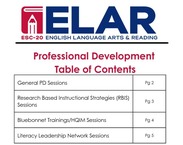
Check out the sessions we are currently offering. This link is live and will be updated frequently as more sessions are offered. |

Upcoming Literacy Holidays
 |
|
May 4-10 Children's Book Week: Serving as the longest-running national literacy initiative in the country, Children’s Book Week encourages young people to participate by attending events at schools, libraries, and bookstores. You can also celebrate at home by engaging with authors online.
https://everychildareader.net/cbw/faq/
|
May 4-8 Teacher Appreciation Week: During Teacher Appreciation Week, we proudly celebrate the incredible educators who inspire learning, foster growth, and make literacy come alive every day!
 |
|
Thank you for your engagement with the monthly Literacy Leader Network newsletter and your work on behalf of region's students.
For questions or assistance, please contact:
Linda Cavazos
Consultant, English Language Arts and Reading
linda.cavazos@esc20.net
|
|