|
Replies to this message are sent to an unmonitored mailbox.
To contact me, please click here: Rep.AnnaScharf@oregonlegislature.gov
Dear Friends,
Much has happened since my last newsletter, including the tragic assassination of Charlie Kirk. The positive impact this young man had on so many was evident by the masses that spoke up across our nation and around the world. I mournfully celebrated a life cut short, but pledged to carry his message forward. His message of courage, faith, family and country.
After watching his memorial and listening to Erika Kirk's inspiring message, I felt hopeful. For the first time in a long time, I am hopeful for our nation that people from different backgrounds will come together in a way long forgotten. As Charlie said, "Faith is the compass that keeps us steady, even in storms."
I know that we may not agree on everything politically, but I bet more than not, there is something we can find common ground on. As your State Representative, please know I am always open to have a conversation and I am willing to listen. I, like Charlie, believe in civic engagement, the power of the Constitution and the responsibility we all share in shaping the future of our state and our nation.
I hope you find this newsletter helpful, there is a lot going on locally and nationally, and it goes without saying, but thank you for your continued support.
Sincerely,
 Anna Scharf
State Representative - HD 23

GOVERNOR’S TAX AND SPEND PACKAGE PASSES

Even with overwhelming statewide opposition to the $4.3B tax hike, the Senate officially passed the transportation package on Monday, Sep. 29th.
Ironically, the bill passed one month from originally being introduced on the House side.
In case you missed it, the vote was delayed in the Senate due to lack of support. With Senator Gorsek (D-Troutdale) out for health reasons, the Senate Democrats did not have the required two-thirds vote to pass the transportation package. Senator Gorsek was cleared to attend the Senate Floor Session on Sep. 29th, finally providing the required votes to pass the bill.
|

It's a sad day when a transportation tax package is delayed during a Special Session for ONE VOTE. A session that was called by the Governor and in which she needed every last one of her members to attend and vote yes. A one-party tax package is a better way to look at it.
However, the most interesting part of the entire special session fiasco was the fact that Governor Kotek delayed the agency layoffs until Oct. 15th. So were the layoff’s even every necessary? In addition, the bill does not take effect until 91 days after adjournment of the Special Session, which puts it out to 2026.
Special sessions are meant to be used to deal with EMERGENCIES. If the situation was so dire, why was it OK to wait for weeks for one member? Why were ODOT employees given layoff notices but then told they were on hold? Why was the public told that roads would not be plowed this winter unless it passed? We could very well have feet of snow before it even goes into effect.
Mark my words, this will not be our only special session this year. With the funding cuts happening at the federal level, we could very well see the Legislature being called back in for another special session later this year.
|
51 NEW LAWS INTO EFFECT
 Click here to read about the new laws that recently went into effect.
FEDERAL GOVERNMENT SHUT DOWN UPDATE
The federal government "shut down" on Wednesday, September 30th, because the government ran out of appropriated money. This is also the end of the government's fiscal year.
One of the most important responsibilities the Constitution gives Congress is the “power of the purse.” That means deciding how taxpayer dollars are raised and spent. The government is supposed to be funded each year through the passage of 12 individual appropriations bills, passed before October 1st, the beginning of the federal fiscal year. If those 12 bills are not signed into law by September 30th, Congress and the President usually agree on a temporary spending bill, known as a “Continuing Resolution” (CR), which provides stopgap spending during a specified period of time. The CR was passed by the House during the end of September, but failed to pass in the Senate which led to the government shut down.
You may be wondering why the CR was not passed? What was the controversy?
Senate Democrats proposed a short-term (CR) that would introduce $1.5 trillion in new partisan spending. This was their only compromise to keep the government open and provide four weeks of funding. Their bill would have given free healthcare to illegal immigrants and able-bodied workers, reinstated funding for news sites like PBS and NPR, repealed Republicans’ proposed funding for rural hospitals, and permanently extended the Affordable Care Act, which is set to expire at the end of this year. Senate Republicans didn't agree to this proposal.
Government shutdowns are bad for our economy and a huge waste of money. One-third of government employees are not affected because they work for the U.S. Postal Service or other agencies with their own funding mechanisms. One-third of the workers will work without pay because they are essential to public safety (airport screeners, air traffic controllers, border protection workers, federal law enforcement, in-hospital medical care, the military, power grid maintenance staff and Veterans Administration caregivers). One-third won’t work during the shutdown (part-time workers and agency workforce).
In the meantime, Congressional House Republicans attempted to avert the shutdown and introduced a nonpartisan 24-page CR that was a clean, seven-week payroll resolution, that simply extends funding at current levels. Unfortunately, this did not pass as a CR requires 60 votes to pass in the Senate, so some Democratic votes were needed.
The Trump administration has a contingency plan for many of the federal agencies. You can find a list of plans here.
OREGON LOOKS TO SEPARATE FROM FEDERAL TAX CODE
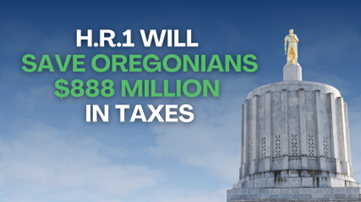
Democrats have been discussing severing Oregon’s tax code from the federal tax code after state economists predicted a major budget shortfall for the state following the passage of Trump’s Big Beautiful Bill, H.R.1.
What Oregonians might not realize is why the State is losing money because of H.R.1. No, it is not all about Medicaid and SNAP cuts like the media has been talking about. It is also about losing tax revenues because of cuts implemented with HR1.
However, the money that isn’t going to the government, will be staying in your pocket and that is good thing. H.R. 1 includes several tax cuts for working Oregonians. In fact, Oregon’s chief economist confirmed that the tax cuts in H.R. 1 will benefit working-class families the most.
Oregonians have overwhelmingly stated that they can barely afford to live in the state — families are struggling with the rising costs of housing, gas, groceries, utilities, and taxes. The new federal tax code will provide much-needed relief.
More than a third of the budget shortfall comes from Trump’s “No Tax on Tips” and “No Tax on Overtime” provisions. This money will stay with Oregonians who need it the most.
Additionally, H.R. 1 will help businesses stay in Oregon. Nearly 39,000 businesses have closed in the first few months of 2025, while approximately 74,000 businesses closed in 2024. Businesses have quoted tax incentives as the number one reason they move out of state.
However, should Democrats in Oregon push to separates from the federal tax code - we lose all these new benefits, and many more, from H.R. 1.
|
MORE INFO ON THE BIG BEAUTIFUL BILL
In addition to "No Tax on Tips" and "No Tax on Overtime", the bill invests in securing our borders, increases funding to the Department of Defense budget, allocates funding for Air Traffic Control upgrades, and provides new means of incentivizing removal of timber from our forests.
H.R. 1 prevents a scheduled 22% tax hike on millions of people. It raises the Child Tax Credit to $2,200. It strengthens the Paid Family and Medical Leave Tax Credit, and supports Made-in-America manufacturing. It also makes permanent the 20% Qualified Business Income deduction—and this is very significant for over 350,000 Oregon small businesses, including S-Corps, LLCs, and family-run partnerships. H.R. 1 will benefit 33.9 million seniors, about 4 million tipped workers, and roughly 97.7 million overtime workers.
For Oregon’s farmers and ranchers, this bill includes over $10 billion in tax cuts, continues disaster relief funding, strengthens crop insurance, and increases the wheat reference price from $5.50 to $6.35 per bushel. It will also help reduce wildfire risk and put Oregonians back to work in the woods by mandating a year-over-year increase in timber harvested from Forest Service and BLM lands. Harvesting trees rather than watching them burn.
The bill provides $175 billion for border enforcement including an additional 701 miles of physical wall and 900 miles of river barriers. It funds 3,000 new Border Patrol agents, 5,000 new customs officers, provides $150 billion to modernize our military and $12.5 billion to begin the overhaul of our air traffic control systems. All aimed at keeping Americans safe from drug trafficking across our boarders and while traveling our airways.
Media has been talking about the massive cuts in H.R. 1 to healthcare and nutrition assistance reforms, but here’s the truth: this bill protects Medicaid for those who it was meant to serve; seniors, individuals with disabilities, and low-income families. It is also important to note that H.R. 1 does not touch Medicare. Instead, it slows unchecked spending and begins the process of fixing loopholes that states have exploited for years. For example, Oregon is currently the only state that provides most adult Medicaid recipients with two years of continuous eligibility…UNCHECKED. As a result, even when people get jobs with access to employer-sponsored insurance, many stay on Medicaid.
Starting in 2027, the law will require that states conduct eligibility redeterminations twice annually for ACA expansion enrollees (Able-bodied Adults), replacing the patchwork of state schedules with a clear six-month standard. State programs will also be able to automate verifications using federal data, like Social Security numbers and death records, eliminating repetitive paperwork and catching cases of fraud. The bill invests $250 million in system upgrades to support these changes. Taken together, these reforms reduce administrative layers, speed benefit processing for those who are actually eligible, and give states the resources they need for efficient, accountable implementation.
For those impacted by Medicaid eligibility redeterminations, alternative coverage remains available through employer-sponsored plans, private insurance, or the subsidized ACA marketplace (Obama care).
The bill also takes long-overdue steps to restore integrity to the SNAP (Food Stamp) program. It establishes clear work requirements for Able-Bodied Adults Without Dependents (ABAWDs). It requires that if an individual wishes to be eligible for these benefits, they will need to work, volunteer, or attend school for at least 20 hours per week. It implements a state cost-share model to hold states accountable for states’ performance.
Oregon has been a low performing state, well below the national average for several years. In 2022, Oregon had one of the worst SNAP error rates in the nation, being responsible for nearly $250 million in overpayments. Under this bill, states with error rates above 6% will be required to contribute up to 20% in matching funds unless corrective action is taken. States that manage the program properly will not be penalized. This will force accountability and if a state performs poorly, then the state picks up the cost of the program, not people in other states who are working hard to be good stewards of the federal funding they are receiving.
This is not a complete summary of what’s in the bill, nor is it a detailed summary of the provisions in the bill. For further information, it is best to go online and review one or more of the many articles that have been posted.
THE OREGON SCORECARD
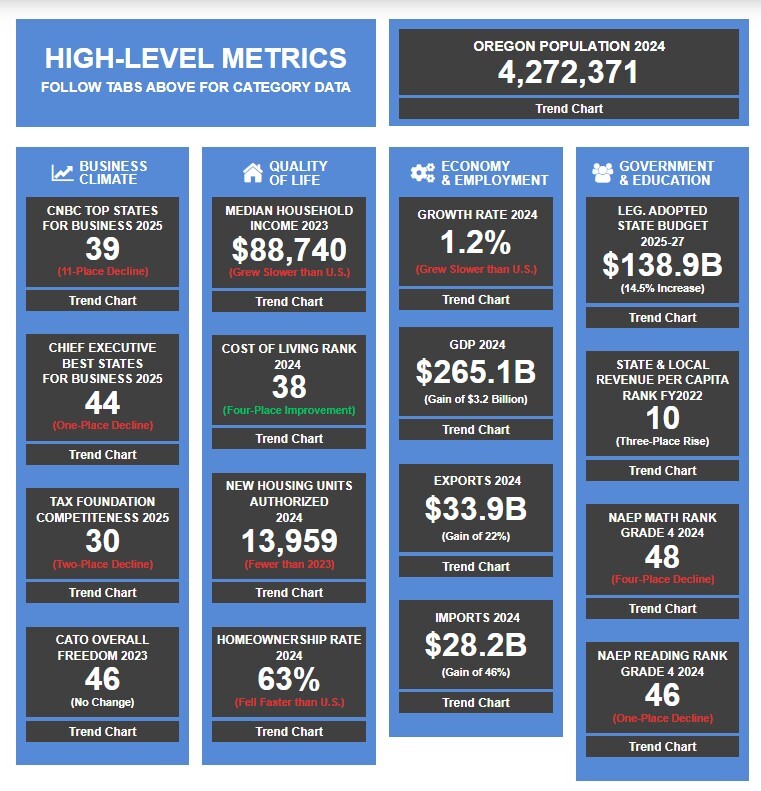
Please take a moment to click on the below link which is an Oregon scorecard - a collection of information that sheds light on Oregon’s overall economic health and relative competitiveness. This information was gathered by Oregon Business Industry and truly shows an accurate picture of where Oregon stands economically.

UPCOMING DISTRICT EVENT
DMV KNOWLEDGE TEST UPDATE

ONLINE CYBERSECURITY CLASSES AVAILABLE
 Register for a free cybersecurity webinar offered by Enterprise Information Services.
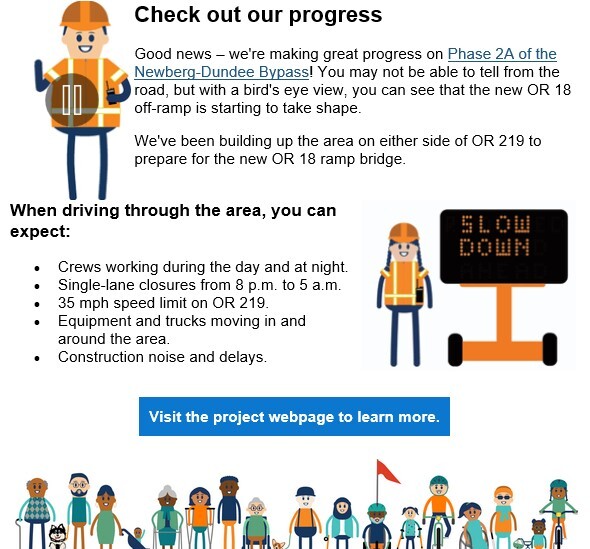
ODOT NEWBERG-DUNDEE BYPASS UPDATE
ARE Manufacturing, DCI, Climax, and Fernwood Grange Team Up on Blood Drive

Capitol Phone: 503-986-1423
Capitol Address: 900 Court St NE, H-387, Salem, OR 97301
Email: Rep.AnnaScharf@oregonlegislature.gov
Website: https://www.oregonlegislature.gov/scharf
| 

