|
Replies to this message are sent to an unmonitored mailbox.
To contact me, please click here: Sen.MichaelDembrow@oregonlegislature.gov
September 2, 2024
Dear Neighbors and Friends,
First of all, let me wish you and yours a very Happy Labor Day. Labor Day is of course a special moment to recognize and celebrate those who are performing jobs that are crucial but difficult. There are many people out there making sacrifices for the greater good, and Labor Day is one of many days that we should be recognizing them. They deserve fair wages, proper working conditions, and all our respect.
Second, this is a particularly special newsletter for me, as it marks my final month in office as a legislator after sixteen years in the House and Senate.
As I’ve mentioned before, I'll be leaving my position as an Oregon State Senator at the end of this month in order to make way for my successors to take office a little early and be better prepared to be effective in the 2025 session. I’ll say more about the details of that process in one of my final newsletters.
Staying on through the end of the month will allow me to complete my work on several task forces and work groups (here in Oregon and nationally) that I’m leading, participate in September Leg Days (more on that below), and meet the deadline for 2025 bill requests.
Then it’s off to Ashland for a few days of plays!
In this newsletter you’ll find details about this Saturday’s constituent coffee and the following Saturday’s Bike Town Hall. You’ll get the schedule and other information about September Leg Days as well as my (final) detailed summary of the most recent Revenue Forecast. You’ll also get the latest updates on Wildfire Season, Transportation Road Shows, FAFSA, and COVID, as well as a recent request from the City of Portland that the Legislature rescind or modify the state law on homeless camping. You’ll also find details of an interesting report on the factors causing educators to leave or remain in the profession. In my remaining newsletters I’ll be sharing more of the information about the educator workforce and education funding that we’re learning from a variety of sources right now and which will lead to legislative action in the future.
And finally, you'll also find links to some articles of interest, including to a very useful resource on the candidates campaigning for Portland Mayor and City Council under the brand-new system now underway.
Please do let me know if anything in this newsletter provokes any questions, concerns, or suggestions. All the best to you and your loved ones.
Next (and my Final) Constituent Coffee September 7
Saturday, September 7, is the first Saturday in September, and that means time for another constituent coffee.
Since the last one had to be virtual, for this one we’ll be back (with coffee and cookies) at the Hollywood Senior Center, 1820 NE 40th Avenue (from 9 am to 10:30 am).
This one will be my last one after all these years, since I’m stepping down at the end of September. Hard to believe.
We’ll again have a zoom option for the meeting to accommodate those who cannot be there in person. (Register for Zoom access here)
This will be an opportunity for me to share with you the implications of Oregon’s latest Revenue Forecast and share with you what’s in the works in the lead-up to September Legislative Days and preparation for the next session.
And of course I look forward to hearing your priorities and concerns, as well as your thoughts about what I should be focusing on during my final few weeks in office.
Hope to see you there!
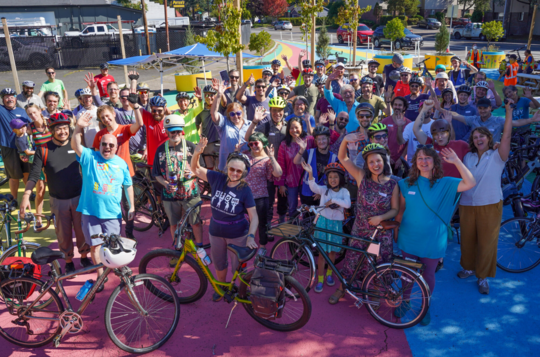 Coming Soon: BIKE TOWN HALL
It’s time for the Fifteenth (my very last as a legislator) SD 23 Bike Town Hall. It will be Saturday, September 14, 12:30-4:00 p.m.
All three SD 23 legislators (Reps Khanh Pham, Thuy Tran, and I) will be there, and I believe we’ll be joined by HD 46 Representative-elect Willy Chotzen for his first bike town hall.
This year’s bike town hall will cover neighborhoods in HD 45, the northern half of SD 23. It will feature a fun, social group bike ride starting in the Montavilla neihborhood. .As usual, we’ll be making a number stops to get a better sense of both the challenges and the successes occurring in those communities. Stops and speakers along the route will highlight education, climate, transportation, equity, and housing with a local emphasis at sites throughout our neighborhoods.
I’m proud that we’ve been able to arrange these bike town halls for 15 of the 16 years that I’ve been in office, as HD 45 representative and SD 23 senator (we had to skip 2020 because of COVID). It was the brainchild of one of my first staffers, Alex Berke, who saw it as a way for us to bring constituents together, take the traditional town hall outdoors, meet with community activists, and see first-hand what was going on in a chunk of the district. Together with my SD 23 colleagues at the time, Senator Jackie Dingfelder and Rep Ben Cannon (HD 46), we tried it, and it worked! And it has kept on working.
Hope you can join us for this one! You can RSVP here.

Coming End of September: Another Round of Legislative Days
During the interim period between sessions, legislators head to Salem for three or four days of committee and task force meetings every few months. In addition, Senators meet to confirm (or not) the Governor’s appointments to boards, commissions, and executive officers. And the Emergency Board and its subcommittees, which do the work of Joint Ways and Means, generally meet to make necessary interim appropriations. These days of convening have come to be known as “Leg Days.”
We have the next round of committee meetings coming September 23-25. The meeting schedule has recently been sent out to legislators. You can find the schedule here.
We’ll start seeing the agendas for the various committees show up on OLIS, the Oregon Legislative Information System, the week before Leg Days. My plan is once again (and for the last time) to set up and send out a consolidated list of and links to all those agendas the weekend before.
The end of that last week of September is another important date: it’s the deadline for legislators to submit drafting requests for any personal and committee bills that they may want to introduce and have available on the first day of the 2025 session. These are known as “Pre-Session-Filed Bills.” Needless to say, legislators are already at work on their bill requests for next year.
The Latest Revenue Forecast Is In: Good News for School Funding
On Wednesday the members of the House and Senate Revenue Committees received the latest quarterly Revenue Forecast from the economists at the Office of Economic Analysis (OEA). Though released at the end of August, it is technically known as the September 2024 forecast. It’s the result of analysis by Oregon’s State Economist and the members of his team, with input from a panel of national economists. It gives us both the big picture of how the U.S. and Oregon economies are doing now and a prognosis of what that suggests for the future. Similarly, it examines patterns in Oregon’s current tax collections and predicts what we can expect for future tax revenues. The September forecast is an important one because it includes data on the taxes paid on time in April, as well as many of those filing late.
The economists are now predicting a successful transition out of the post-pandemic inflationary boom, with the clear likelihood that the Federal Reserve will cut interest rates soon as a result of declines in inflation and a more stable labor market. Here’s how interim State Economist Josh Lehner put it in the OEA blog that also came out on Wednesday:
The [U.S.] economy has transitioned out of the inflationary economic boom and into what will hopefully become a sustained expansion. So far the Federal Reserve appears to be threading the needle. High interest rates were needed when inflation was running near double-digit rates, but no longer. The key will be when, and how quickly the Fed adjusts course. Expectations are interest rate cuts will begin next month. This should stabilize and revive rate-sensitive parts of the economy in the year ahead. The labor market is expected to improve as well following the past year where slower hiring has led to a rising unemployment rate, despite layoffs remaining low.
Similarly, the prediction now is that Oregon is likely to enter a healthy period of sustained economic expansion. Oregon’s economy in general is doing better than economists had expected a year ago. Tax revenues in the first year of the biennium are already far ahead of what the economists predicted in May 2023, when the current biennial budget was finalized. As Lehner put it in the blog:
Over the entire cycle to date, Oregon’s economic performance has been solid. . . .In recent months withholdings and job gains have picked up. The number of personal income tax returns filed and processed so far this year has increased. These data could be the first indication that Oregon’s patterns of growth have shifted out of the pandemic era lull, and back toward something more like the typical expansion.
In fact, the economists now see unexpected “green shoots of stronger gains” that lead them to be more optimistic than they have been in the past. As a result of the more positive economic prognosis and the higher rate of tax collections, they are now predicting that by the end of this biennium personal income tax revenues will be $869.7 million (4.1%) higher than they had assumed last year when the current biennial budget was built.
This is significant in its magnitude, but also because of its effect on Oregon’s kicker process. Remember that if revenues come in 2% or more higher than was projected in the June 2023 forecast, all the dollars that came in above that original projection must be returned to taxpayers in tax credits. As a result of this forecast, the kicker is now projected to be $987 million, paid out in 2026. This is lower than it has been recently but still a significant amount of money.
As Josh Lehner put it, “More revenues [than projected] today means more kicker tomorrow.”
Corporate profits, which fuel corporate income tax revenues, also continue to outperform the economists’ expectations, and the corporate kicker is again projected to kick. In the last forecast it was projected to kick to the tune of more than $500 million. In this latest forecast, that number has grown to $883 million (39% higher than originally projected). The good news is that those dollars are constitutionally required to go to support K-12 education next biennium. Our school districts will definitely benefit from this added support. I’ll discuss that in greater detail elsewhere.
Lehner indicated that he and his colleagues are trying to determine whether the increased personal and corporate income tax revenues are due to the fact that collections are truly booming or whether their earlier projections were too conservative. He believes that it’s both, but more the latter—that their earlier projections were too low. [This despite the fact that they had changed their methodology after the last huge kicker and thought they were already being less conservative in their outlook.]
We’ll see if this realization leads to a higher revenue forecast next June—when the next biennial budget is finalized--or if the forecast is again overly cautious and we remain locked into another kicker cycle. A less cautious forecast will mean more money available to be budgeted for investments in Oregon’s priority needs, but of course it runs the risk of insufficient funds if the economy goes into a downturn.
It's not easy being a State Economist in Oregon, thanks to our crazy kicker law (which is locked into the Constitution), with its tiny 2% window
Here are some of the details of what we heard on Wednesday:
- From an economic standpoint we’re doing about as well as you could hope for as we’re transitioning out of the post-pandemic inflationary boom.
- Inflation is now down to the 2.5%-3% range, close to the Federal Reserve goal.
- The labor market is cooling, as a result of slower hiring, perhaps more so than the Fed would like.
- Assuming that the Fed cuts interest rates, that will help rate-sensitive sectors like housing and construction and lead to more hiring there.
- Although the RATE of inflation is going down, that doesn’t mean that prices are going down in many areas. Retailers are still able to take advantage of consumers’ willingness to pay.
- We’re seeing more layoffs in Oregon right now than in the nation as a whole, particularly in higher-paid jobs and in three areas core to Oregon’s economy: semiconductors, shoe/fashion apparel, and timber. The first is largely due to restructuring by a single employer (Intel, which accounts for half of the employment in this sector). Timber layoffs are part of a multi-generational trend.
- Despite the recent layoffs, electronics employment has been relatively stable during the 20 years since the Dot-com recession of the early 2000s.
- Big investments in semiconductors are coming as a result of the Federal CHIPS Act. So the economists are expecting growth in this sector in the years ahead. They also see potential for future growth in footwear/apparel.
- The recent downward revision of last year's job numbers for the nation as a whole was not true for a few states, and Oregon is one of them. The revision actually pushed Oregon’s numbers higher.
- Oregon is among the upper tier of states (#15) for productivity, one of the lowest in birth rate.
- The growth that we’re seeing in Oregon is despite the slowdown in our population growth (which has largely been responsible for our economic growth in the past). If we see an increase in Oregon’s population, the projected growth in our economy will be even greater.
- Corporate profits, especially for large multinationals, are at or near record highs, which in part has led to the big increase in corporate income tax revenues. It’s also partly due to increased collections from corporations, which are a little better here in Oregon than in the nation as a whole.
- They expect corporate profits to come down as prices inevitably become more competitive [assuming that there is true competition].
- Whereas in the past Oregon’s economy has been especially volatile relative to other states, with roller-coaster cycles of booms and busts, we now seem much more stable, more in line with the national average.
- Our Other Funds (Lottery Funds, Corporate Activities Tax, and Marijuana Tax) are all projected to be fairly stable, though Marijuana revenues are projected to go down as a result of over-supply and consequent price reductions.
- As it has ever since reacting to the Great Recession, the Legislature continues to steadily build up its reserves in case of another unanticipated shock to the economy: by the end of June 2025 our Education Stability Fund will be $1.007 billion, our Rainy Day Fund $1.899 billion, and our ending fund balance $1.841 billion, for a total in reserve of $4.747, or 17.6% of general funds—among the best in the nation.
And here are some links for you to pursue if you want to dig into the forecast:
What’s Causing Educators to Leave or to Stay?
On March 20 members of the Joint Taskforce on Statewide Educator Salary Schedules heard about teacher recruitment and retention from Dr. Emily Penner of UC-Irvine, based on research findings from a study that she and colleagues did on a large California school district. We were not surprisingly interested to see if those findings would largely be true of Oregon as well, and how its findings extended to non-teaching educator staff.
Fortunately for us, the Oregon Department of Education and its Educator Advancement Council commissioned Dr. Penner to take a closer look at the situation in Oregon. We just received that new study, which you'll find here.
Here are the highlights, most of which echoes what we’ve been hearing from other experts and from educators themselves.
- The highest turnover rates are among classified staff, followed by administrators, and then teachers.
- The highest turnover rates among both classified staff and teachers are among those in Special Education.
- Turnover among teachers is highest among those new to the profession, with nearly 1/3 of new teachers leaving the profession after their first year.
- With respect to ethnicity, white teachers have the lowest turnover rates and black teachers have the highest.
- Oregon has made substantial progress in diversifying the entering teacher workforce. From 2012 to 2022, the proportion of teachers of color among new entrants more than doubled, increasing from 9% to 21.4%. [For more on this, see this recent story from KOIN.] We are doing as well or better than high-performing states like Maryland, Massachusetts, and Washington.
- However, as noted above, retention of these new teachers of color remains a challenge in Oregon.
- Interestingly, Hispanic/Latino teachers have the lowest turnover rates of all new teachers.
- Newer teachers tend to be working at lower-performing schools, while master teachers are working at higher-performing schools. Entering teachers are disproportionately placed into schools where students may most be in need of additional support but, at the same time, have fewer experienced colleagues who might serve as mentors. (This is not unique to Oregon.)
- For most teachers, leaving the profession does not result in higher earnings. This is especially the case for more experience teachers (i.e., those higher on the salary schedule due to experience). Newer teachers are more likely to see pay increases after leaving, and a need for more income may be driving their decision to leave.
- The study’s evidence suggests that if there are efforts to increase teacher pay, these efforts might be particularly effective for two groups Oregon might hope to influence most: early-career teachers and special education teachers.
- Switching to a four-day schedule may in fact hurt retention efforts.
- Mentoring programs for new teachers can substantially improve retention, especially for new teachers of color.
The Task Force is currently finalizing specific recommendations to address a number of these findings, many of which will ultimately be introduced as legislative concepts for the next session.
The Task Force report and recommendations will be released mid-September and presented to the Education committees during Leg Days.
Wildfire Season: Fingers Crossed for the Next Few Weeks
Legislators haven’t had a wildfire briefing for a couple of weeks now, and that’s good news. The rains and relatively cooler weather experienced in much of Oregon in recent weeks were truly a blessing, given the devastation that we’ve experienced this summer. It allowed firefighters to complete their containment of the megafires and prevented new fires from spreading. It also allowed many firefighters to take a well-deserved break.
There’s plenty of reason for optimism that the worst is behind us, but there’s also cause for caution: we know that September is when winds traditionally blow from the East, and lightning-strikes and human-caused events due to complacency can wreak havoc on areas of high population. We need look no farther back than the Labor Day fires of 2020 for examples of devastation. So we need to remain careful.
Here's a story from OPB and one from the Capital Chronicle that explore the duality of where we are right now.
Looking back on the fire season at this point, we can see that in some ways it has been unusual. The total number of acres burned has been record-setting, but thanks to the location of the fires and hard work by dedicated professional and volunteer firefighters the overall toll on homes and human lives has been lower than is too often the case (32 homes and only one lost life—the pilot whose plane went down during a firefighting operation). Still, the cost of fighting these fires has been high (the Legislature’s Emergency Board will need to spend most of its available funds paying for these operations).
And the economic impact on Eastern Oregon, and particularly its ranchers, has been devastating. The bulk of the wildfires this time have burned through Eastern Oregon grass and shrub, with only about 25% of it in forestland, according to the Wildland Mapping Institute. More than one-third of all acres burned have been on private land, and about 62% has been on federal land. This is where cattle graze (either on private ranches or on federal leases), and the overall loss of cattle lives is still unknown. With those losses, and with so many acres now blackened and devoid of the grasses on which their cattle can feed, many ranchers are facing economic ruin. We won’t know the extent of these losses for a while yet.
For an up-close sense of the challenges faced by Oregon ranchers right now, I’d recommend this NPR story from a few days ago.
Governor Kotek has reached out to the federal government for relief on their behalf. Here's a story about that.
And once again, here are some wildfire resources for you to follow:
You can follow the fire season here in Oregon in the ODF Wildfire Blog and the Oregon State Fire Marshal Blog.. For news about Oregon AND the entire Pacific Northwest, check out the Northwest Interagency Coordination Center blog, All three are updated each day.
Oregon Wildfire Response and Recovery also maintains a site that tracks evacuation orders in the state, providing daily numbers of those under Level 1, 2, and 3 orders.
Even when there is not a wildfire nearby, your region may be experiencing smoky conditions. You can track those conditions at Oregon Smoke.
Upcoming Transportation Sessions
The Joint Transportation Committee is continuing its “Road Show,” visiting locations around the state for first-hand briefings on transportation project needs and meeting with local folks to hear their priorities. Members of the Joint Committee on Transportation, along with other local legislators, are there to take testimony (in person and in writing) during those sessions. This is all in preparation for the 2025 legislative session’s deliberations over transportation funding as the current program is set to expire.
Here's a PowerPoint presentation from ODOT Director Kris Strickler that was delivered at the last stop (in Hermiston) that lays out the challenges we’re facing.
Seven more sessions are coming up over the next two months, six in-person and one a virtual session coinciding with Legislative Days at the end of September.
Here are the remaining dates:
- Bend - Thursday, September 12
- The Dalles - Friday, September 13
- Happy Valley - Thursday, September 26
- Hillsboro - Friday, September 27
Here’s the link to the Joint Committee's website. If you’re interested in reading some of the written testimony that has come in, go to the individual meeting dates and click on “Meeting Materials.”
The Latest on FAFSA
With many colleges and universities about to begin their 2024-25 academic year, the travails of this year’s “Better FAFSA” (Free Application for Federal Student Aid) appear to be behind us. Here in Oregon we were able to reach near-normal rates of applications by the end, after much delay. However, the full extent of the delayed roll-out on enrollment has yet to be fully understood.
In the meantime, believe it or not, it is just about time for next year’s process to begin. Normally, the FAFSA for the 2025-2026 academic year would become available on October 1.
But will it be ready in time?
Worried that there hasn’t been enough time for all the bugs in the new version to be worked out—given that work on the last FAFSA only ended two months ago—higher education leaders and student financial aid advocates asked the Department of Education to hold off on releasing the new FAFSA until December 1 to give them time to review and provide input on the new form (a process that would normally have begun in the spring). After some hesitation, the Department has agreed—sort of.
The Department announced a few days ago that it will release the 2025–26 FAFSA on Oct. 1 as planned, but only for a limited number of students and institutions, who will test the system and provide feedback. Based on that feedback, it will slowly open up the application to more participants and then make it available to all (approximately 17 million students) by Dec. 1.
Here's a news release rom the U.S. Department of Education with details of the plan. And you can read more about it in this article from Inside Higher Education.
This does seem like a sensible way to make sure that last year’s frustrations are avoided and get the process back on schedule. We’ll see how it works out.
On the COVID Front: Summer Surge and the New Vaccine
I’m sure that you won’t be surprised to learn that Oregon is awash in COVID right now. Wastewater reporter shows very high levels of COVID virus here right now. (You can track COVID wastewater levels here.) Most of us know people (or are those people) whose plans have been disrupted by the fever, fatigue, and sore throat that lead to a positive test result. Fortunately, this new COVID variant—though highly contagious—is not as virulent as earlier forms of the virus. Still, hospitalizations and deaths—though nothing like pandemic levels—are higher than they’ve been recently.
The big news, of course, is that new versions of the Pfizer and Moderna vaccines—focusing on the newer variant—has been approved for distribution by the FDA and CDC and should be available in Oregon this week if it hasn’t already been by the time you receive this newsletter. Older Oregonians will be encouraged to get vaccinated within the next month or so, along with the flu vaccine.
Here are a bunch of links to recent COVID-related articles:
- Here’s an article from MedPage Today on the FDA's initial approval of the new vaccine.
- And the CDC'S.
- OPB and the AP report on the impending availability of the vaccine in Oregon.
- The Kaiser Family Foundation (KFF) asks the question, “Should you rush to get the vaccine now or wait until we’re closer to the usual winter surge?”
- Unfortunately, too many of those who certainly need to be vaccinated—those older Americans living in congregate care—are not getting them. Here’s more. Here's more. [You may need a New York Times subscription to access this.]
- As reported by OPB, this has led the Oregon Health Authority to encourage us to be particularly cautious here in Oregon.
- The Capital Chronicle discusses the current COVID summer surge.
- And a New York Times piece on what to do if you fall victim to the current variant. [You may need a Times subscription to access this one.]
- On the positive side, the virus has become less virulent, particularly for those who’ve been vaccinated. We’ve just learned that COVID has dropped to be the tenth leading cause of death in the U.S.
- And many now consider it to be “endemic.” Here's an article from NPR explaining what that means.
- As COVID moves from being a “pandemic” to being “endemic,” many are taking a more lackadaisical approach. This can be dangerous for those in contact with vulnerable individuals, particularly those who have not been vaccinated. Here's a story from the New York Times. [Accessing this story may require a Times subscription.]
- For more perspective on where we are right now with the disease, here's an interview with a group of epidemiologists who are experts in this question.
- This interview with the director of OHSU’s Long COVID program provides a useful summary of what we now know about Long COVID.
- One of the sad consequences of the pandemic has been lingering disinformation around vaccines in general and an increased tendency among parents to request non-medical exemptions for their children from the vaccinations required for school. Here's an article from Axios. which shows where each of the states ranks in the number of exemption requests. (You’ll see that Oregon, which has always been higher than average, is now #2 after Idaho.)
- And finally, for those of you interested in more of what Dr. Anthony Fauci has to say about his relationship with former President Trump, Here's video and a transcript of a recent interview.
Portland Asks Legislature to Rescind or Clarify State Law on Homelessness
A couple of weeks ago, legislators received a letter from Mayor Wheeler and the Portland City Council requesting legislators to rescind HB 3115 (2021), the measure that requires cities to treat homeless campers in a manner that takes the needs of the homeless into account and is “objectively reasonable as to time, place and manner with regards to persons experiencing homelessness.” They argue that the recent Supreme Court ruling (Johnson v. City of Grants Pass) allows cities everywhere except in Oregon the ability to use their own discretion in how they treat homeless campers. They want Portland to have this same ability. Absent a full repeal, they ask that we provide clear definitions of what is meant by “objectively reasonable” and frees Portland from having to pay legal fees if they lose a lawsuit challenging their ordinance.
I discussed the Supreme Court ruling in my July 5 newsletter, pointing out that the ruling was focused on the constitutionality of the Grants Pass ordinance that effectively prohibited public camping in that city, even though there was nowhere else for the unhoused to go. The ruling in no way abrogated the rights of state legislatures to prohibit cities from passing unreasonable ordinances that did not consider the needs of the homeless. In fact, as I mentioned, Justice Gorsuch specifically called out HB 3115 as an example of what states could do. (HB 3115 was not itself relevant to the case before the Supreme Court, as it was passed after the legal journey of Johnson v. City of Grants Pass had begun.)
I understand the Council’s desire to have as much latitude as it wants in creating policy around homeless camping. I understand their desire to discourage potential lawsuits by removing their responsibility to pay plaintiff legal fees even if they lose. I understand and appreciate their commitment to doing the right thing and belief that they will do the right thing. I suspect that every city would say the same. It’s a predictable response.
But I stand by the basic purposes of HB 3115 and its insistence that the needs of the homeless must be considered along with other needs. I’ll remind everyone that 3115 was the product of a long work group process that included the cities, designed in part to protect cities from arbitrary lawsuits and from having to pay monetary damages. There was a desire at the time to keep the requirements loose (i.e., “objectively reasonable”) to provide cities with more flexibility.
On the other hand, if there’s a desire for more clarity as to what constitutes “objectively reasonable as to time, place, and manner with regards to persons experiencing homelessness,” that is definitely something that the Legislature can work on during the 2025 session. As I mentioned in the July 5th newsletter, “If the cities and counties now feel that they need more specificity in state statute around what is meant by “objectively reasonable as to time, place and manner with regards to persons experiencing homelessness,” then they can of course propose changes for the next legislative session. But so far HB 3115 appears to be working.”
(They’ll just need to do it without me!)
Additional Links of Interest
- This past week marked a monumental moment in salmon restoration here in the Northwest, as the last of the Klamath Basin dams was removed, allowing salmon to swim freely upstream for the first time in a century. Here's reporting from OPB.
- Grant High School students will be required to give up their cell phones this year and keep them stored in pouches during the day. OPB’s Natalie Pate entered SD 23 to interview students about how they were feeling about this decision. Here's what she heard.
- Who’s suffering most from student debt? Here's reporting on a new study by the Urban Institute that digs into this question. You may or may not be surprised to learn that it’s not just Gen-Z and Millennials: 6 percent of older adults—or 7.2 million Americans—have yet to pay off their student loans. And too many are behind on their payments.
- Even as the subject of decriminalization of small amounts of hard drugs remains controversial, physicians continue to believe that addiction should be treated as a medical condition. That position was confirmed at the recent national meeting of the American Medical Association.
- Now that the filing deadline for Portland’s Mayor and City Council races has closed, it’s time for us to familiarize ourselves with the candidates. As has always been the case, the races attract many candidates who will never obtain more than a handful of votes. That’s even more true of the reconfigured City Council structure. But of the 18 candidates for Mayor and 86 candidates for the 12 City Council positions, there are already clear frontrunners. For an in-depth look at the candidate patterns, here’s a very helpful overview from Rose City Reform, overview from Rose City Reform, whose candidate tracker you’ll also find useful as the race progresses.
Until next time,
 Senator Michael Dembrow
District 23
email: Sen.MichaelDembrow@oregonlegislature.gov
web: www.senatordembrow.com
mail: 900 Court St NE, S-407, Salem, OR, 97301
| 

