|
July 5, 2024
Dear Neighbors and Friends,
Happy Independence Day to you all! I hope that you, your friends, neighbors, and loved ones were able to take advantage of this lovely weather, before it got too hot, and enjoy a bit of rest, relaxation, and celebration.
As we are now beginning to experience record heat once again, it’s a good time to review the best medical advice for coping with high heat, as well as the resources that are available locally. To help with that, I recommend that you take a look at the excellent information that my friend and colleague, Representative (and MD) Lisa Reynolds and her team have just provided in her newsletter. Thanks, Lisa et. al. And here’s the latest on resources in Multnomah County. cooling resources in Multnomah County.
In today’s newsletter, I first of all want to remind you about tomorrow’s constituent coffee and to catch you up on some of the work that’s occurring around school funding and spending here in Oregon and around the country. I also have the latest on the troubled (but improving) rollout of the FAFSA, the Transportation road shows, the recent Eastern Oregon Economic Summit and a trip that I took to prisons in that area, and a bunch of other links to resources, including to the latest COVID news. You’ll also find info on fire season, along with my thoughts on the Supreme Court’s recent homelessness decision.
At the end of the newsletter you’ll find a couple of photos from a farewell party that former and current staffers put on for me. It brought together a large number of people I’ve known and worked with in my legislative world. I was dreading it, but it actually was quite bearable—very moving, actually. I continue to owe so much to my staffers over the years, such a talented, smart, big-hearted bunch of people. Needless to say, I’m spending a lot of time these days looking back, even as I’m trying to get things wrapped up for the impending handoff.
Until the next newsletter, please stay healthy and safe, and do let me know if you have any questions about anything in this newsletter.
Next Constituent Coffee This Coming Saturday!
This coming Saturday, July 6, is the first Saturday in July, and that means time for another constituent coffee.
This being an odd-numbered month, this one will be entirely by zoom. Register for Zoom access here.
I look forward to bringing you up to speed on the work groups and task forces (state and national) that I’m involved with. I’ll also be happy to share my sense of the potential impacts of the recent Supreme Court decisions for us in Oregon. And of course I look forward to hearing your priorities and concerns, as well as your thoughts about what I should be focusing on during my final months in office.
Hope to see you there!
All Things K-12 Funding/Spending: CSL, QEM, Educator Salaries
I’ve just returned from a National Conference of State Legislatures series of meetings on a variety of pressing education issues. It brought together Chairs of Education policy and budget committees (K-12, Higher Education, or as in my case both) from around the country. It became clear that when it comes to education budgets, we’re all wrestling with the same challenges, which are leading to staff reductions in most states. There are three primary reasons that states are having difficulties right now with K-12 funding:
-
The ESSER Fiscal Cliff: During the pandemic school districts received millions of dollars in pandemic relief (ESSER) funds to help them improve their schools’ ventilation systems, provide mental health and behavior supports, minimize learning loss, and create innovative summer learning programs. Those funds must be spent within the next few months. Districts will generally be unable to continue funding those positions, even where they’ve proven their worth. If they do want to continue them, they’ll need to eliminate other positions.
-
Even though the Rate of Inflation Is Going Down, the Legacy of Record Inflation Continues to be a Problem: As is true for all employees, the 2-3% COLA increases that were the norm for decades have translated into serious losses of purchasing power for educators. They need and are demanding higher wage increases to catch up, which is leading to staff reductions in order to help pay for them. Similarly, inflation and supply-chain problems are causing non-personnel costs to go up as well. These extraordinary increases appear to be lessening, which bodes well for the future, but for now these are difficult problems for school districts everywhere.
-
Public School Enrollment Is Declining in Most Regions: Demographers have known for some time (and before COVID) that declining birth rates are causing and will continue to cause K-12 enrollments to decline. The COVID experience accelerated this trend further, causing more families to choose home-schooling or private schools. The problem with that is that our funding model is based on per-student appropriations. Every student that a district loses means a loss of revenue. This is a particular problem for small rural districts. In many cases a reduction in funding just a few students can have a great impact on a district. This is causing some states to begin to rethink the basic per-student funding models that they’ve been relying on for years.
Aside from these three, which are leading to cutbacks nearly everywhere, we’re also seeing an additional complicating factor:
-
The Social-Emotional Challenges that Are the Legacy of the Pandemic (for both students and teachers): Students continue to be marked by the COVID experience, including those in states that returned to in-person instruction relatively quickly. As a result, educators are having great difficulty getting their students to focus, pay attention, and behave. They are feeling a need for MORE teachers and instructional assistants, smaller class sizes and counselor case loads, more supports of various kinds. Instead, for the reasons outlined above, they are seeing the reverse as the result of funding losses.
State budgets are also hurting right now for the same reason that school budgets are: they too enjoyed added support from the federal government during COVID. The loss of those dollars is creating challenges for state budgets everywhere.
Unlike the federal government, the states are constitutionally required to balance their budgets. That’s why here in Oregon the legislative practice is to require that any positions created with one-time dollars (including short-term federal grants) must be “limited duration” positions, i.e., temporary. When the next biennial budget is created, these limited duration positions are removed from the “current service level” (the amount needed to continue current operations). If there is no added grant funding to continue them, they go away. As a result, it’s hard for state legislatures to come up with the additional dollars needed to increase school appropriations.
As a result of all these stresses, many states are looking closely at their school funding and spending models in search of better, more realistic ways to create adequacy and stability. Oregon is no exception. Bills that we passed in 2023 and in 2024 have created the framework for this analysis and discussion, and the Governor’s office has been closely involved in this work. As have I in my final months in office.
I’d like to provide a brief status report on three of the topics of engagement: Current Service Level, Quality Education Model, and Educator Workforce.
An Increased Current Service Level (CSL)
Believe it or not, state agencies are already close to completing their final budget requests for the next biennium (2025-27), a process that will be completed a year from now. These will be winnowed, modified, and generally cut back in a series of decisions leading up to the release of the comprehensive Governor’s Recommended Budget early in December. The GRB will then become the basis for changes made by the Legislature in the first half of 2025, leading up to the LAB, the Legislatively Approved (and then Adopted) Budget.
The first step of the process each biennium is for the Department of Administrative Services (DAS) to calculate the “Current Service Level,” i.e., what it would cost to continue to operate the same programs with the same people (including their longevity salary increases) for the following biennium. An inflation factor is then added to that amount, and the result is the CSL.
The way that CSL is determined for schools is roughly the same, though there are differences. One of the most noteworthy is that school districts all negotiate salaries and benefits with their employees separately, as they do their purchases and other contracted services, so it’s difficult for the state to anticipate (and control) their true costs when calculating CSL. As a result, there have been ongoing disputes between DAS and the Legislative Fiscal Office on the one hand, and school districts and advocates on the other. Much of the legislative session is spent battling over what is the “real” CSL, as well as how much that CSL needs to be increased.
I and my House counterpart (House Education Chair Courtney Neron), along with many education advocates, have been advocating for an improved process for some time, and I’m pleased to report that the Governor took these concerns seriously and asked her staff and the agencies to work directly with advocates to resolve them.
The results of those discussions were reported to the Education chairs last week, and those results are both encouraging and daunting. As a result of agreed-upon changes to the CSL calculation methodology, next biennium’s CSL will be $515 million higher than originally calculated. This increase will presumably be reflected in the Governor’s Recommended Budget coming in December. That’s good news for schools. What the Governor will need to cut in order to find this additional half-billion dollars is an open question, however.
Quality Education Model
While it’s good news that the State and the school districts are coming to agreement on the CSL, that’s really just the first step. Yes, it’s important to accurately identify what it would take to continue what is currently being offered, but that may not be what we SHOULD be offering and spending. That’s where the “Quality Education Model” comes in. The QEM is intended to reflect how much of an appropriation it would take to offer a quality education in Oregon, as determined by the Governor-appointed Quality Education Commission. The Legislature was getting very close to reaching that goal, especially with the passage of the Corporate Activities Tax and the Student Success Act, but then the pandemic set things back.
In any case, everyone agrees that the QEM is an outdated model that doesn’t accurately reflect student needs and district spending. So, as part of the Education Omnibus bill this past session, we included funding for a deep-dive analysis of the QEM, preparing the Legislature for substantial changes to the model in the next session. Here’s what is required:
SECTION 12.
(1) The Legislative Policy and Research Director shall conduct a study of:
(a) The Quality Education Model; and
(b) The state’s system of financing public education from kindergarten through grade 12.
(2) The study conducted under this section must include at least:
(a) A review of the education funding formula for public education for kindergarten through grade 12 in this state and an exploration of options that would provide a uniform and equitable design for financing the cost of an adequate education for all public school students in kindergarten through grade 12 in this state.
(b) A review and evaluation of the Quality Education Model, including the processes used to:
(A) Determine the best practices included in the model;
(B) Estimate school district operating expenses for purposes of the model;
(C) Select quality indicators for the model; and
(D) Accurately calculate the cost of a quality education for all students of this state.
(c) The identification of trends and disparities since the 2019-2020 school year in student performance across the state in kindergarten through grade 12 based on current school funding.
(d) The establishment of the baseline for the costs, programs, staffing and facilities needed to provide the opportunity for an adequate education.
(e) A review of the costs and existing funding for special education and related services and an exploration of possible alternative funding formulas.
I’m pleased to report that the Legislative Policy and Research Office has just awarded the contract to do this analysis to a highly-respected research firm, the American Institutes for Research (AIR). AIR will be starting this work soon, with a completion date targeted for the end of this calendar year.
I can’t overstate the importance of our need for clear, objective data and metrics when it comes to determining how much is needed and how to ensure that the funds are being spent in ways that lead to student success in all parts of the state. This QEM work will help.
Educator Workforce
As part of the 2023 Education Workforce Omnibus bill, the Task Force on Statewide Educator Salary Schedules was created. Chaired by Rep Neron and me, it has spent the last nine months looking at a variety of challenges and ways to improve the recruitment and retention of our educator workforce (again, something that nearly all states are wrestling with right now). We’re not just talking classroom teachers here, but also the counselors, librarians, therapists, classified workers, and administrators. We have amassed a wealth of useful materials and testimony over these months. You can find them at the Task Force web page.
We’ve explored ways to create more uniform statewide salary schedules for educators, ways to create more uniform job descriptions for classified workers, ways to create ways to raise the salaries for new teachers, ways to better support student teachers, even the possibility of statewide collective bargaining, as exists for state workers, and a number of other potential improvements.
The Task Force is now in the process of synthesizing its findings and creating recommendations. These will be presented to the Legislature in September, in time to incorporate any recommendations into 2025 Legislative bill requests.
I can't say that we're all on the same page on every issue. However, at its last meeting on Monday, the Task Force voted unanimously to approve a set of “Values, Findings, and Goals,” based on this work. The next step is for the group to agree on a set of specific recommendations in pursuit of these goals. You can check out the Values, Findings, and Goals document here. If you have any suggestions for specific recommendations, please send them my way.
In our last meeting we also received a very interesting report on the "Supply and Demand of Oregon Educators" from the Oregon Longitudinal Collaborative, a research wing of the Higher Education Coordinating Commission that has access to a wealth of Oregon and national data related to licensed educators. I’d encourage you to look at all their slides, but here are their major findings:
- Oregon’s Educator Preparation Programs (EPPs) are not graduating as many educators per capita as national medians.
- Oregon has higher student to teacher ratios across all levels of K-12 compared to national medians, and regional states.
- Nationally, Oregon average teacher salaries and new teacher salaries are competitive.
- New Oregon teacher salaries are less competitive than regional states.
- Oregon utilizes more inclusion time for SPED students than other states.
- Oregon high school graduates often enroll in Educator Preparation Programs (EPPs) within the same region as their high school.
- Roughly two thirds of Oregon’s Public EPP graduates come from Oregon high schools.
- Over 85% of Oregon Public EPP graduates remain and work in Oregon. Washington’s public K-12 system attracts roughly one third of those that leave.
- The majority of EPP graduates that later work in Oregon remain in the same region of Oregon as their program.
- Historically the majority of new teachers employed come from Oregon EPPs. Oregon also attracts new and experienced teachers from other states.
- Oregon’s projected teacher job openings are primarily replacement openings.
- Oregon has a measurable unmet need for more teachers.
- New teachers in a third of Oregon counties could not afford to rent an average cost 2- bedroom apartment.
- Expanding the supply of teachers would require more qualified students looking to enter programs. Oregon EPPs currently accept 90-100% of qualified applicants.
- Oregon’s unmet need for educators, as represented by higher student teacher ratios, is likely due to limits on resources to hire more educators.
The Supreme Court’s Grants Pass Homeless Ruling: Not Much Will Change—Here in Oregon at Least
In one of its blockbuster rulings this past week, the U.S. Supreme Court ruled in City of Grants Pass v. Johnson, ruling that homeless individuals do not have constitutional protections from punishment for camping in public places when they have no viable alternatives, based on the Eighth Amendment’s prohibitions against cruel and unusual punishment.
Here is the Supreme Court Ruling opinion by Justice Neil Gorsuch.
I disagree with this ruling. Gorsuch’s opinion is primarily based on review and relevance of earlier cases that relied on the Eighth Amendment; I’m not a constitutional lawyer, and I’m not going to weigh in on that. However, I do believe that it is the responsibility of municipalities to provide reasonable shelter or places to camp for people who have none, and until they do, it is cruel and unjust for the municipality to punish them for sheltering themselves. It is cruel and unjust of cities to pass laws whose intention is to force homeless residents to leave and become another city’s problem—which was precisely the stated original rationale for the City of Grants Pass’s prohibition ordinance.
Here is the original ruling in Blake v. City of Grants Pass, which I believe is the correct one.
Having said that, of course, the Supreme Court’s ruling is now the law of the land. But what exactly does it mean for us here in Oregon? Ironically, despite the fact that Grants Pass is of course an Oregon city, not much. That’s because the Oregon Legislature passed legislation in 2021 that applies in this situation and that continues to make the Grants Pass ordinance unacceptable.
Justice Gorsuch himself makes reference to this law in his opinion: States and cities are free as well to add additional substantive protections. Since this litigation began, for example, Oregon itself has adopted a law specifically addressing how far its municipalities may go in regulating public camping. See, e.g., Ore. Rev. Stat. §195.530(2) (2023). For that matter, nothing in today’s decision prevents States, cities, and counties from going a step further and declining to criminalize public camping altogether.
The law in question is HB 3115 (2021). It was the product of a bipartisan work group put together by then-Speaker Tina Kotek that included local governments and legal experts. It was an attempt to bring some order and predictability into the way that cities around the state were responding to the burgeoning homeless crisis in light of recent court cases (especially the Ninth Circuit’s 2018 Martin v. Boise decision and the Grants Pass case itself).
Its central requirement was actually quite simple, and I think it’s something that most Oregonians would continue to agree with: Any city or county law that regulates the acts of sitting, lying, sleeping or keeping warm and dry outdoors on public property that is open to the public must be objectively reasonable as to time, place and manner with regards to persons experiencing homelessness. It goes on to define “reasonable” as follows: For purposes of subsections (2) and (3) of this section, reasonableness shall be determined based on the totality of the circumstances, including, but not limited to, the impact of the law on persons experiencing homelessness.
In other words, the city or county can’t act arbitrarily to exclude homeless individuals without taking their needs into consideration. To be homeless is not in and of itself criminal conduct. The legislation deliberately refrained from being more specific than that, leaving the details up to individual cities and counties and providing them protection from frivolous lawsuits.
I was proud at the time to sponsor the bill and to carry it on the Senate floor. I continue to feel that way.
There are some who are now saying that the Supreme Court is telling us that we should reverse HB 3115 and allow Oregon cities free rein to act without any consideration of the needs of the unhoused. I think you can see from the section of Justice Gorsuch’s opinion that I quoted that this is simply not true. Oregon continues to have the right—and I would say the responsibility—to have laws everywhere in the state that consider the needs of all residents, the unhoused as well as the housed. This is a responsibility that must not be weakened or distorted for political ends.
If the cities and counties now feel that they need more specificity in state statute around what is meant by “objectively reasonable as to time, place and manner with regards to persons experiencing homelessness,” then they can of course propose changes for the next legislative session. But so far HB 3115 appears to be working.
To give you a sense of the testimony at the time, here is testimony from then-Speaker Kotek in support of HB 3115. Here is testimony from the Oregon Law Center and from the Housing Alliance.
And here is testimony in support from all the Portland-area mayors, the Metropolitan Mayors' Consortium.
Here is the Capital Chronicle’s coverage of the Supreme Court decision and coverage from OPB.
And here’s a subsequent OPB article on how the case impacts Oregon (or doesn't).
The Latest On the FAFSA
I have some good news to report for us here in Oregon: with the bugs in the new Free Application for Federal Student Aid (FAFSA) system pretty much worked out by the end of May, Oregon seniors have been able to successfully file their financial aid statements at close to usual levels. By July 1, 132,493 high school seniors had successfully filed. This is just under 5% less than the 139,303 who had filed by July 1 last year. It’s actually nearly the same as the number filing two years ago (133,058). The people at the Higher Education Coordinating Commission believe that an additional 2-3% will likely still come in.
So, the good news is that so many Oregon seniors and their families persevered, made it through this transitional year, and completed the application process. However, I can’t yet tell you how many seniors made it to the next step: receiving award letters from the institution of their choice and deciding to register. Some may have decided to put off college for a year as a result of their difficulties with the process (which unfortunately means that they will not be eligible for the Oregon Promise (free community college) in the future (the Promise is only open to students coming straight out of high school). On the other hand, some who were originally hoping to attend a university may have chosen instead to start at a community college, where deadlines are much more flexible. We shall see.
I did receive some first-hand testimony on the new “Better FAFSA” from my son. He recently filled it out with my granddaughter, who has just completed her first year of college. (Yes, the FAFSA must be completed each year a student is in school, though the deadline is later than it is for graduating high school seniors.) He acknowledged that for them at least, it was MUCH easier and faster than the old form.
The U.S. Department of Education is continuing to work on further improvements to the form in time for the roll-out of next year’s form in the fall. Next year’s process SHOULD be a smooth one, but we shall see . . .
On a somewhat related note, Oregon’s Student Loan Ombuds Office has just released their 2024 report detailing the ways that they have been providing support to those who are facing challenges with their student loans and student loan servicers. The work that they do is particularly important right now, as the COVID suspension of loan repayment is over, and there is a lot of confusion around what is and is not possible for borrowers. If you know of anyone struggling with this problem, please do let them know about this resource.
A Trip to Eastern Oregon
For the last few years, the fine women of the Eastern Oregon Women’s Coalition Eastern Oregon Women's Coalition have been organizing the Eastern Oregon Economic Summit, designed to bring together legislators, other elected and tribal leaders, businesspersons, and advocates from Eastern Oregon and other parts of the state. The EOWC, led by now-Representative Bobby Levy (R-Echo), is the group that I first interacted with back in 2013 and worked with (along with Senator Bill Hansell) to set up some exchanges between Hansell’s district and mine.
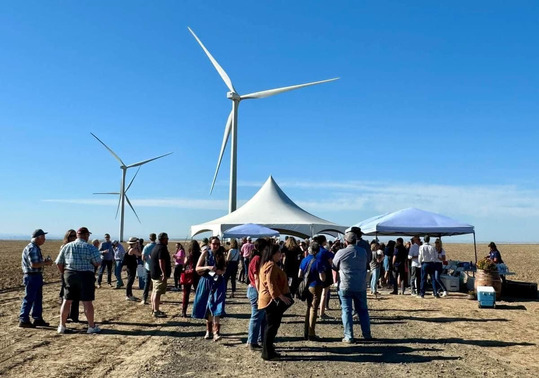
This year’s Summit took place in Hermiston on Thursday, June 20, and Friday, June 21. It included tours on Thursday of a number of area businesses, farms, producers of manufactured housing, and other operations. There was a reception on Thursday evening at a remarkable remote location: right in the middle of a dryland wheat farm co-located with wind turbines. Check it out:
And here I am with three of my Senate colleagues (Wagner, Golden. and Taylor):

And then on Friday we heard from people on a variety of topics, nearly all of them related to ways in which Eastern Oregon was confronting the ever-present realities of climate change: energy use, transportation, workforce development, traditional/indigenous knowledge, and tourism. You’ll find the detailed agenda here.
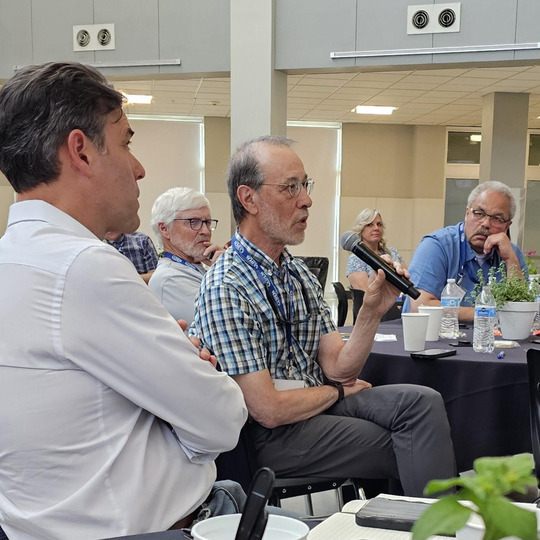
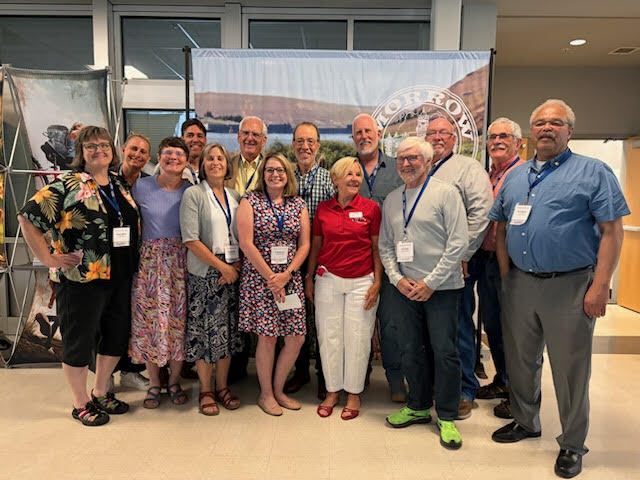 L-R: Sen Janeen Sollman (D-Hillsboro), Sen Kate Lieber (D-SW Portland), Sen Elizabeth Steiner (D-NW Portland), Sen President Rob Wagner (D-Lake Oswego), Rep Lisa Reynolds (D-NE Washington County), Sen Bill Hansell (R-Athena), Rep Emerson Levy (D-Madras), Yours Truly, Rep Bobby Levy (R-Echo), Rep Mark Gamba (D-Milwaukie), Rep John Lively (D-Springfield), Sen Lynn Findley (R-Vale), Sen Jeff Golden (D-Ashland), Sen Lew Frederick (D-NE Portland), Not in photo but at Summit on Thursday: Sen Chris Gorsek (D-Troutdale), Sen Kathleen Taylor (D-SE Portland).
I’m really proud that of the sixteen legislators who attended this year’s summit, thirteen of them were Democrats from the Valley, from Southern Oregon, and from Central Oregon. This is typical of these Summits. Despite what you hear about the Urban/Rural Divide, here in Oregon urban Democrats do go out of their way to reach out, listen, and learn from their rural colleagues. These summits have always resulted in important bipartisan legislation succeeding in the next legislative session.
Visiting Eastern Oregon Prisons
Since we were headed over to Eastern Oregon anyway, Senator Janeen Sollman and I took advantage of the time to visit the Eastern Oregon Correctional Institution in Pendleton and Two Rivers Correctional Institution in Hermiston. Janeen is the Senate Co-Chair of the Joint Ways and Means Subcommittee on Public Safety, and she shares an interest in prison reform and prison education. Though we’ve been to many of Oregon’s institutions, this was the first time for both of us at these two.
We saw a lot and learned a lot. At EOCI we visited the Disciplinary Segregation Unit (DSU, aka solitary confinement) to see how reforms there are going, now that length of stay has been reduced first from unlimited to 180 days, and more recently from 180 days to 90 days (efforts that I’ve been involved in). The number of AICs in DSU has gone down considerably, and those in the DSU have more access to activities and therapy. That’s all to the good. Needless to say, more is still needed.
Both EOCI and Two Rivers have GED classes delivered through Treasure Valley CC in Ontario, and we heard good things about the quality of those classes (previously they’d been delivered by Blue Mountain CC in Pendleton but changed recently). Both are hoping to deliver more college-level classes in the future. The Department of Corrections is including a funding request for next year that will allow the education expansions that we funded in 2022 for Coffee Creek (the women’s prison in Wilsonville) and Snake River (men’s prison in Ontario) to be extended to these other prisons.
Speaking of Prison Education, check out this recent reporting from OPB on new programs at Deer Ridge Correctional Institution in Madras offered by Central Oregon Community College. Very encouraging.
Equally encouraging is the journalism program at EOCI. The AICs (Adults in Custody) there put out a monthly magazine, The Echo: News from the Inside. Here’s the one from April, and the one from May. I encourage you to check them out. You will be impressed.
Follow the Fire Season
With the hot weather coming this weekend, concerns are naturally rising about this year’s fire season in the West. We’re already seeing wildfires causing extensive damage in New Mexico, California, and Washington. Central Oregon just experienced its first major fire of the summer: the Darlene-3 Fire in LaPine, finally contained at just under 4,000 acres. You can read about it in this reporting from OPB.
You can follow the fire season in the Northwest Interagency Coordination Center blog, which provides official fire information about wildland fires across the Pacific Northwest. It’s updated each day.
Fingers crossed that this will be a relatively easy year.
Your Voice Is Needed Again in the Transportation Road Show
"Perspectives and information gathered by the committee during its 12-stop tour will inform legislators as they develop a plan in the 2025 session to maintain critical infrastructure, complete work on major projects, and guarantee the safety and diversity of transportation systems across the state.”
We know that the 2025 legislative session is going to have many priorities, but among those foremost will be transportation. The transportation funding package that was created in 2017 is up for revision, and there are many, many questions that need to be answered about how we fund needed road maintenance as the gas tax brings in less and less money (thanks to more fuel-efficient cars and trucks), make our roads safer for all (including cyclists and pedestrians), how we move away from business as usual as we seek to reduce emissions and combat climate change. How do we pay for the new I-5 Bridge and what changes are needed to that project? What is the role of tolling to fund needed roadwork? Should tolls be used as a strategy for reducing congestion? Whose responsibility is it to pay for more public transit. Many, many questions.
As a transportation package is being crafted, legislators need to be hearing from as many constituents, experts, and organizations as possible. As part of that effort, the Senate President and Speaker of the House have scheduled a dozen listening sessions around the state between now and the end of September. Two have already occurred: Portland and Tillamook.
Here are the remaining dates:
- Albany - Tuesday, July 16
- Eugene - Wednesday, July 17
- Coos Bay - Wednesday, August 7
- Medford - Thursday, August 8
- Ontario - Wednesday, August 28
- Hermiston - Thursday August 29
- Bend - Thursday, September 12
- The Dalles - Friday, September 13
- Happy Valley - Thursday, September 26
- Hillsboro - Friday, September 27
Members of the Joint Committee on Transportation, along with other local legislators, will be there to take your testimony (in person and in writing) during those sessions. There will also be a virtual session during September Legislative Days (during the fourth week of September).
Here are the details for the two sessions in July, in Albany and Eugene.
Here’s more about the statewide tour as a whole: Press release announcing statewide tour.
Additional Links of Interest, Including the Latest on COVID
- One of the factors driving up the cost of our State Corrections system is the ever-increasing expense of providing medical care for adults in custody, particularly given our aging prison population. Those in state custody are not eligible for federal Medicaid or Medicare benefits. However, the Biden administration has recently allowed states to request waivers to that prohibition for AICs who are at the end of their sentences and are transitioning out of custody. Health and Human Services has just announced that five states are being granted demonstration waivers: Illinois, Kentucky, Utah, Vermont, and Oregon. (Washington, California, Montana, and Massachusetts have already been granted such waivers.) Early access to Medicaid/Medicare will help Oregon AICs more successfully navigate the difficult (and too often unsuccessful) process of reentry. Here’s the announcement from CMS, with details about the waiver program.
- Aside from its prison population, Oregon is set to further expand access to its Medicaid plan (the Oregon Health Plan), receiving permission from CMS to offer the “OHP Bridge Program.” OHP Bridge will extend Medicaid benefits to those who earn up to 200% of the federal poverty level: individuals who earn about $30,000 a year or families of four who earn $62,400 a year. Here's reporting from the Capital Chronicle.
-
Here's information about the Portland program that is distributing free air conditioners to low-income Portlanders.
- ODOT has just received $52 million from the National Electric Vehicle Infrastructure Program to increase the number of fast-chargers in more rural parts of the state and to keep them maintained. Here’s reporting from OPB..
- On the COVID front, the most recent wastewater analyses are showing national increases in COVID, with notable increases in Washington, California, and Idaho. Oregon is showing declines for now.
- The Washington Post’s Dr. Leona Wen has a new column, in which she discusses the newly-configured COVID vaccine that will come out in the fall. Does everyone need to be vaccinated? She argues for a nuanced response to that question. However, she makes it clear that those older than 50 or 60 should certainly be getting it, just as they should be getting annual vaccines against the flu. As is the case for flu vaccines, the new COVID vaccine may not prevent a person from getting COVID entirely, but it will make the case much less serious.
- Meanwhile, NPR is reporting that many nursing homes are failing to keep their residents vaccinated. This is the exact population most at risk from premature death by COVID.
- Speaking of vaccines, the National Institutes of Health just reported that it is sponsoring a trial testing a new nasal COVID-19 vaccine. If successful, this could lead to an increase in people seeking a vaccine and would potentially be more successful at preventing even mild cases.
- And the New York Times tries to answer the question, “If you test positive for COVID, can you still travel?” (You may need a subscription to the Times to access this one.)
-
CBS has reporting on what we now know about the effectiveness of masks to ward off viruses like COVID. In short, they are very effective.
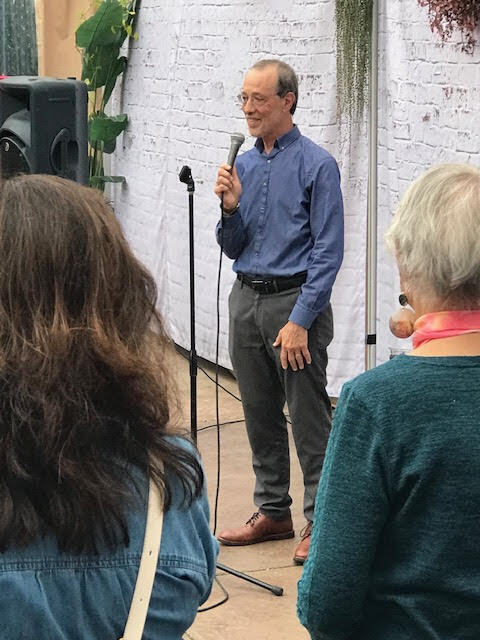 At my retirement party.
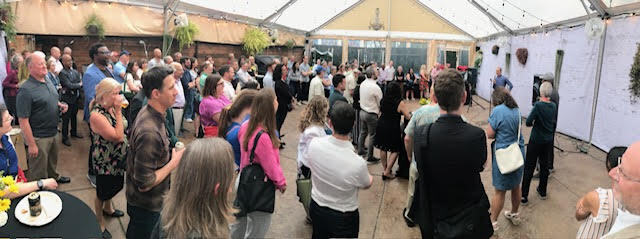 and a zoom out..
All the best,
 Senator Michael Dembrow
District 23
email: Sen.MichaelDembrow@oregonlegislature.gov
web: www.senatordembrow.com
mail: 900 Court St NE, S-407, Salem, OR, 97301
Replies to this message are sent to an unmonitored mailbox.
To contact me, please click here: Sen.MichaelDembrow@oregonlegislature.gov
| 

