|
April 23, 2023
Dear Neighbors and Friends,
I hope that you and your loved ones are doing well, staying healthy, and looking out for your neighbors and friends during this past week.
In tonight’s newsletter I’ll give you a sense of where we are at this point in the session—on the floor, in the policy committees, and in the Ways and Means Committees. I’ll be giving you some statistics on just how partisan (or not) the bills we’re considering on the Senate floor are. I’ll also be letting you know about a few more of my sponsored bills that have made it out of the Senate.
You’ll also get a report on this past weekend’s Ways and Means “Road Show” in Roseburg, with its hearing on Friday evening and its community tours on Saturday.
On the COVID front, the overall metrics remain relatively low. All counties but one remain at Low Risk, and wastewater analysis again shows a stable level of virus.
The CDC has just made some of us (those 65 and older or with immunocompromised conditions) eligible for a second bivalent booster. More on that below.
We received an update from our State Epidemiologist this week. As you’ll see below, it will be Dr. Sidelinger’s final regularly scheduled COVID update unless things take a turn for the worse (fingers crossed that won’t happen).
Until next week, please do your best to stay happy, healthy and safe. And let me know if you have any questions or thoughts about anything in this week’s newsletter.
The Week Ahead in the Legislature
As we approach the end of April, we’re well into policy committees hearing bills that have come over from the other chamber. The hearings on these bills are generally much faster and easier than they were in the first chamber. Most of the bills have already been amended to resolve outstanding concerns, and nearly all of them have some degree of bipartisan support. (See more on that just below.) That’s not to say that controversial and difficult bills don’t remain, but most of them are either in Ways and Means (because they involve a budgetary requirement) or still in the Rules Committee in their first chamber.
Nearly all the bills coming to the Senate floor now will be House bills coming out of a Senate policy committee. On Monday we only have just one Senate bill scheduled and 22 House bills. Because of the slow pace required by bill readings and other filibuster techniques, the Senate will henceforth be meeting every Monday evening from 5 to 9. Once we’re in May (and our last Friday “Road Show” hearings have ended), we’ll also be meeting every Friday and eventually likely on weekends as well.
The spotlight will increasingly be on budgetary issues as the session winds down. In the Natural Resources subcommittee of Joint Ways and Means (of which I’m the Senate Chair), we just finished our final set of Agency presentations (with the Oregon Watershed Enhancement Board). That means that we’ll begin voting on several budgets this week: the Land Use Board of Appeals (LUBA), the Marine Board, and the Department of Land, Conservation, and Development (DLCD).
My House counterpart (Co-Chair Khanh Pham) and I have been working with Legislative Fiscal Office staff to get these budgets ready for their votes. Believe me, it hasn’t been easy, given the severe budget constraints that we’re under this year. So far, we’ve been able to keep agency budget cuts low, but there hasn’t been much if any room for new requests. (These come in the form of what’s known as “POPs”: Policy Option Packages.)
We’re hoping that the May 17 revenue forecast will give us a little more room for growth, in which case the approved budgets may be able to be further augmented. We’ll see.
In the meantime, in order to see what the recommended budgets look like prior to their votes, go to the appropriate hearing date and click on “Meeting Materials” for that day. We’re hoping to get them posted at least a couple of days in advance of the vote.
Meanwhile, in my other Ways and Means subcommittee--the Education Sub—we’re still in the middle of hearing presentations from higher education entities. This week we’re doing community colleges and public universities. Once those are done, it will be time for votes on the Early Learning, K-12, and Higher Education budgets.
You can still sign up to offer public testimony on either the community college or university budgets this week. You can do that via the Subcommittee website. Go to the appropriate meeting day and click on “Register to Testify.”
Some Statistics from the Senate
Given the Republican insistence this year on continually delaying floor action, speaking at length and questioning every bill, and forcing us to spend extra days and evenings on the floor, you might think that every bill this year is politically charged and is being passed on a party-line vote.
Nothing could be further from the truth.
As of April 14th, the Senate had passed 197 bills. Of those bills, 94% passed on bipartisan votes. More specifically:
- 115 of those bills, 58%, had votes from both parties.
- 71 bills, 36%, were passed unanimously.
- Only 11 bills, 5.6%, were passed on a party-line vote.
Here are some graphs that provide a visual sense of this bipartisanship.
I can tell you that this level of bipartisanship is the result of serious efforts at compromise on both sides.
That’s not to say that we don’t have some hot-button votes ahead of us in the coming weeks, notably related to reproductive rights and firearms safety. But if you hear anyone say that the Democrats are “steamrolling their agenda” and “ignoring the minority party,” please remember the reality revealed by these statistics.
A Few More of My Priority Bills Make It to the House
Last Monday we passed a few more of my Education priorities from the Senate floor. They’re now being assigned to House Higher Education. Here they are:
SB 270 is another bill focused on improving access to prison education. It will allow the Department of Corrections to partner with a variety of community colleges to provide instruction, not just the one where the prison is located. SB 270 passed on a broadly bipartisan 23-5 vote. For more information, here's my floor speech.
SB 273 makes changes to university governing boards in an effort to create more transparency and better communication with their local university communities. It also added a graduate student to most boards. SB 273 passed on a 16-12 party-line vote, For more information, here's my floor speech.
SB 523 will allow community colleges to offer Bachelor’s degrees in Nursing. It is designed to allow graduates of 2-year RN programs to continue at the community college for their BS in Nursing. It’s an especially attractive option for students living in rural parts of the state. I co-carried SB 573 with one of my Republican colleagues, Sen. Fred Girod. SB 523 passed on a 28-0 vote. For more information, here's my floor speech.
I’ll keep you informed on how the bills do in the House.
Ways and Means Road Show #3 Report
The third Ways and Means road show took place on Friday evening at Umpqua Community College in Roseburg. Those testifying came from counties all over southern Oregon, from Eugene down to Ashland and over to Klamath Falls. There again wasn’t enough time for the legislators to hear from everyone, but we did get to hear from 62 individuals, each trying hard to tell their stories and communicate their passionate pleas in 2 minutes or less.
The topics covered had some overlap with those we heard about in the last two weeks, but again there were differences. We heard a lot about the special challenges faced by families living in rural districts with very limited access to services. As you’ll see in my list of what we heard from each of the 62, there is a great deal of need out there.
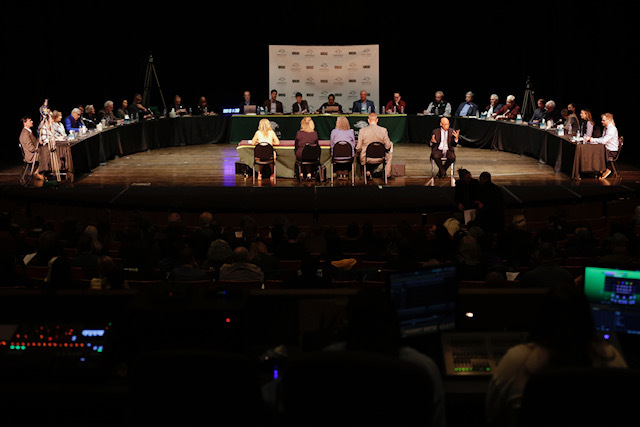 Here's the schedule for the remaining hearings:
Friday, April 28 (5:00 - 7:00pm) - Ontario
- Location: Four Rivers Cultural Center
- 676 SW 5th Ave, Ontario, OR 97914
- Note: Ontario, Oregon is in the Mountain Time Zone
Wednesday, May 3rd (5:00-7:00pm) - Remote
You can sign up to provide in-person testimony (or remote testimony on May 3rd) or submit written testimony on the .Ways and Means webpage.
Roadshow Redux
As I mentioned last week, we tend to accompany these roadshow hearings with visits to local sites and discussions with local leaders. The Roseburg tour involved two major stops on Saturday:
- We visited five different nonprofits located together on a campus in North Roseburg, the Jerry Bruce Community Campus:
- Aviva Health Clinic
- The Fish Food Pantry
- The Family Development Center, a local relief nursery
- Umpqua Homes, a group home for individuals with severe intellectual and developmental disabilities
- The UCAN (Douglas County Community Action Network), which helps get food from the Oregon Food Bank and other resources out into communities around Douglas County.
- We visited timber property owned by Lone Rock Resources https://www.lonerockresources.com/ and heard about their vision for sustainable forestry. They were one of the parties involved in discussions that led to the historic Private Forest Accord reached between timber companies and environmentalists two years ago.
Many thanks to my colleague, Senator David Brock Smith, for setting up these tours and a dinner the night before.
Next week in Ontario we’ll be visiting Snake River Correctional Institution, a company manufacturing homes using 3-D technology, and, I believe, an onion operation.



ON THE COVID FRONT
Weekly Data Report:
OHA now updates and reports COVID metrics once a week, on Wednesdays. Here are the most recent set of weekly results, for this past week from 4/13/23 through 4/19/23.
This week’s report shows mixed results for the COVID metrics in Oregon. However, the overall trajectory remains positive.
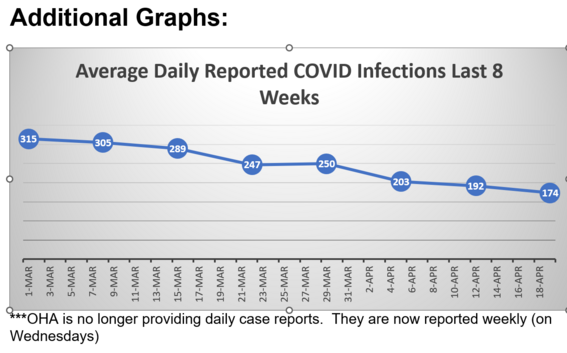
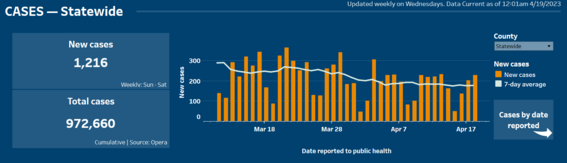
- The 7-day average for newly reported infections continued to decline, from 192 to 174 reported infections per day this last week. The number of new cases is likely an undercount, as many people are using home tests to determine their infection status but are not reporting those results.
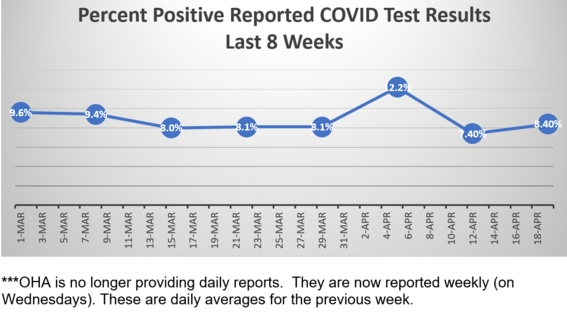
- Average test positivity went back up a little last week from 7.4% to 8.4%. The number probably skews high because it likely reflects a higher proportion of people showing COVID symptoms (and thus reporting or going in for a test, rather than self-testing and never reporting).
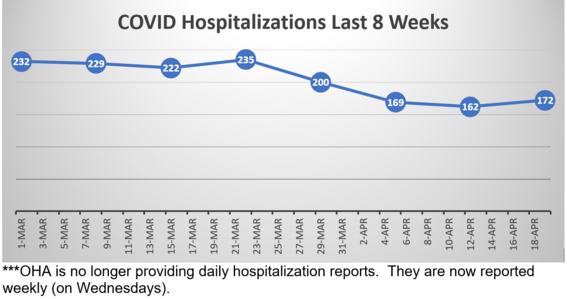
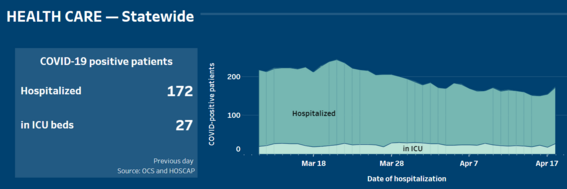
- On Wednesday there were 172 COVID hospitalizations, a small increase from the previous week’s 162 COVID-19-related hospitalizations statewide. Hospitalizations are now our best indicator of disease spread. Again, however, most of these hospitalizations are not in and of themselves due to COVID—most are those who tested positive after having been admitted for other reasons.
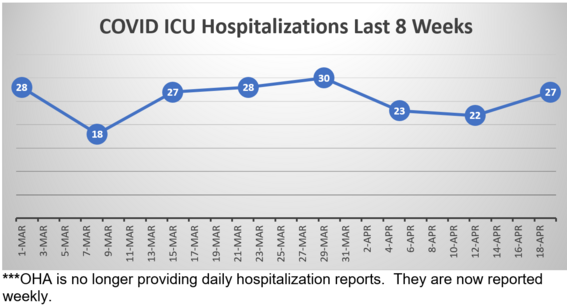
- The number of COVID patients in Oregon’s ICUs on Wednesday went up last week, from 22 to 27 statewide. These are the most serious COVID infections.
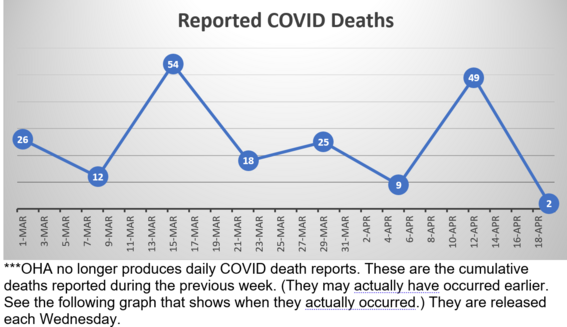
- There were just 2 COVID-19-related deaths reported during the last week, down from the previous week’s 9. However, it’s important to remember that many of every week’s reported deaths actually occurred in earlier weeks but were just reported to the state, and others that likely occurred have yet to be reported. The newsletter’s final graph shows when the deaths actually occurred, and you’ll see that the number of COVID deaths each day continues to remain consistently low.
Weekly County Report: All Counties But One at Low Risk
The CDC assigns risk levels based on a combination of the number of new COVID cases and the number of people in hospital for COVID.
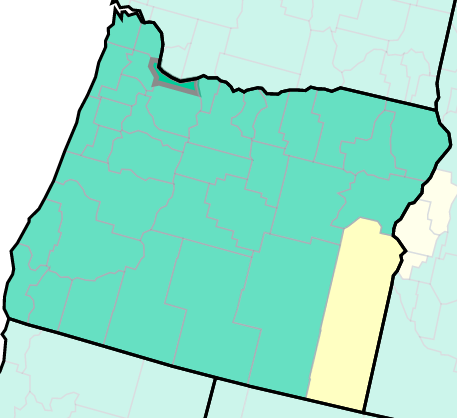
According to the CDC Daily Counter (updated each Thursday), 35 Oregon counties that are reporting are at Low Risk status. Only one county, Malheur County in Southeastern Oregon, is now reporting to be at Medium Risk.
We can also track the cases, deaths, and test positivity rates for each county at this website.
Two of the three Metro-area counties saw an increase in positivity rates last week. Clackamas County is now at 8.9% (up from 6.5% the previous week). Multnomah County is again at 5.6% (same as last week). Washington County is now at 9.0% (up from 8.5%).
Remember, though, that these are all based on reported test results, and so are more likely to be a little higher than the total percent positivity (i.e., if one were to include all tests taken).
This Week’s Wastewater Monitoring Report: No Increases
With testing reports giving us just a fraction of infections out there, wastewater monitoring has become a more reliable indicator of the amount of virus in cities around the state. That report is updated each week.
This week’s report, updated on Wednesday, reveals that none of the cities tested showed increases or sustained increases last week (down from 9% last week). Eighteen percent showed declines or sustained declines (up from 12%). The remaining 82% (up from 79%) showed no change.
Dr. Sidelinger Gives His Last Regular Pandemic Press Conference
At a press conference on Thursday, our State Epidemiologist, Dr. Dean Sidelinger, announced that this would be his last regular pandemic press conference. Most recently he has been offering these on a monthly basis, but earlier in the pandemic he was doing them much more frequently. At Thursday press conference, he promised that they would restart in the future if circumstances warranted.
At you can see in his prepared remarks Dr. Sidelinger pointed out that the number of COVID deaths and hospitalizations have continued to drop in Oregon. He also talked about changes to COVID-19 vaccination and booster recommendations, which federal health authorities announced this week (see more about that in the links section of the newsletter), as well as the May 11 end of the national public health emergency and what that means in terms of COVID-19 services and Oregon Health Plan (Medicaid) coverage.
On April 18, 172 people were hospitalized in Oregon with COVID-19-related illness, compared to the peak of 1,178 from Sept. 1, 2021.
He did point to a cautionary note in last week’s OHSU forecast. (See ast week's newsletter.) The forecast predicts that two new variants, XBB.1.16 (Arcturus) and XBB.1.9, will likely cause a COVID wave during the next two months that is similar to the recent BA.4/BA.5 and winter waves, since they are highly infectious. However, like the winter waves, they are not expected to result in big increases in hospitalizations or deaths.
You can watch the press conference in its entirety here.
And here’s reporting on the press conference from the Capital Chronicle’s Lynne Terry.
COVID Q & A from OHA (from OHA weekly newsletter)
Dr. Paul Cieslak, OHA senior health advisor and medical director, Communicable Diseases and Immunizations Program, and Emily Droge, health promotion strategist, and Jen Chandler, nutrition policy specialist, both from OHA’s Health Promotion and Chronic Disease Prevention Section, answered this weeks questions.
Q: Is there a new bivalent COVID-19 booster available to seniors? My husband has several co- morbidities. We are up to date with initial vaccines and boosters and want to get any new boosters promptly.” – Julia, Pacific City
A: “Yes. This week, in fact, federal authorities authorized another bivalent booster dose for people age 65 and older, as well as for most people with compromised immune systems. The booster is not ‘new,’ however; it is the same bivalent booster that was first authorized for a single dose last September, and now it is authorized for some people to receive it a second time. For more details on this week’s changes to COVID-19 vaccine and booster guidance, visit our blog.”
Q: Obesity continues to be a national problem. Why hasn’t Oregon required all restaurants to include calorie counts on their menus? – Mary, Corvallis
A: “Thank you for your question. Oregon does require that some restaurants include calorie counts on their menus. Oregon’s Menu Labeling Act requires chain restaurants with 15 or more outlets nationwide to print basic nutrition information, including calories, on their menus. However, there is not a lot of evidence that doing so improves customers’ health. In reality, most communities that experience the highest rates of diet-related chronic diseases such as heart disease, stroke, diabetes and some cancers simply don’t have adequate access to affordable, culturally relevant, healthy foods.
“As for obesity – the conventional thinking of ‘calories in-calories out’ does not accurately describe how our bodies work and ignores other factors that cause weight gain. Obesity is a complex issue that OHA is addressing on many fronts. Oregon’s State Health Improvement Plan, Healthier Together Oregon, outlines OHA’s efforts to ensure access for all to healthy, affordable, and culturally appropriate food, enable people to be as active as they’d like, prioritize strong social relationships, and adequately address mental and emotional health.
“We want Oregon to be a place where good health and wellbeing are enjoyed by people of all races, ethnicities, disabilities, genders, age, sexual orientations, socioeconomic status, nationalities and geographic locations. Learn more about these goals and how you can support them in your community by visiting Healthier Together Oregon.”
Additional COVID Updates and Links

Here again are some COVID resources that you will find useful:
If the above links are not providing you with answers to your questions or directing you to the help that you need, please consider me and my office to be a resource. We’ll do our best to assist you or steer you in the right direction.
Sincerely,
 Senator Michael Dembrow
District 23
email: Sen.MichaelDembrow@oregonlegislature.gov
web: www.senatordembrow.com
mail: 900 Court St NE, S-407, Salem, OR, 97301
| 

