|
April 16, 2023
Dear Neighbors and Friends,
I hope that you and your loved ones are doing well, staying healthy, and looking out for your neighbors and friends during this past week.
In tonight’s newsletter you’ll get a first-hand report on the many challenges—but also a number of successes—that we’re experiencing during this 2023 legislative session. We’re spending unusually long hours on the Senate and House floors for this time of session, but it’s been needed to cope with a deliberate slowdown strategy (what I would call “creative filibustering”) hoping to keep key bills from crossing over to the other chamber. So far it’s not really working, but it is fairly excruciating. Fortunately, so far everyone has been able to keep their tempers in check and stay on good terms. You can read more about it below, along with news about some of my sponsored bills that have made it out of the Senate.
You’ll also find more specific details about this Wednesday evening’s SD 23 Town Hall (with Reps Pham and Tran) at PCC-Southeast. You’ll also get a report on this past weekend’s Ways and Means “Road Show” hearing in Newport.
On the COVID front, last week saw ongoing improvements in nearly all of the COVID metrics, including COVID cases, hospitalizations, and positivity rate. (The latter was especially good news, since those rates had jumped last week for some reason. They’re now back to relatively low rates. All counties but one remain at Low Risk, and wastewater analysis shows a stable level of virus.
We did receive the most recent monthly OHSU forecast report this week. It shows ongoing improvements for COVID, flu, and RSV. You’ll find the details below.
Before I say goodnight, I do want to give a special acknowledgment to two long-time public officials that we lost over the last few days. Bill Bradbury was a long-time legislator from Bandon, Senate President, and Secretary of State. Bill was one of our leading environmentalists, someone who had deep feelings for Oregon’s special relationship with the salmon and the ecosystems that support them. He has been challenged for many years now with very serious multiple sclerosis but never lost his good cheer and upbeat take on the world. He and his wife Katie were in the middle of a journey around the world when he passed. I know that he died happy, fulfilled, but still ever-curious.
Dick Springer also left us a week ago. Dick served in the Legislature for 16 years, both in the House and the Senate, where he served as Majority Leader. I got to know him back in the 1980s when he served on the PCC Board of Directors. He helped us get through some rocky times financially and organizationally. He was assertive, opinionated, but always with high expectations for public service. He retired after serving a stint as executive director for the West Multnomah County Soil and Water Conservation District, a great way for him to cap a lifetime of environmental service. After his retirement in 2015 he used to show up at my constituent coffees, always full of passion and insight.
I’ll miss them both, and I know I’m not alone.
Until next week, please do your best to stay happy, healthy and safe. And let me know if you have any questions or thoughts about anything in this week’s newsletter.
 
COMING THIS WEEK: SD23 Town Hall
Reps Pham, Tran, and I will be holding another town hall Wednesday evening, April 19th. This will be an opportunity for you to hear what's going on in both the House and the Senate, with info on priority bills, those that won't be moving forward this session and those that will. And of course it will be an opportunity for you to get your questions answered.
This one will at last be in person, at PCC-Southeast Campus, 2305 SE 82nd Avenue, 6-7:30 pm.
The Town Hall will be held in the Community Hall Annex (COMX) at Portland Community College Southeast campus. The entrance of COMX faces Division between SE 77th and SE 79th, behind a small building. Nearby, free parking can be found in PCC Southeast’s F Lot, just north of the intersection of SE Division St and SE 77th. Other parking is available on side streets such as SE 77th. The building and F Lot are ADA Accessible. There are signs for the building, and we will have a larger sign outside for the event. Here's a map of the campus:
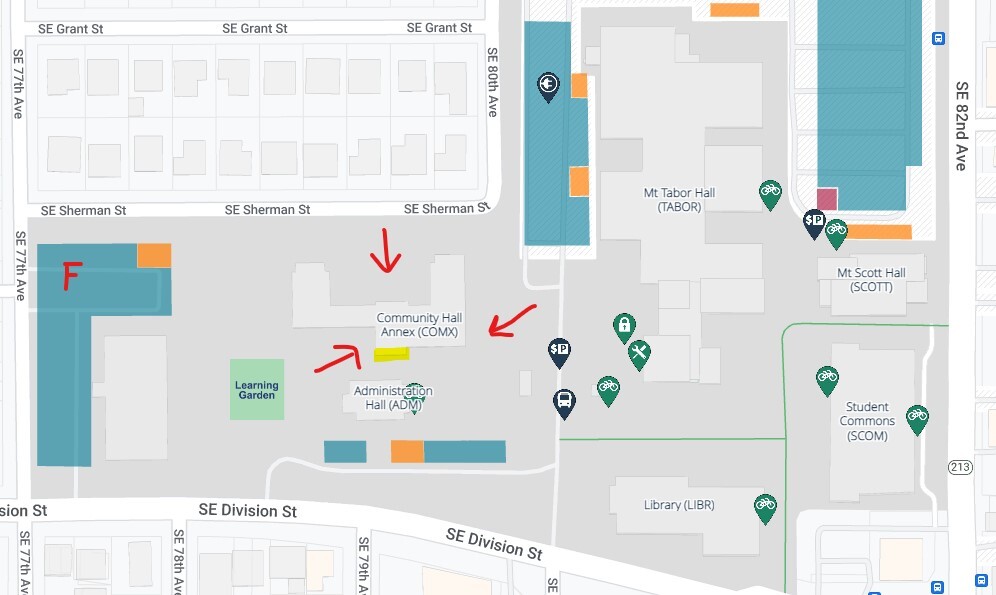 The Community Hall Annex will have seats for approximately 100 people. Light snacks and drinks will be available inside the Town Hall event space.
In online maps, the PCC Southeast address is 2305 SE 82nd Ave.
Here's a Google form that Rep Tran’s office created to help capture any topics that you’d like us to cover and any accessibility requests. If you think you’re going to attend, we’d appreciate your filling it out so that we have a sense of how many people are planning to attend.
See you there!

Ways and Means Road Show #2 Report
The second Ways and Means road show took place on Friday evening in the Newport Performing Arts Center. The Center was filled with people from up and down the coast and inland from several nearby rural counties. There again wasn’t enough time for the legislators to hear from everyone, but we did get to hear from 61 individuals, each trying hard to tell their stories and communicate their passionate pleas in 2 minutes or less. We were able to hear from a few more than last week, but we also went a few minutes longer.
The topics covered had a lot of overlap with last week’s, but it clearly had a coastal flavor. We heard requests to preserve funding for the Marine Reserve program (an important and successful program that allows groups of fish and other sea creatures to live undisturbed while their health is restored. We also heard requests for a number of coastal infrastructure projects, mainly involving clean water, as well as support for coastal arts organizations.
But there was lots more. Here's my list of what we heard from each of the 61.
Here's the schedule for the remaining hearings:
Friday, April 21 (5:00 - 7:00pm) - Roseburg
- Location: Umpqua Community College
- 1140 Umpqua College Rd, Roseburg, OR 9747
Friday, April 28 (5:00 - 7:00pm) - Ontario
- Location: Four Rivers Cultural Center
- 676 SW 5th Ave, Ontario, OR 97914
- Note: Ontario, Oregon is in the Mountain Time Zone
Wednesday, May 3rd (5:00-7:00pm) - Remote
You can sign up to provide in-person testimony (or remote testimony on May 3rd) or submit written testimony on the .Ways and Means webpage.
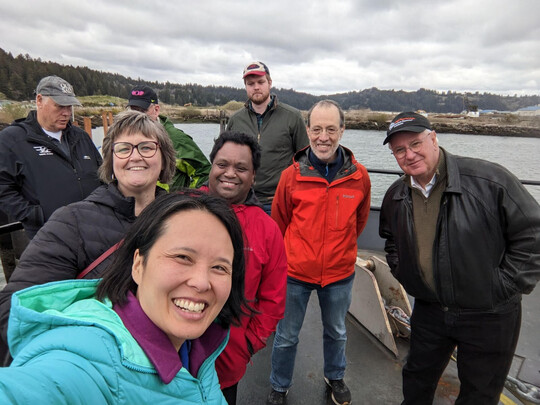
On Saturday a bipartisan group of us legislators boarded the Predator, a trawler based in Newport, as the guests of the Midwater Trawlers Cooperativeand its executive director, Heather Mann.
We had the opportunity to sail around Yaquina Bay, learning about the commercial fishery that works out of that port. It's a unique but very fulfilling lifestyle, with most of the trawlers splitting their time between Newport and Alaska. They mainly fish for Pacific Whiting off the Oregon coast, and cod off the Alaska coast. As it seems everyone else is, they're experiencing workforce challenges right now.
I learned a lot. That's one of the fringe benefits of these Ways and Means Road Shows.
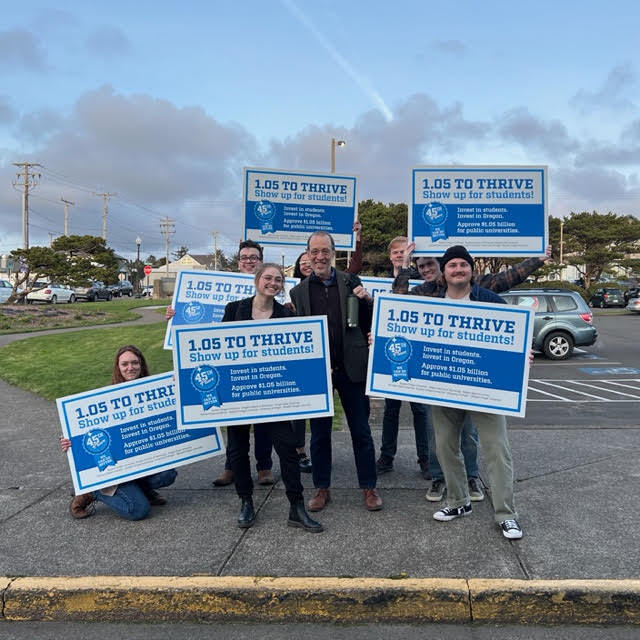
Long Days on the Floor
You may remember that in last week’s newsletter I predicted that we would have two very full days on the House and Senate floor ahead of us. Well, I under-estimated things!
Though Monday and Tuesday were the longest for us in the Senate (going from 10:30 a.m. to 9 p.m.), we ended up going 10:30 to 5:00 on Wednesday and 10:30 to 4:30 on Thursday as well. We made it through 56 bills in all, broken down as follows:
Monday: 17
Tuesday: 21
Wednesday: 8
Thursday: 10
That may seem like a lot, but it actually is reflective of a very slow pace, the product of a deliberate slowdown campaign by Senate Republicans. The first 2-3 hours of each day were spent on long speeches on unrelated topics via “courtesies,” “remonstrances,” and procedural motions to bring to the floor a series of Republican bills that had never had votes in their committees. A group of five or six R senators insisted on speaking to the fullest extent allowed on each bill, then followed that with a “Vote Explanation.” (In the House, Vote Explanations are done in writing, but in the Senate they can be given orally.)
These delay tactics reached a new level of lunacy on Wednesday morning, when they started reading from the biographies of Democratic senators, taken from our individual websites “for the purpose of getting to know one another better”(!). I was the third to receive this honor. (It was actually a very nice acknowledgment from my Education Committee Vice-Chair, Senator Suzanne Weber.) I politely thanked her for this honor and asked them to please provide any further information about us via email. You can read about that and the delay tactics in general in this reporting by OPB’s Dirk VanderHart.
In the House the methods were different, but the effects were the same. Monday, Tuesday, and Wednesday went very slowly. (Remember, the House has twice as many Republicans to speak!):
Monday: 13
Tuesday: 6
Wednesday: 8
By the end of the day on Wednesday, a deal had been reached between the two parties to speed things up. The two most controversial bills that are out there—HB 2002 on Reproductive Rights and HB 2005 on Firearms Safety—will now not have their House floor votes until May 1 and May 2. The hopeful effect of that was to calm things down. It appears to have worked:
Thursday: 23
Friday morning: 33
As you can see, following the agreement on HB 2002 and HB 2005, the House was able to move quickly through the remaining House bills on their list.
We’ll see how things go tomorrow in the Senate. The Senate will have its usual morning floor session, then reconvene for a few more hours in the evening. This will allow us to have our regular committee meetings tomorrow.
We have 21 Senate bills scheduled for tomorrow, with another 9 Senate bills on deck for the following day. There are also a number of House bills (22 right now) waiting to be voted on, but we’re waiting on those till we get through the Senate bills, which need to move over to the other chamber to be assigned to their second committee.
You may wonder how we can put up with the slow pace. Well, it’s not easy! It’s so tempting to respond to the often provocative arguments being made by our Republican colleagues in an effort to get into a debate that will only eat up more time. We’ve been able to keep our cool and our patience. There are a number of rules changes that we could make in order to speed things up, but for now we don’t think that will be necessary. Though it’s irritating, for now we remain on schedule.
And ironically, on a personal level, there’s a lot of camaraderie and even good humor on the floor, including among senators of different parties (this is actually no easier on the Rs than it is on the Ds). We’ll get through this.
Some of My Priorities Bills Make It Through the Senate
Though everything felt slow as molasses this past week, we were able to get a number of good bills over the Senate finish line. Among them were a several for which I was the lead sponsor. Here are four of them, all of which passed with very strong support:
SB 123 is a bill that is part of our recycling modernization effort. You can read about it in my "floor carry," the testimony that I gave when I introduced the bill. It passed comfortably, 21-7.
SB 269 is one of the bills I’ve been working on that will improve and increase the education and training programs that are offered in our state prisons. It will allow us to make better use of the new federal “Second Chance Pell” program that was created at the end of the Trump administration and goes into effect this summer. You can learn more about it in my floor carry for SB 269. I’m pleased to report that the bill passed without a single No vote: 28-0.
SB 275 initiates a process that will likely lead to the merger of the Teachers Standards and Practices Commission and the Oregon Department of Education. They used to be within the same agency, as is the case in most states, but over time became two separate agencies. This has led to duplication and slow response times for TSPC. I think we can do better. Here's my floor carry. which goes into the reasoning behind this effort. This bill passed the Senate floor on a 22-7 vote.
Finally, one of my top priorities of this session is to continue the work allowing juvenile ex-offenders to have their records automatically expunged. We started a few years ago with the lowest level of offenses, and now we’re moving on to include most misdemeanors. The bill is SB 519,and you’ll find more details in my floor carry. I was so grateful to see this bill pass on a 28-1 vote, with lengthy testimony in support by several of my Republican colleagues, who focused on the benefits of giving these young people a second chance to be productive community members.
I have several more coming up tomorrow. I’ll report on them next week.
ON THE COVID FRONT
Weekly Data Report:
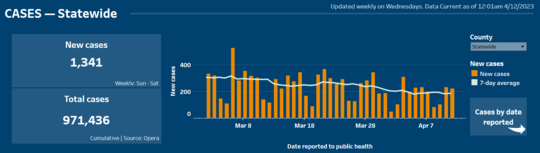
OHA now updates and reports COVID metrics once a week, on Wednesdays. Here are the most recent set of weekly results, for this past week from 4/6/23 through 4/12/23.
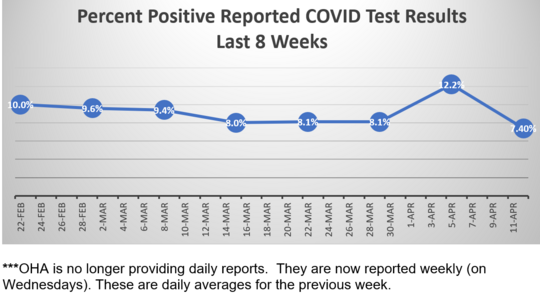
This week’s report shows ongoing declines in nearly all the COVID metrics here in Oregon. Last week’s unexpected rise in test positivity now appears to have been an anomaly. The overall trajectory remains positive.
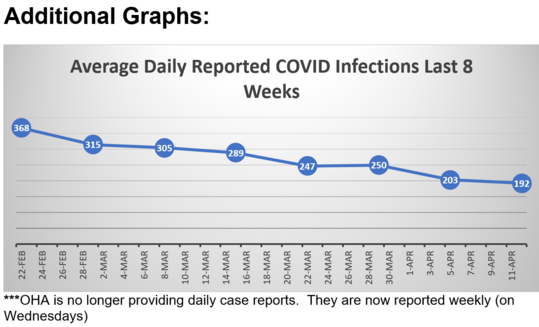
- The 7-day average for newly reported infections continued to decline, from 203 to 192 reported infections per day this last week. The number of new cases is likely an undercount, as many people are using home tests to determine their infection status but are not reporting those results.
- Average test positivity went back down last week from 12.2% to 7.4%. The number probably skews high because it likely reflects a higher proportion of people showing COVID symptoms (and thus reporting or going in for a test, rather than self-testing and never reporting).
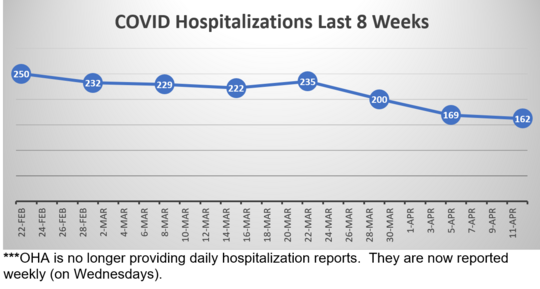
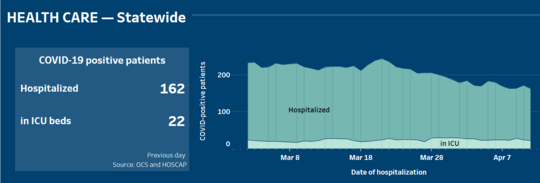
- On Wednesday there were 162 COVID hospitalizations, a reduction from the previous week’s 169 COVID-19-related hospitalizations statewide. Hospitalizations are now our best indicator of disease spread. Again, however, most of these hospitalizations are not in and of themselves due to COVID—most are those who tested positive after having been admitted for other reasons.
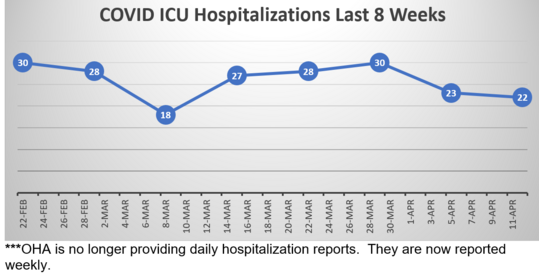
- The number of COVID patients in Oregon’s ICUs on Wednesday went down again last week, from 23 to 22 statewide. These are the most serious COVID infections.
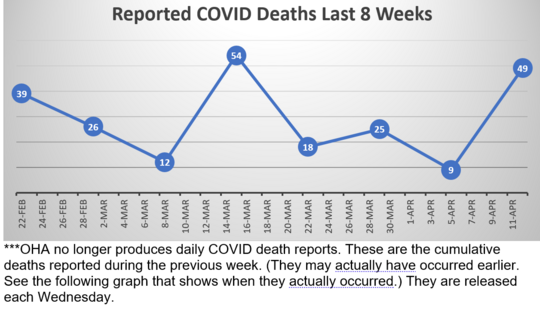
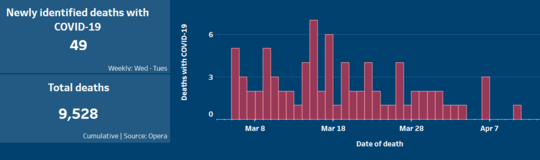
- There were 9 COVID-19-related deaths reported during the last week, down from the previous week’s 25. However, it’s important to remember that many of every week’s reported deaths actually occurred in earlier weeks but were just reported to the state, and others that likely occurred have yet to be reported. The newsletter’s final graph shows when the deaths actually occurred, and you’ll see that the number of COVID deaths each day continues to remain consistently low.
Weekly County Report: All Counties But One at Low Risk
The CDC assigns risk levels based on a combination of the number of new COVID cases and the number of people in hospital for COVID.
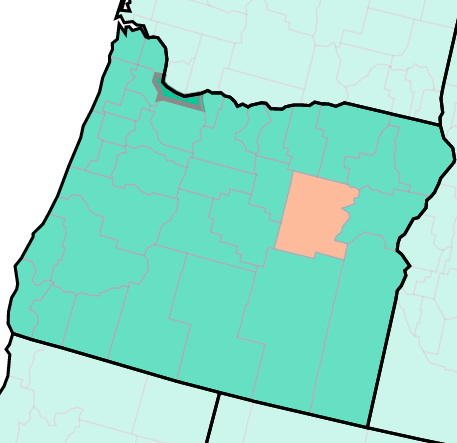
According to the CDC Daily Counter (updated each Thursday), 35 Oregon counties that are reporting are at Low Risk status. One county, Grant County in Eastern Oregon, (which had not reported data for the last two weeks) is now reporting to be at High Risk.
We can also track the cases, deaths, and test positivity rates for each county at this website.
Last week I reported that positivity rates for the three Portland-area counties had soared during the previous week. That was either a reporting error or an anomaly. Clackamas County is now at 6.5% (down from 15.2% the previous week). Multnomah County is now at 5.6% (down from 15.1%). Washington County is now at 8.5% (down from 19.4%). These are much more in line with recent trends (actually, they indicate an ongoing decline.
Remember, though, that these are all based on reported test results, and so are more likely to be a little higher than the total percent positivity (i.e., if one were to include all tests taken).
This Week’s Wastewater Monitoring Report: Again, Not Much Change
With testing reports giving us just a fraction of infections out there, wastewater monitoring has become a more reliable indicator of the amount of virus in cities around the state. That report is updated each week.
This week’s report, updated on Wednesday, showed 9% of cities showing increases or sustained increases last week (up from 12% last week). Twelve percent showed declines or sustained declines (down from 16%). The remaining 79% (down from 72%) showed no change.
Albany, Bend, and Warm Springs showed sustained increases last week.
OHSU Report Shows Declines in Flu and RSV, Small Increases in COVID
Another OHSU Forecast Report, was released on Thursday, April 13th. It is now being called the “OHSU Oregon Hospital Forecast and Trends: COVID, Flu, RSV.” It now comes out once a month.
It uses data provided by OHA and others that project how fast the viruses may spread in the population and provides projections on possible outcomes, including infection rates and impacts on hospital capacity. The lead author is Dr. Peter Graven, Director of OHSU’s Office of Advanced Analytics.
This week’s report—the first in nearly a month—shows overall stability in the disease metrics, with small COVID increases and ongoing declines in flu and RSV. The primary forecast has been revised upwards to include the effects of XBB.1.5. This current trend of small COVID increases should peak in two weeks.
Here are some details:
- The number of people hospitalized in Oregon with COVID-19 peaked on Feb. 23 at 261. It was at 162 as of April 11.
- The XBB.1.9 and XBB.1.16 variants are expected to cause a wave of COVID-19 infections similar to the recent BA.4/BA.5 and winter waves. The peak is expected at the end of June, based on preliminary data from India.
- The XBB.1.16 (Arcturus) variant seems to be evading COVID-19 immunity in some areas.
- Arcturus is not expected to lead to more severe hospitalizations than the recent BA4/5 and XBB.1.5 waves. In most cases COVID is not likely to be the primary cause of the hospitalization.
- Coronavirus levels in Oregon wastewater peaked the week ending March 1. Other U.S. regions have seen dropping levels as well.
- The wastewater levels in Oregon show the effect of the recent XBB wave. While virus levels in the water reached similar levels to those observed during the winter surge, the impact on hospitalizations remained mild and infection levels have declined subsequently.
- Wastewater levels around the US have continued to decline.
- The rate of people in the hospital with COVID-19 across the U.S. also has dropped.
- As of April 13, two Oregon children were in the hospital with COVID-19 (same as last month).
- Cases of flu and RSV are expected to remain low. RSV numbers have returned to nearly negligible levels in Oregon. Flu hospitalizations have dropped to nearly zero.
- The number of COVID deaths is expected to remain low.
OHA Releases Quarterly Data
OHA has just released it quarterly data and outbreak report. (You may remember it when it was updated each week, then each month.) The COVID-19 Data Report includes demographic and geographic information about COVID infections. The Congregate Care Setting Outbreak Report tells us about COVID metrics for those living in congregate care.
COVID Q & A from OHA (from OHA weekly newsletter)
Dr. Paul Cieslak, OHA senior health advisor and medical director, Communicable Diseases and Immunizations, and Dr. Melissa Sutton, OHA medical director of respiratory viral pathogens, answered this week’s questions.
Q: My wife and I got vaccinated last October with our 4th shots. Should we get another booster this spring? We are in our seventies. – David, Cornelius
A: “If you received your last COVID-19 booster in October, it was the updated (bivalent) shot from Moderna or Pfizer. (The monovalent, or original, booster was discontinued in September 2022.) Only one dose of the updated booster is authorized. Therefore, it is not possible for you and your wife to receive any more shots at this time. Check the CDC’s page on COVID-19 vaccination recommendations for additional information.
“You might consider following the FDA’s Vaccines and Related Biological Products Advisory Committee (VRBPAC)—which meets periodically to discuss all types of vaccines. If the FDA authorizes another shot, the CDC would then have to recommend it before states can begin administering shots. The FDA advisory committee calendar may be found here.”
Q: Where can I get an RSV PCR test done? – Steve, Eugene
A: “’RSV testing is not readily available to people in the same way COVID-19 testing has been. Only a health care provider can order an RSV test, and it occurs within a doctor’s office, hospital or other clinical setting. Most RSV testing occurs in moderately to severely ill children or older people with RSV-like respiratory symptoms. Confirming an RSV infection with a test is not particularly informative in most cases because there is currently no treatment for RSV (respiratory syncytial virus).
Additional COVID Updates and Links
Here again are some COVID resources that you will find useful:
If the above links are not providing you with answers to your questions or directing you to the help that you need, please consider me and my office to be a resource. We’ll do our best to assist you or steer you in the right direction.
Sincerely,
 Senator Michael Dembrow
District 23
email: Sen.MichaelDembrow@oregonlegislature.gov
web: www.senatordembrow.com
mail: 900 Court St NE, S-407, Salem, OR, 97301
| 

