- Preliminary Allocations Posted
- ESSA Quick Reference Brief: Determining Allowability
- 2026-2027 Course to Endorsement Catalogue Now Available
- Join us for a Federal Systems webinar!
- Spring Issue of the Division 22 Newsletter
- Effectively Braiding Funds for Summer Learning Programs
The Federal Systems Team (FST) is happy to report that the Oregon Department of Education (ODE) has been awarded funding for the 2026-2027 school year for the following Title grants: Title I-A
- Title I-C
- Title I-D, Subpart 2
- Title II-A
- Title III-A
- Title IV-A
Please note that these allocations are not final and should be used with caution for planning purposes for the upcoming school year. Several factors influence district level allocations. Preliminary allocations are based on the U.S. Department of Education’s budget and are distributed to states and districts, in part, using census data. As a result, even small updates to this data may lead to changes in your district’s allocation for the 2026-27 school year.
The Federal Systems and the Multilingual & Migrant Teams at ODE expect to receive final allocations in July. Preliminary allocations are posted here.
Please reach out to the appropriate ODE program specialist with questions related to budget planning.
On March 16, ODE launched the phase 1 (pilot) Unified Application, a long-term effort to streamline state and federal grant processes and refocus district planning on what matters most: improving student outcomes. Since June, 34 pilot districts have partnered with ODE in a thoughtful co-creation process to design and refine the Unified Application. As part of the pilot:
- The Budget Narrative (BN) will open on May 1, 2026
- Only pilot districts are expected to complete their application during this phase
- The Budget Narrative will open for all other districts in August 2026
What’s Changing for all Districts All districts will see important updates to the Budget Narrative process:
Reduced Questions
- Just over 50% of the questions have been removed
- The carryover application will no longer be required for the 2026-27 application and all applications moving forward.
Updated Response Approach
- Introduction of Budget Description Standards
- Shift from narrative responses to clear, structured list responses that include required information
New Completion Process for Supporting (formerly called prerequisite) Documents
- All districts are required to complete supporting documents to receive funding
- Supporting documents will be completed through a district-specific secure OneDrive folder
- This replaces previous submission methods and provides a more streamlined process
Next Steps
- Pilot districts will complete the updated BN during the spring pilot window, beginning May 1
- Non-pilot districts will complete the updated BN beginning in August
- All districts may begin preparing supporting documents ahead of their deadlines (non-pilot districts will receive more information soon!)
Learn more about these changes in the upcoming Federal Systems webinar (information included later in this newsletter). Please reach out to your Regional Support Team (RST) or regional ESEA contact with any questions.
The table below outlines key deadlines for both pilot and non-pilot districts.
|
Supporting Documents & Prerequisites
|
Pilot District Deadline
|
Non-Pilot District Deadline
|
|
ESEA Assurance
|
April 30
|
June 30
|
|
GEPA Statement
|
April 30
|
June 30
|
|
School Prayer Certificate
|
April 30
|
June 30
|
|
Tribal Consultation
|
June 30
|
October 1
|
|
Equitable Services Consultation & Affirmation
|
June 30
|
October 1
|
|
Contacts (Completed in BN)
|
June 30
|
October 1
|
|
Complete Consolidated Spending Page (Completed in BN)
|
June 30
|
October 1
|

Join us on Tuesday, April 21, from 10:00-11:00 am PT on Zoom for an upcoming webinar: “Updates to the 2026-2027 CIP Budget Narrative.”
The CIP Budget Narrative is the primary platform districts use to apply for federal funds, and important updates are coming for the 2026-2027 cycle. This session will provide a clear overview of what’s changing and what it means for your work.
During the webinar, we will cover:
-
Why updates are being made
-
What is changing in the application
-
How timelines are being impacted
-
Where to go for questions and support
Whether you support Title programs or are involved in the application process, this session is designed to help you prepare for what’s ahead.
We hope you’ll join us!
|
|
Each program within ESEA is authorized for a specific purpose, intended to support improved outcomes for identified groups of students. While “allowable activities” are often articulated in the authorizing statute, states and districts must also look to regulations from the U.S. Department of Education (ED) for direction on how to spend federal funds in allowable ways. In ESSA Quick Reference Brief: Determining Allowability, learn more about the Education Department General Administrative Regulations (EDGAR), the Uniform Grants Guidance (UGG) and key questions to ask when determining allowability.
Check out other ESSA Quick Reference Briefs here
|
|
 |
The Course to Endorsement Catalogue for SY 2026-27 is now available on the ODE website, and the Look-Up Tool has undergone extensive improvements! While the content remains the same, changes have been made to provide a more tailored experience, allowing users to more clearly see which courses they are eligible to teach based on the type of license they hold.
The Course to Endorsement Catalogue is a collaborative project between ODE and Oregon's Teacher Standards & Practices Commission (TSPC). The Catalogue includes descriptions of each course as defined by the National Center for Educational Statistics (NCES) and identifies, by endorsement, the courses that teachers are authorized to teach. The Catalogue is updated each year with any changes to ensure consistency with NCES course codes.
A brief video walkthrough will be posted in the next few weeks to assist with the transition. If you have questions about these changes, please reach out to Sarah Martin.
The Spring issue of the Division 22 Standards newsletter is now live! Here’s a preview of what you’ll find inside:
-
New and Noteworthy: Learn about revisions to the Identification of TAG Students rule, as well as updated requirements for Emergency Procedure Drills and Testing for Lead in Water.
-
November 2025 Assurances - Reporting Highlights and Data: Recognition of districts that have exemplary Division 22 community reports and webpages and an overview of compliance data.
-
Final Notes: Professional learning opportunities and new substance use prevention resources.
Questions? Contact Susan Payne, Education Standards and Systems Specialist

You are invited to join us for a virtual learning session focused on effectively braiding funding sources to support expanded access to high-quality summer learning programs.
ODE program staff will share updated guidance and practical examples for braiding state and federal funds with specific emphasis on:
- State Summer Learning Grants
- Title I-C (Migrant Education Program)
- Title IV-B (21st CCLC)
The session will also include time for ODE staff to answer questions and address specific braiding scenarios and considerations.
We encourage all grant managers and partners supporting out-of-school time, summer learning, migrant education, and special education services to attend and learn alongside colleagues from across the state.
Webinar Details
-
Date: Monday, May 4, 2026
-
Time: 2:00-3:30 PM (PT)
-
Format: Virtual - Zoom Registration
Note: This 90‑minute session will be recorded, posted on the ODE website, and shared with grantees for those unable to attend the live session.
Contact Us
|
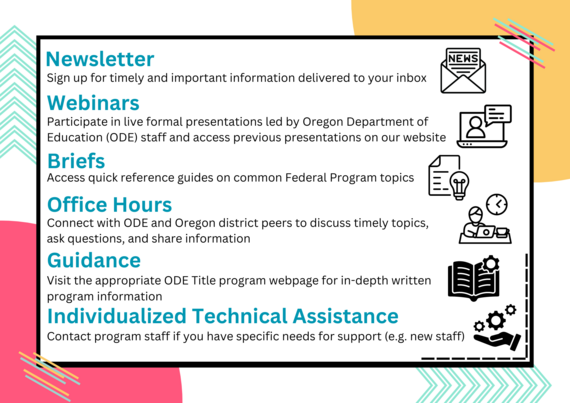
Federal System Team's "Framework of Support"
Our goal is to provide differentiated support and strengthen the partnership between districts and ODE federal program staff. Check out the resources and support below and reach out to let us know how we can support you!
|