|
In This Issue
-
New and Noteworthy: Learn about revisions to the Identification of TAG Students rule, as well as updated requirements for Emergency Procedure Drills and Testing for Lead in Water.
-
November 2025 Assurances - Reporting Highlights and Data: Recognition of districts that have exemplary Division 22 community reports and webpages and an overview of compliance data.
-
Final Notes: Professional learning opportunities and new substance use prevention resources.
|
|
Section 1
 In This Section:
|
|
Proposed Changes to TAG Identification OAR 581‑022‑2325
The Oregon Department of Education will bring proposed amendments to OAR 581‑022‑2325 to the State Board of Education for final adoption in April 2026. The proposed changes will create consistent equitable TAG identification screening practices statewide.
Why the Rule Is Changing
The rule needs to be updated to align with the changes due to passage of SB 934 (2025), which was developed after families engaged The Oregon Association for Talented and Gifted (OATAG) and highlighted inconsistent TAG screening practices across districts in Oregon.
The current rule lacks clear direction on how the initial recommendation for screening should occur. As a result, practices vary widely and may inadvertently restrict student access.The updated rule will:
- Create more on‑ramps for students who may benefit from TAG services.
- Reduce inconsistencies that previously limited identification opportunities.

Key Changes Coming With Adoption
1. Clarification of the Term “Screening”
The rule now includes a formal definition of “screen” specific to TAG: “to use district policies and procedures that have the purpose of identifying which students are eligible to receive talented and gifted services, supports, or programs.” This clarification is necessary because:
- For other Division 22 requirements (e.g., dyslexia, dental, vision), “screening” often implies evaluating all students. This is not necessarily the case for TAG screening.
- For TAG, screening does not automatically mean testing. Many students are identified without additional assessments.
- Districts will use their locally developed policies and procedures specifically designed to screen and identify students as Talented and Gifted.
- If a district includes formal assessments in its process, testing will continue to follow local assessment windows and timelines.
2. Expanded Pathways for Screening Recommendations
To increase access and reduce barriers, the amended rule will:
- Allow any individual who knows the student (educators, parents, caregivers, community members) to submit a TAG screening recommendation.
- Permit screening recommendations at any point during the school year, not just at set intervals.
- Require districts to provide clear information to families about local TAG programs and screening procedures.
3. Clarification of FERPA Concerns
In accordance with FERPA, current district policies require parents or guardians to be notified of their student’s recommendation for TAG screening and provide explicit opt-in consent before screening occurs. The amended draft rules do not change this requirement; only individuals authorized under FERPA will be included in the screening and communication process.
Next Steps
- The State Board will conduct its second reading and vote on the amended rule at the April 16 meeting.
- Upon adoption, ODE will begin developing companion guidance to support districts with successful implementation.
- For questions, contact ODE's TAG Education Specialist Angela Allen at angela.m.allen@ode.oregon.gov.
|
|
|
Changes to Required Emergency Procedure Drills: OAR 581-022-2225
Last year’s legislative session introduced an update to the statute that covers requirements for emergency plans and drills in Oregon schools (moved from ORS 336.071 to ORS 339.408). ODE is currently working on an update to the supporting rule (OAR 581-022-2225) to reflect the changes in statute; the updated rule is scheduled to be adopted by the State Board of Education in May 2026.
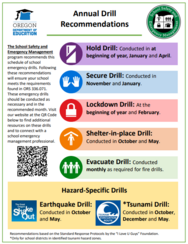
The good news is that if your school or district is already following the School Safety and Emergency Management’s recommendations on what and when to drill, you will have no issues confirming compliance for the 2026-27 school year. If not, then you may need to consider some minor changes to your school or district’s Emergency Operations Plan (EOP) and drill calendar.
|
|
|
2026-27 SY Requirements
Most importantly, the language for the required “safety threat actions”—or your emergency drills—has been updated to align with the Standard Response Protocol (SRP) developed by the I Love U Guys foundation. This does not mean that your school or district must adopt the SRP, but it does mean that you need to have protocols in place that reflect the same types of responses. Here is a breakdown of what will be required in school emergency plans and drills for the 2026-27 school year (changes are identified in brackets):
- A comprehensive safety program that includes plans for the following—an EOP:
- Protocols for Evacuation, Lockdown, Secure [language change], Hold [new] and Shelter-in-Place.
- Communicable disease management (already required).
- Responding to medical emergencies (already required).
- Providing instruction on emergency drills and procedures (30 minutes a month, already required).
- Every protocol identified above must be drilled at least once during the school year [new].
- Earthquake drills must be conducted at least twice during the school year and schools in tsunami inundation zones must conduct earthquake and tsunami drills three times per year (no change).
- School boards are required to consider the installation of a wireless panic alarm system that is capable of connecting with emergency services [new].
It is important to note that the purchase or installation of new systems is not required. But your school board must consider systems that would increase the safety and security of students which may decrease emergency response time. Feel free to contact the SSEM team at ODE.SSEM@ode.oregon.gov if you have any questions about these changes or would like assistance updating your school or district’s safety plans.
|
|

Revisions to Lead Testing Requirements (OAR 581-022-2223 Healthy and Safe Schools Plan)
Thank you to all Districts, ESDs and Charter Schools that have completed testing for lead in water at all their facilities during the past 6 years! The close of the current school year will also mark the end of the first 6-year cycle of mandatory testing for lead in water. ODE has supported this work with more than $1 million in direct laboratory reimbursement and approximately $2 million in additional funding, supporting over 45,000 tests.
With a new testing cycle starting next school year, ODE is taking the opportunity to use lessons learned over the past 6 years to make a few revisions to the rules to make the requirements clearer and improve compliance. There are no major policy changes, with most modifications aimed at cleaning up the language. The proposed revisions are scheduled to be adopted by the State Board of Education in May 2026.
|
Key revisions include:
- Clarifying that districts may report results to the public by electronic mail to just the staff/students/parents associated with a particular building
- Specifying that if a Charter School leases their building from a District, the District will be responsible for testing
- Maintaining testing schedule integrity by requiring schools that miss their scheduled year of testing complete testing as soon as possible. After that, they will return to their initial schedule, even though it will result in testing earlier than 6 years
- Specifying that schools must submit testing documentation to ODE even if they choose not to seek reimbursement
- Specifying that ODE may require use of specific templates and forms for reporting data
For questions, please contact Healthy and Safe Schools Program Administrator Brian Hodges-French at Brian.French@ode.oregon.gov.
|
|
Section 2: November 2025 Assurances
In This Section:
|
|
November 2025 Assurances: Providing Evidence of Compliance
Exemplary Reports
We'd like to recognize the efforts of district leaders who shared Division 22 Standards compliance reports that go beyond the minimum requirements. The following districts provided exemplary reports to their school board and community, including detailed explanations and evidence for compliance on all the standards:
|
|
Honorable Mention
Kudos to the following districts for including some evidence and explanations in their written reports:
Burnt River, Coos Bay, Culver, Dayville, Fern Ridge, Glendale, Imbler, Jefferson, Nestucca Valley, Newberg, North Powder, Oakridge, Pleasant Hill, Riddle, St. Helens, St. Paul, Springfield, Stanfield
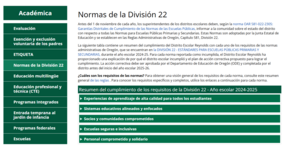 Reynolds SD's translated Division 22 webpage/report
|
Including Speakers of Other Languages
Seventy districts provided reports to their communities in English and Spanish; that is 36% of all districts in the state. A special shout out to districts that posted reports in 3 or more languages:
Beaverton, Centennial, David Douglas, North Clackamas, Parkrose, Reynolds, Woodburn
A Note on Website Translation Tools:
Speakers of languages other than English are not be able to utilize translation tools built into your district website for documents that open in a new window. The solution is to embed the Division 22 report in the district's webpage as opposed to posting it as a separate document (see Reynolds School District Compliance Report for an example).
|
|
School Board Engagement and Webpage Exemplars
ODE encourages districts to provide context for the Division 22 Standards report by posting the slides from the board presentation to help build understanding of what the standards are and why they are important. Some districts also post the video of the board presentation. A dedicated Division 22 Standards landing page makes the report easy to find and many districts archive reports from the last few years there, as well.
|
|
Division 22 Standards Assurances Data
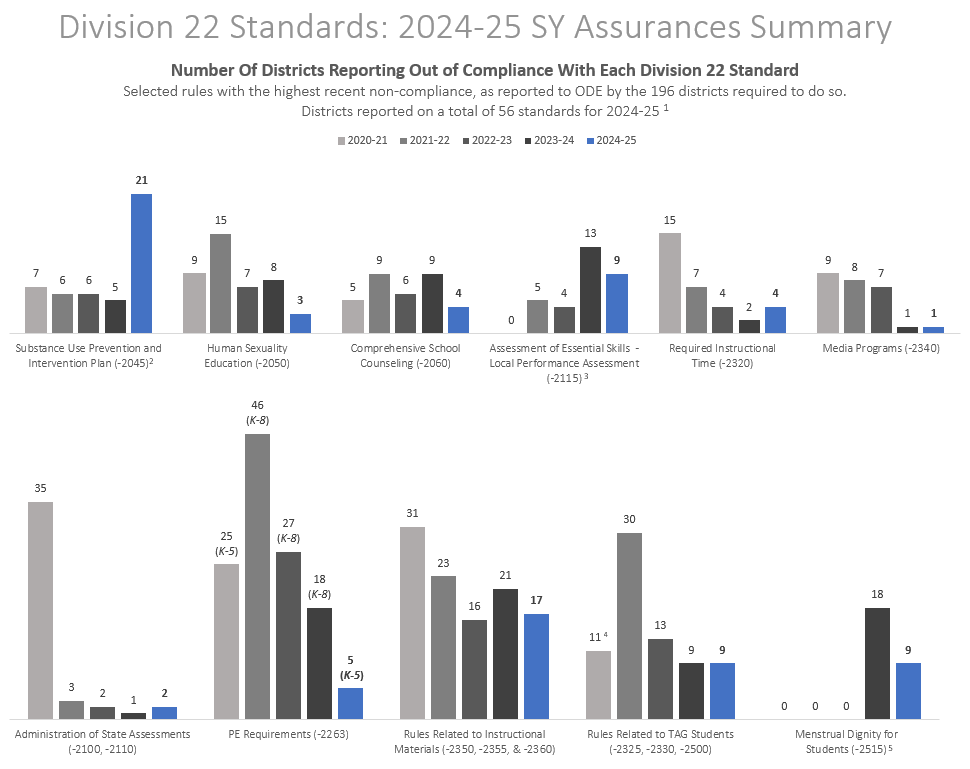
In January, ODE posted an overview of Division 22 Standards compliance data, which includes results from the most recent reporting year as well as historical comparison data. The report shows the number of districts reporting out of compliance on one or more rules and the number of rules with one or more districts reporting out of compliance. It also includes an out of compliance count by rule for the current reporting year, with comparison numbers from the last four years.
The graph below shows selected rules that had the highest number of non-compliance reports over the last five years.
|
|
Section 3
 In This Section:
|
|
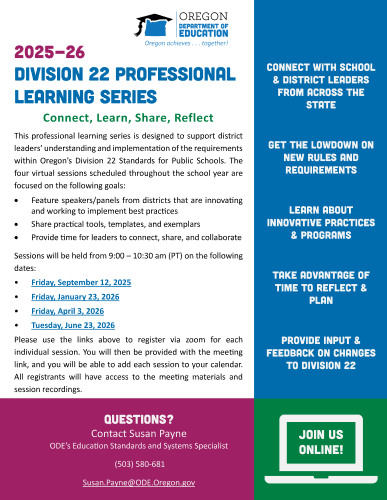
There are two professional learning sessions remaining in the 2025-26 school year. Register now to be in the loop on the latest information and updates on the Division 22 Standards. Recordings and resources will be shared with all registrants.
Friday, April 3, 2026, 9:00 - 10:30 am
The Best Practice Spotlight will focus on understanding the instructional requirements for students identified as Talented and Gifted (OAR 581-022-2500) and how to support teachers in meeting the needs of all learners. Register for the April session here.
Tuesday, June 23, 2026, 9:00 - 10:30 am
Join us for a a deep dive on Oregon's career education requirements (OAR 581-022-2055). ODE specialists will provide guidance for how to intentionally design a career education curriculum that ensures every student has equitable access to the knowledge and skills needed to thrive in school, career, and life. Register for the June session here.
|
Waivers, Extensions, and Postponements: Decoding the Details
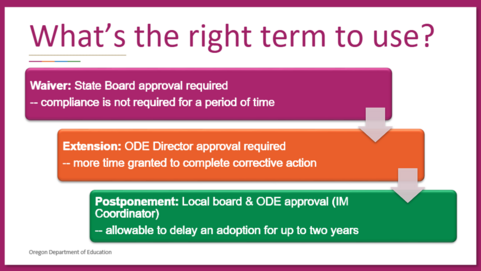
If you are not sure what the difference is between a Division 22 waiver and an extension or postponement, check out this quick video tutorial (7 minutes) from the January Division 22 Professional Learning session. Alternatively, you can review slides 15-20 from the accessible session slide deck.
Screenshot of Slide 16: What's the right term to use?
Substance Use Prevention
Annually Required Opioid Prevention Lessons Are Now Available in Spanish
The ODE Opioid Prevention Lessons, required by OAR 581-022-2045 Substance Use Prevention and Intervention Plan, are now available in Spanish. These lessons and other substance use prevention lessons are available on the ODE website.
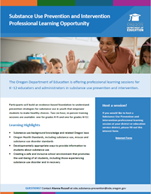
New Substance Use Professional Development Resources from ODE
Two new training packages are available on the ODE website and include all of the materials needed to deliver two, full-day, in-person professional learning sessions designed to support educators’ understanding of substance use prevention strategies and confidence in implementing the ODE K-12 Substance Use Prevention Lessons. The sessions are designed for delivery by regional or district professional learning providers. Training packages are available for both Elementary and Secondary audiences.
For questions or technical assistance, contact ode.substance-prevention@ode.oregon.gov.
|
|
|
|
|
|