|

Welcome to the 2025-26 school year!
This issue includes information on the 2025 Education Accountability Act (SB 141) and highlights newly developed resources to support district implementation of Substance Use Prevention and Intervention plans. If you are new to your role, you’ll want to check out the professional development resources that will help you get up to speed on the basics of the Division 22 standards and how to prepare for the November assurances.
New Newsletter Format!
To improve accessibility, the Division 22 Standards newsletter is now being distributed through GovDelivery, ODE’s digital communications platform. The Division 22 Standards topic is unlisted, so if you know someone who would like to receive the newsletter, they can request to be added to the subscriber list by emailing Division22@ode.oregon.gov. The content is most appropriate for district staff who have responsibility for maintaining and reporting on compliance with the Division 22 Standards.
Newsletters will continue to be archived on the Division 22 Standards Professional Learning webpage, along with all of the recordings and resources from the Division 22 Standards professional learning series. More information about the series can be found in the Final Notes section of the newsletter. If you have any feedback about the new format or suggestions for topics you’d like to see addressed, let us know! Our team is here to provide support and we strive to be responsive to your needs.
|
|
|
Administration of State Assessments Rule Updates
Revisions to OAR 581-022-2100 Administration of State Assessments were approved at the June 12th State Board of Education meeting. This rule, which outlines requirements pertaining to the Oregon Statewide Assessment System, was due for revision as some of its language no longer accurately reflected assessment requirements in Oregon. Revision also provided the opportunity to increase clarity of existing requirements, rectify omissions, and include new required elements (such as the SEED Survey). Revisions to the rule included the following:
- Updated definitions and labels for components of the Oregon Statewide Assessment System (e.g. replacing specific vendor names with generic labels)
- Removed language already present in the Test Administration Manual
- Added SEED Survey as required OSAS component
- Added mention of ELPA Screener as required OSAS component (not a new requirement, just making the rule more complete)
- Added clarification that districts must abide by ODE decisions regarding student test records
- Streamlined and clarified as necessary throughout; removed or updated outdated language
Please contact the ODE Assessment Team with questions or concerns.
The SEED Survey is now a required component of the Oregon Statewide Assessment System.
|
|
Education Equity Advisory Committees
House Bill 2453 was passed in the 2025 Legislative Session and amends statute regarding district equity committees. The bill removes the direct relationship between district equity committees and school boards, thus making district equity committees no longer subject to public meeting law. This addresses a concern many school leaders elevated regarding the sensitivity of the conversations district equity committees are charged to have and the need to ensure committee members can have open and honest dialogue.
Instead of advising both the district superintendent and the school board, district equity committees now inform and advise the superintendent directly.
|
If a district equity committee chooses to prepare an annual report on their work and recommendations, this would still be shared with the school board (either by the superintendent or the committee), distributed to families, and posted on the district website. ODE will be updating its guidance and associated administrative rules to align with this change in statute. Districts will still use the Division 22 Assurances process to report on their compliance with the requirement to have a district equity committee. If your district’s ADMw is under 1650 and you are choosing to establish your committee in regional partnership with other districts and/or your ESD, please complete this Form by September 15th to notify ODE who the best points of contact are for your regional committee. Contact ODE.EII@ode.oregon.gov with questions. |
|
New Administrator Standards
In June, the State Board of Education adopted new school leadership standards, the Professional Standards for Educational Leadership (PSEL). As PSEL standards are already used for licensure purposes by the Teacher Standards and Practices Commission (TSPC) and aligned with those used for administrator preparation, this change will increase cohesion and clarity for leaders across the system. Together, ODE and TSPC will work toward fully implementing these standards by the start of the 2027-28 school year.
We are keenly aware that shifts like this take time. ODE is currently working to set up regional workshops to unpack these standards and translate them into specific and actionable skills, behaviors, and knowledge. If you have any questions, please reach out to Tim Boyd, Director of District and School Effectiveness, at tim.boyd@ode.oregon.gov.
Learn more about what this means for school districts...
|
|
Request for Resources: Administrator Evaluation
At the June professional learning session, we received a request for examples of documents and tools that districts use for the evaluation of district leaders. If you have resources to share, please send them to Division22@ode.oregon.gov.
|
|
Legislative Update: 2025 Education Accountability Act
Senate Bill 141 (2025)—known as the 2025 Education Accountability Act—marks a pivotal advancement in Oregon’s approach to public education. The bill calls for a reimagined accountability system that emphasizes partnership, shared accountability, student outcomes, equity, transparency, and streamlined state oversight.
Learn more about how this will impact Division 22...
|
|
Division 22 Standards Professional Learning Series
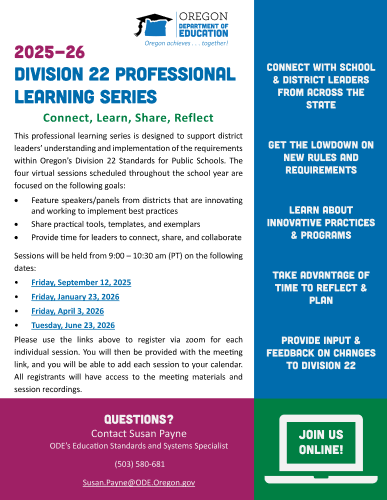
This series is designed to support district and school leaders’ understanding and implementation of the requirements with Oregon’s Division 22 Standards for Public Schools. More details and links to register for each of the quarterly sessions are included on the informational flyer.
Provide Input on Topics and Format for the 2025-26 Series: Please take a few minutes to let us know what you’d like to learn more about in the coming year and provide input on the structure of the sessions.
|
|
Professional Learning Resources
All video recordings and resources from last year’s series are available on the Division 22 Standards Professional Learning webpage. Highlighted topics include Transformative Social Emotional Learning, Comprehensive School Counseling, and Substance Use Prevention and Intervention Plans.
Are You a New Superintendent or District Leader?
The following recorded sessions are recommended especially for you!
-
September 2024: Division 22 Basics (ODE presentation) & Including Evidence on Your Community Report (district leaders sharing in breakouts by district size)
-
June 2024: District Panels on Tracking & Monitoring Compliance (breakouts by district size)
November 2025 Assurances Checklist
Consult the following timeline to ensure you are on track to complete your district's assurances on time.
| Timeline |
Action |
| June - August |
Gather and review evidence of compliance. The District Internal Tracking Tool may be used for this purpose. |
| September 1 |
Deadline to request an extension of the timeline to complete corrective action from the previous year. |
| Thursday/Friday afternoons in the Fall |
Division 22 Standards Help Desk Office Hours - Book an appointment or call 503-580-6814 for questions or support. |
| September or October |
Present the assurances report to the local school board in a public meeting. |
| By November 1 |
Post the community report on the district website. |
| By November 15 |
Submit your report to ODE using the Smartsheet form.
|
|
|
|
NEW RESOURCES NOW AVAILABLE!
|
Substance Use Prevention and Intervention Program
New resources developed by ODE in partnership with WestEd to support students and school communities with substance use prevention are now posted on ODE's Substance Use Prevention webpage and linked below. New resources include comprehensive planning tools and media campaigns. Supplemental materials and professional development opportunities related to substance use prevention and intervention are also available. Questions? Contact ode.substance-prevention@ode.oregon.gov.
|
|
|
Substance Use Prevention and Intervention Comprehensive Planning Tools: These resources include an exemplar Substance Use Prevention and Intervention Plan as well as a template that districts can use to meet the requirements of OAR 581-022-2045 .
Substance use prevention media campaigns: Three campaigns developed in partnership with WestEd and Song for Charlie. These materials, tailored for elementary, middle and high schools, aim to educate students and engage caregivers in discussions about substance use awareness and prevention.
New opioid prevention lesson plans for grades K-12
|
Substance Use Prevention Virtual Professional Learning Series. ODE hosted a series of virtual webinars throughout May designed to equip Oregon’s educators and school administrators with essential knowledge and resources to prevent opioid misuse, support at-risk students, and foster prevention-awareness in a proactive school-based climate. |
|
Division 22 Required Trainings
Our Division 22 team has developed a new one-pager that outlines all staff training that is required as part of the Division 22 Standards.
|
|
Menstrual Dignity Rule Change: Request for Feedback
ODE is considering a change to the menstrual dignity grant reimbursement process. Since 2021, the Menstrual Dignity for Students Program has operated on a yearly cycle, providing school districts, charter schools, and ESDs new grants or grant amendments every year.
Based on external feedback and ODE streamlining initiatives aimed at reducing administrative burden, ODE is proposing revising OAR 581-021-0596 to require a biennial grant and reimbursement process, rather than a yearly one. This would mean that ODE would determine how much funding is available to eligible entities each biennium, using 100% of the legislatively approved budget, without a 49% / 51% yearly split.
ODE is looking for feedback on the impact of this proposed change. Please complete by September 2, 2025.
|
|
|
|
|