Ashland Middle School Students Win OBOB State Championship Title
Ashland Middle School students have earned top honors taking home the title at this year’s Oregon Battle of the Books (OBOB). Designed to spark enthusiasm for reading, the OBOB program challenges students to dive into a diverse list of books and then demonstrate their knowledge in a series of team-based quiz battles. The event not only celebrates literary achievement but also builds critical thinking, collaboration, and a lifelong appreciation for reading. Read more about the winning team in this article.
NEW: FAQ Transitioning into Kindergarten for Families
The Oregon Department of Education (ODE) and the Department of Early Learning and Care (DELC) have released a new Frequently Asked Questions (FAQ) Transitioning into Kindergarten for Families. The FAQ will help answer common questions families have about kindergarten and is translated into nine different languages.
National Student Support Accelerator Program Survey Opportunity
The National Student Support Accelerator, a program of the SCALE Initiative at Stanford University, is conducting a survey on the impact of Elementary and Secondary School Emergency Relief (ESSER) funding on the creation of high-dosage tutoring programs and learning recovery efforts after the pandemic. They are seeking school districts’ perspectives on the ways in which districts are responding to the end of ESSR funds. The survey will take about 20-30 minutes to complete and a $25 gift card to Amazon will be given as a token of appreciation. If you are a district leader and implementing a high-dosage tutoring program, please consider sharing your perspectives here. Thank you!
Literacy Leaders’ Network Meeting: June 5 – Save the Date!
Our Mission: To build a literate society of readers, writers, thinkers, and listeners
Purpose: The goal of the Oregon Literacy Leaders’ Network (LLN) is to build a diverse community of language arts and literacy practitioners working together to share inclusive literacy practices–reading, writing, speaking, and listening–that align with the needs of all students (i.e. multilingual learners, students experiencing disabilities, etc.).
Who we are: Collectively, we are individuals who support literacy development for students.
When do we meet?
- Meet virtually every Second Thursday on Zoom, from 3:30-5:00 p.m.
What to Expect in Monthly Meetings:
- Meet and connect with other literacy practitioners from across Oregon
- Share a “Bulletin Board” of opportunities
- Collaborate through self-selected breakout rooms to go deeper on topics of interest
- Read, write, and think about language arts and literacy together, occasional featured speakers
- Highlight high-leverage instructional practices
Link to Professional Learning Goals:
- Tie your attendance and participation in the LLN to your professional learning goals, particularly for goals 9 & 10, with local administrator approval.
- Receive professional learning and build a professional network during LLN meetings.
- Earn PDUs for your attendance and participation in the LLN.
Meeting Facilitation: Co-hosted by Oregon Council of Teachers of English (OCTE), Oregon State Literacy Association (OSLA), Oregon Association of School Libraries (OASL) and the Oregon Department of Education Language Arts, Literacy, Assessment, and Multilingual and Migrant Education teams, Office of Indian Education, and WestEd.
K-5 Newsletter
The Oregon Department of Education’s (ODE) Office of Teaching, Learning, and Assessment is launching a new quarterly newsletter for K-5 educators. This newsletter provides resources, opportunities, guidance, and ODE updates tailored specifically to support the integrated and well-rounded instruction that elementary education entails. It aims to streamline information related to K-5 academic standards and instruction into one convenient communication.
To sign up for the newsletter, click here
Amplify Podcast: Everything You Need to Know About Knowledge Building
Building background knowledge is essential to reading comprehension—and to literacy more broadly—yet it is often overlooked, particularly in discussions surrounding the science of reading. Susan Lambert, Amplify’s Chief Academic Officer of Literacy, and Jackie Eunjung Relyea, Ph.D., Assistant Professor of Literacy Education in the College of Education at North Carolina State University, discuss how to support the integration of background knowledge into instruction and help cultivate a content-rich learning environment in Amplify’s Science of Reading: The Podcast, Season 9, Special Episode.
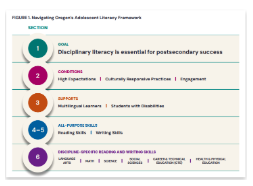
Oregon Department of Education Has Published the Adolescent Literacy Framework
The Oregon Department of Education (ODE), in partnership with WestEd, released the Adolescent Literacy Framework on February 25, 2025. This document serves as a guide to support literacy instruction across the disciplines in grades 6-12. The new framework is housed on the Adolescent Literacy Framework page on ODE’s website.
|
Native Ways of Knowing: Debbie Reese; Learn About New Children’s Books by Native People
San Diego County Office of Education is hosting Native Ways of Knowing: Debbie Reese; Learn About Children’s Books by Native People. Attendees from outside of California are welcome; register one time for access to upcoming webinars and past recordings.
OASL Fall Conference: Session Proposals Being Accepted
The Oregon Association of School Libraries’ (OASL) annual fall conference will be at North Eugene High School on Saturday, October 4, 2025. It’s always a powerful professional learning experience and networking opportunity. The conference committee is currently accepting session proposals through at least early May. They would love to have you be part of the conference and share your ideas with other library staff. Please direct questions to Jessica Lorentz Smith (jessica.lorentzsmith@bend.k12.or.us) or Amy Page (page_a@4j.lane.edu).
Virtual Multilingual Learner Symposium, June 5, 2025
Don’t miss this one-day, virtual learning experience designed for educators supporting multilingual learners! Featuring a keynote by Dr. Ayanna Cooper and six timely, interactive breakout sessions, this event will offer practical, research-based strategies to strengthen multilingual learner programming, family engagement, literacy, and more. Click here to register for this event.
Free Formative Assessment for English Learners/Multilingual Learners: Level 1 & Level 2 Workshops, June 2025
Looking to strengthen your formative assessment practices for English Learners (EL) and Multilingual Learners (ML)? These engaging, hands-on workshops are designed to support educators in using real-time feedback to guide instruction and monitor student progress—while keeping student assets at the center.
Level 1 offers a strong foundation in formative assessment practices tailored for EL/MLs. Participants will explore the components of an effective formative assessment framework, learn to identify and collect evidence of language development, and apply new strategies for embedding assessment throughout instruction.
Level 2 builds on this foundation by helping participants apply the formative assessment framework to each phase of the lesson cycle. Attendees will practice collecting, analyzing, and responding to student performance data in real time to support both language development and content learning. Participants can choose from the following workshop dates.
You will receive the joining information and the link to download your notetaking guide.
Online Course: Teaching Early Literacy from a Multilingual Perspective, July 7 – August 10, 2025
A five-week summer session of Teaching Early Literacy from a Multilingual Perspective, Oregon State University professional learning course, is now open for registration on a first-come, first-served basis. It will run online asynchronously between July 7-August 10. This course is designed to empower K-5 educators with the knowledge and tools to implement culturally responsive, multilingual literacy instruction. This course aligns with the Oregon Department of Education's Early Literacy Framework, ensuring your teaching strategies reflect current best practices for fostering literacy in diverse classrooms. For more details or to register, visit the Teaching Early Literacy from a Multilingual Perspective page or view the flyer.
Contact murphym@wlwv.k12.or.us with questions, comments, or suggestions.
WestEd Offers Summer Reading and Writing Apprenticeship Opportunities
Looking to enhance classroom instruction, deepen expertise in academic literacy, or support students in more meaningful ways? Reading Apprenticeship offers a range of professional learning opportunities—both in-person and online—for middle and high school educators, administrators, and college faculty. This summer, explore our offerings and connect with a community of educators dedicated to advancing student success.
Essentials I is the perfect starting point for you and your team to begin your journey with Reading Apprenticeship. Designed for middle school, high school, and college educators, this professional learning experience—offered both in-person and online—introduces practical strategies for building a supportive classroom community that centers on student strengths and meaningful texts.
Essentials II is designed to deepen and expand your Reading Apprenticeship practice. Focusing on practical routines that support cognitive development and knowledge-building in the classroom, in this next-level experience for middle school, high school, and college educators, educators will learn how to embed targeted strategies that help students activate personal schema and engage more effectively with disciplinary texts, language, and concepts. Essentials II also offers a deeper exploration of the Reading Apprenticeship framework’s four dimensions of learning—social, personal, cognitive, and knowledge-building—through the continued use of metacognitive conversation.
Writing Apprenticeship, geared toward middle school and high school language arts teachers and history/social studies teachers, features an instructional approach that transforms classroom instruction by engaging students in authentic, discipline-specific writing, thinking, and dialogue within a supportive learning environment. Through this approach, students develop strong writing capacities in the humanities, gaining the tools to write with clarity, purpose, and confidence.
2025 Confederated Tribes of Grand Ronde Education Summit–Registration Open
Registration is now open for the 2025 Confederated Tribes of Grand Ronde Education Summit!
📅 Date: Wednesday, August 6, 2025
📍 Location: Spirit Mountain Casino in Grand Ronde, Oregon
🎓 Theme: Sacred Teachings, Strong Communities
This year’s summit will bring together educators, administrators, and community leaders to explore how culturally rooted education strengthens students, families, and communities. Join for a day of inspiring speakers, interactive workshops, and collaborative learning centered on Indigenous knowledge, educational sovereignty, and place-based practices.
👉 Register now
Please feel free to share this invitation with colleagues and partners. Looking forward to learning, growing, and building together.
National Council of Teachers of English’s New Grant Program for Teaching Memoir
Educators are invited to apply for a new grant program from National Council of Teachers of English (NCTE), Penguin Random House, and the Anne Frank Fonds. This funding would support educators in using memoir to educate and inspire student writers.
Through the new award program, ten English teachers will each receive a $1,000 grant to teach memoir across language arts education—especially texts focused on children’s voices and experiences during times of war, such as The Diary of a Young Girl.
The application is open through August 1. Grant recipients will be selected by a panel comprising teachers appointed by NCTE and a representative from the Anne Frank Fonds and Penguin Random House Education.
Application and more information
Oregon’s Kitchen Table and Oregon’s Department of Environment Quality Seeking Feedback
Oregon's Kitchen Table (OKT) organizes opportunities that allow Oregonians to influence the decisions that impact their lives. Oregon's Department of Environmental Quality (DEQ) is working to create a statewide plan to manage nutrients in our water. They have partnered with OKT to solicit feedback. Educators and students can share their thoughts by completing this survey or by hosting a classroom conversation and sharing a summary with OKT!
Next Up Action Fund
Oregon House Bill HB 3012, also known as the Student Voice and Democracy Act, would allow registered 16- and 17-year-olds to vote in local school board elections. Advocates say this gives students a voice in their education and strengthens democracy. Young people can share their views on this issue through Monthly Lobbying Days, Monthly Advocacy Nights, and the Contact Your Lawmakers Form.
Write the World Writing Competitions for Students
Write the World helps “students develop the writing skills they need to succeed and make an impact” on their world.” There are seven writing competitions currently available.
If you have ideas for the newsletter or want to contact the ODE Language Arts and Literacy specialists, please reach out:
Language Arts Education Specialist -- ODE.LanguageArts@ode.oregon.gov
English Language Arts / Social Sciences Assessment Specialist -- ode.assmtteam@ode.oregon.gov
K-2 Balanced Assessment Specialist -- ode.assmtteam@ode.oregon.gov
Early Language and Literacy Intervention Specialist -- ODE.LanguageArts@ode.oregon.gov
PreK-3rd Grade Coordinator -- ODE.LanguageArts@ode.oregon.gov
Multilingual and Migrant Education Specialist -- ODE.LanguageArts@ode.oregon.gov
Literacy Specialist -- k12.literacy@ode.oregon.gov
|