
Hello,
I hope this finds each of you doing well, your efforts and activities to serve and give hope to our pre-k, school-aged, and unaccompanied youth are appreciated. This includes partnering with your community agencies, local and statewide, that assist and support families when school is not in session. The newsletter includes resources from office hours, new federal guidelines on the ARP-HCY program and more.
Office Hours Calendar
|
October 16th 1:30 pm - 2:30 pm
|
|
|
November 16th 1:30 pm - 2:30 pm
|
- Senate Bill 819
- Resources to support students receiving services under 504
|
|
December
|
|
Revisiting September Office Hours
The Department of Early Learning and Care (DELC) spoke about the different Early Learning Programs throughout the state and shared free resources for families with children ages 0-5. Also, our friends on the JumpStart Kindergarten team shared their ToolKit and upcoming training for the year. Beaverton School District shared how they organize their staff and program activities to support students receiving services under McKinney-Vento. All of the shared resources can be found at this link. Following each office hours, ODE will share and post an FAQ that answers the questions raised each month on our website.
Preview of October Office Hours
Stay tuned for October office hours which will feature Diego Contrearas Medrano, a Research Analyst on the Migrant and Multilingual Education Team. We will also have a presentation from Marivi Wright, McKinney-Vento Liaison for the Albany School District who is going to talk about how they used ARP-HCY funds to meet the strengths and needs of their kids like developing a Resource Closet.
New Federal Guidance Urges Expediting ARP-HCY Funds
The U.S. Department of Education released a “Dear Colleague Letter” which expanded the allowable uses of funds under the American Rescue Plan - Homeless Children Youth program to meet urgent strengths and needs of students. Some of the expanded uses of funds include:
- Motel stays of longer than three days if “reasonable and necessary” to allow children and youth to attend school, and as a last resort when other funding resources are not available.
- The leasing and purchase of vehicles for the transportation of children and youth navigating housing insecurity, as well as reimbursing parents and youth for gas costs, purchasing prepaid gas cards, and paying for limited car repairs if such costs are reasonable and necessary.
- Providing food assistance if it is reasonable and necessary to assist students experiencing housing insecurity to take advantage of educational and extracurricular opportunities when food is not available to the student through other sources (e.g., free school meals).
- Providing early childhood education to children ages birth to five who are not formally enrolled in the district, but who are navigating housing instability. The Department of Education further elaborated that activities to transition children to kindergarten, coordinating screenings, referrals, activities to determine eligibility for subsidy, and early intervention services (including transportation to those services) are examples of other allowable early childhood activities.
- Assisting youth and their parents/guardians with completion of the Free Application for Federal Student Aid (FAFSA) and many other college readiness and college access activities, adding staff hours to provide such assistance, and providing transportation so that students navigating housing instability may participate in these activities.
Updating Your Point of Contact in the CIP Budget Narrative
In order for us to ensure communication flows to the right person, please make sure your McKinney-Vento or Homeless Liaison Point of Contact is up to date:
To update your district’s McKinney-Vento Homeless Liaison or McKinney-Vento Homeless District Administrative Contact, please revise the Contacts Section of your district’s 2023-2024 CIP Budget Narrative Application. CIP Budget Narrative can be accessed via the Central Login Application on the ODE District Website. For CIP Budget Narrative permissions please connect with your District Security Administrator (DSA).
We recognize that as the Point of Contact you may not have access to the CIP Budget Narrative. Please consider using this draft language when communicating with your District Security Administrator to advocate for communication that will benefit your students and families affected by housing instability.
Hello,
I hope you are doing well. I am the McKinney-Vento Liaison for students experiencing housing instability in the [insert school district]. To adequately serve some of our most vulnerable students it is important that the district updates the McKinney Vento Liaisons Contact with the Oregon Department of Education. This will not only make sure that we are compliant with State and Federal Laws, but also ensure students and families are able to reach me if they need assistance. This will ensure I receive the resources and support I need in this position. My updated contact information is included in my signature below. If you have any questions, please consider reaching out to the State Coordinator Chris James at chris.james@ode.oregon.gov.
Sincerely,
[insert your signature]
10-Day Drop and Students that Qualify as Mckinney-Vento
The beginning of the school year is often a time when students are transitioning to new schools and settling into new routines. As you work with families and students to ensure a successful start to the school year, it is important to note that a school district policy that automatically drops a McKinney-Vento student after 10 days of non-attendance, with no regard for the causes of the absences, the impact of the students housing situation, or intervention to support attendance, is a violation of the McKinney-Vento Act. As a result, school and district leaders must demonstrate due diligence to reach out to the student(s) and/or their parents/guardians and provide services if a student has consecutive absences. If after 10 consecutive days of absence, per the Cumulative ADM and funding rules, the student must be dropped from enrollment reporting. The district, however, is still accountable for providing services to the student(s). The following are resources and more information about the 10-day drop policy as it relates to students who qualify for services under McKinney-Vento:
Question: My understanding is that we cannot do a 10-day drop for students receiving McKinney-Vento services. Is this correct? Any differences specific to the online environment?
Answer: Under the McKinney-Vento Act, local educational agencies must “review and revise policies to remove barriers to the education of homeless children and youth, including barriers to enrollment and retention due to outstanding fees or fines, or absences.” 42 U.S.C.§11432(g)(1)(I). This includes providing immediate outreach to the student(s) and their family/guardian immediately if the student is absent for one or more consecutive days.
Per the rules for Cumulative ADM and funding, students must be dropped from enrollment reporting (“active roll”) after 10 consecutive days of absence. However, school and district leaders must continue to attempt outreach to students who are experiencing housing instability, during that time, and after removing them from the active (enrollment) roll.
Question: The answer on the 10-day drop doesn't align with ODE policy. A student who leaves and cannot be reached after many attempts will need to be dropped - what other options do we have? We can't keep a student as Active who the district hasn't seen in weeks.
Answer: The 10-day drop policy is required for Cumulative ADM and funding reporting but must not be used to remove responsibility to attempt to reach students receiving services under McKinney-Vento. When students are absent, it is best practice to have a discussion internally and reach out to the parents. Questions to consider include how soon the school or district waited to initiate contact, what was the first method of communication, and what if any extenuating circumstances surround the lack of attendance.
Clarification Regarding Eligibility to Participate in National School Lunch Program (NSLP) or School Breakfast Program (SBP) for Students Enrolled in Virtual or Online School
Students that are enrolled in an online/virtual school are not eligible to participate in the National School Lunch Program (NSLP) or the School Breakfast Program (SBP). The regulations found at 7 CFR 210.2 define a school as: “An educational unit of high school grade or under, recognized as part of the educational system in the state and operating under public or nonprofit private ownership in a single building or complex of buildings”.
Therefore, students that are not enrolled in, or attend a ‘brick and mortar’ physical school would not be eligible to participate in the NSLP or SBP.
Should an online/virtual student attend a brick and mortar school that participates in NSLP and/or SBP for a specific program, such as tutoring or lab, and the class is during the meal service time, that student would be eligible to participate in the meal service if the meal is consumed as part of the school program and is on the school/school related premises.
Guidance shared with districts: Clarification regarding eligibility to participate in NSLP/SBP for students enrolled in virtual/online school (govdelivery.com)
Connecting with the Oregon Child Development Coalition (OCDC)
The Oregon Child Development Coalition (OCDC) provides Early Childhood Care and Education services to children, pregnant women, and families. OCDC connects families to programs, services, and opportunities in the community. OCDC is a non-profit organization and operates 9 early care and education programs all functioning under Early Head Start, Head Start, Migrant and Seasonal Head Start and Home visiting.
They provide transportation to and from centers, comprehensive early care and education environments and engage with families as their child’s primary teacher and advocate.
OCDC is engaged with 9 Child Care providers in rural communities across Oregon to support low-income families access to high quality Early Head Start opportunities, and they also provide Home Visiting Early Head Start opportunities in 3 counties.
All families must fall below 130% of FPL to quality for most of the head start services. Families that are considered McKinney-Vento are categorically eligible and qualify for services, regardless of their income level.
For more information, contact Karen Ayers at karen.ayers@ocdc.org.
Additional Training
We will share resources throughout the year to help you be successful in your position. We’d like to highlight some initial resources below:
We recognize this work is challenging in ways we do not know until we are alongside our students and their families. We welcome you to ask for help, as we are all learning. Please remember to take care of yourselves. We look forward to partnering, problem-solving, and persevering with you during this school year. Please, do not hesitate to reach out.
Respectfully,
 Chris James, State Program Coordinator, Chris.James@ode.oregon.gov
For translations of this document, please reach out to OR-MV@ode.oregon.gov.
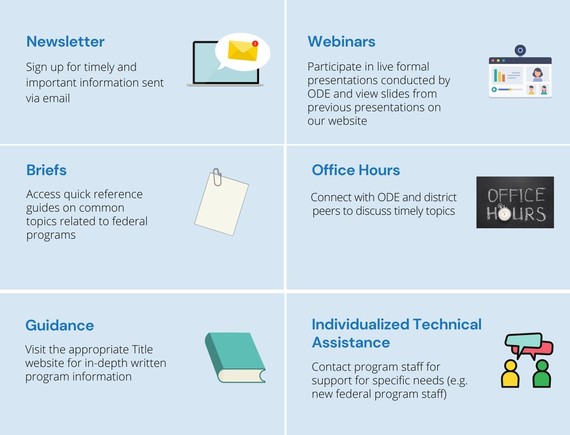
Federal System Team's "Framework of Support"
Our goal is to provide differentiated support and strengthen the partnership between districts and ODE federal program staff. Check out the resources and support below and please don’t hesitate to reach out and let us know how we can support you!
|