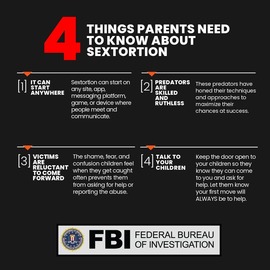
Sextortion and Online Safety Concerns
Governor Mike DeWine signed HB 531 earlier this spring that criminalizes the sextortion of minors and imposes new requirements on social media companies regarding information about minors who have committed suicide.
The legislation followed the high-profile suicides of two Ohio teenagers. One of the teens died by suicide within an hour of being extorted for money after sending inappropriate pictures of himself to someone he believed to be a fellow teen.
The new law classifies sextortion as a third-degree felony. Additionally, it mandates that social media companies provide account access to the parents of teens who have committed suicide within 90 days of the death.
Prevention and intervention are key to combatting the crime of sextortion. Through education and awareness, the Ohio School Safety Center hopes to make students and families aware of this issue and the many resources that are available to help.
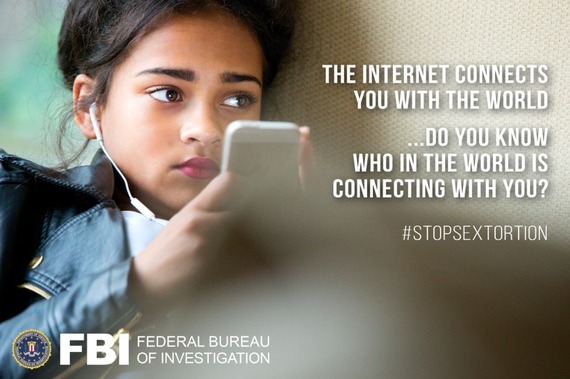 Over the last three years, the FBI has observed a significant increase in financially motivated sextortion schemes targeting young males ages 14-17. Sadly, more than 20 minor victims have died by suicide as a result of being a victim of sextortion.
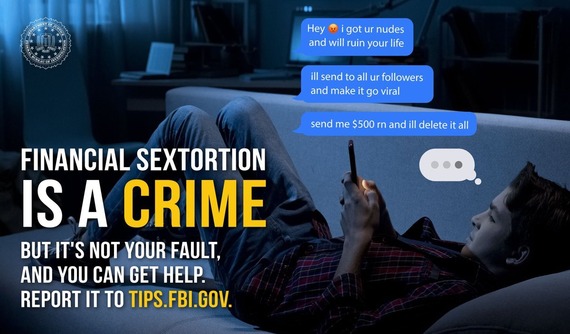
Sextortion is a crime in which a predator coerces a minor into sending sexually explicit images. Then, through threats or manipulation, the predator forces the victim to send more pictures, videos, money, and/or meet in-person. The predator may initiate this interaction by approaching the victim online as a friend or peer. At times, it can start more aggressively with the predator claiming to already have an illicit image of the victim that they are going to share with others. By asking for or demanding images of a minor, the perpetrator is committing a crime.
According to the FBI’s Internet Crime Complaint Center (IC3), there were over 54,000 victims of sextortion in 2024, up from 34,000 in 2023. Over the last two years there have been nearly $65 million in reported financial losses due to this crime.
What do schools need to know?
- Sextortion can impact your students and families.
- It is important to discuss what sextortion is and resources that are available to help.
- Ensure staff, parents/guardians and students know the warning signs of sextortion. Use our letter templates below to share information for parents/guardians and students.
- The FBI has a list of warning signs and recommendations on internet safety. https://www.ic3.gov/PSA/2023/PSA230912
 764 Group Targeting Minors
The FBI is warning students, parents, and educators about the group “764” and other violent online networks that are targeting minors. It is important for the public to be aware of the risk these groups pose and the warning signs exhibited by victims. These networks use threats, blackmail, and manipulation to coerce or extort victims into producing, sharing, or live-streaming acts of self-harm, animal cruelty, sexually explicit acts, and/or suicide. The footage is then circulated among members of the network to continue to extort victims and exert control over them.
The networks use extortion and blackmail tactics, such as threatening to swat or dox their victims, to gain compliance. The actors often coerce victims to produce Child Sexual Abuse Material (CSAM) and other videos depicting animal cruelty and self-harm. Self-harm activity can include cutting, stabbing, or “fansigning.” Members of the networks will threaten to share the explicit videos or photos with the victims' family, friends, and/or post the material to the internet.
The networks control their victims through extreme fear and intimidation. Many members have an end-goal of forcing the victims to live-stream their own suicide for the network's entertainment or to increase the perpetrator’s own fame.
|