|
Issue 41: August 19, 2025 |
|
For Your Awareness
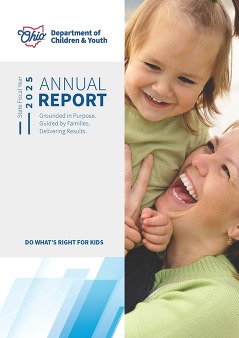
DCY Releases State Fiscal Year 2025 Annual Report
The Department of Children and Youth (DCY) has published its SFY25 Annual Report, highlighting key achievements, data insights, and strategic initiatives that shaped the year. Discover how DCY continues to advance its mission of supporting Ohio's children, youth, and families.
At DCY, we've taken the call to "DO WHAT'S RIGHT FOR KIDS" to heart — because we know that behind every policy is a child who needs us all to do better.
The comprehensive report demonstrates DCY's dedication to transparency and accountability, providing stakeholders with valuable insights into how the department continues building a stronger, more supportive environment where all Ohio children and youth can thrive.
|

Stronger Together Series: September Webinar
The Department of Children and Youth (DCY) invites you to attend the September 2025 Stronger Together webinar. The webinar will feature four family navigator programs from the Department of Health, the Department of Mental Health and Addiction Services, OCALI and the DCY. Learn how these programs connect families to vital resources they need to support their children and serve as a trusted guide in accessing needed services. Please feel free to share the flyer with others who would benefit from this information.
|
|
|
Maternal & Infant Wellness |
|
|
Programs focus on eliminating health disparities, improving birth outcomes, and improving the health status of pregnant women, infants, and children to ensure moms and babies celebrate the child’s first birthday.
|
|
Governor DeWine, Lt. Governor Tressel Announce Nearly $20 Million to Support Young Families and Advance Infant Health
Ohio Governor Mike DeWine, Lt. Governor Jim Tressel, and Ohio Department of Children and Youth (DCY) Director Kara Wente announced earlier this month nearly $20 million over the biennium in grants to 21 nonprofit organizations across the state through the Ohio Parenting and Pregnancy Program. These grants will connect expectant parents and caregivers to education, support, and trusted local services—giving more Ohio babies a healthy start in life.
|
|
Early Childhood Development |
|
|
The Early Childhood Development programs provide technical assistance, education, and referrals for families and youth with evaluations regarding specific needs and disabilities.
|
|
A Story of Thriving Through Early Intervention
At just 20 months old, a bright, energetic little girl continues to defy the odds. Born medically fragile at Boston Children’s Hospital, she was diagnosed with several complex conditions, any one of which could have significantly impacted her development.
Before discharge, a referral was made to Early Intervention (EI) services in her home county. This early connection allowed the team to step in quickly, with a Service Coordinator assigned and services beginning within a month of referral, setting the stage for a strong partnership from the very beginning.
Thanks to collaborative care between Early Intervention, her medical providers, and a physical therapist who offered virtual services, she is now thriving. Despite a daunting prognosis, she is walking, talking, eating, playing, and learning new skills every day. The challenges she faces, including potential difficulties with feeding, breathing, motor skills, communication, and cognition, have been met through her remarkable family and EI team.
She lights up when playing with her older siblings, reading with her grandmother, dancing with her dad, and cooking pretend meals in her play kitchen. What once seemed uncertain has become a story of resilience, joy, and possibility.
This family’s journey highlights the power of early identification and the profound impact of a teaming approach. Recently, the child’s mother shared her appreciation for the support they’ve received from their EI team. She spoke highly of the developmental specialist working with their family, praising her ability to not only support her daughter’s development but also engage the entire family in the process. The mother reflected on the contrast between outpatient services which she described as more structured and time-bound and the EI approach, which she described as warm, flexible, and personal.
Her kind words serve as a powerful reminder of the difference Early Intervention can make by meeting families where they are, building strong relationships, and helping every child reach their fullest potential.
|
|
📣 Early Intervention Forum – Registration Now Open!
Join OACB and DCY, along with Part C providers, partners, and families throughout
Ohio to hear the latest topics and research on best practices for Early Intervention!
All Part C Providers and families are welcome to attend!
|
|
|
Initiatives work to connect educators, families, and youth to education
services and supports.
|
|
Introduction to the Updated Early Childhood Education (ECE) Grant Program
The ECE Grant Program helps prepare children for kindergarten by offering high-quality early learning services to preschool-age children in Ohio. It aims to make early care and education more accessible, improving kindergarten readiness across the state.
Starting in September 2025, the ECE Grant Program will become permanent Ohio law under Ohio Revised Code (ORC) Section 5104.53. This makes the process easier for families and expands opportunities for their preschool children through the Ohio Benefits (OB) system.
How Will This Impact Me?
Here are some important updates and changes to the ECE Grant Program:
-
Rules: Drafting administrative code rules in state fiscal year (SFY) 2026 to further solidify eligibility and other key criteria with the goal of making everyone’s jobs easier.
-
Determining Eligibility: Updating eligibility determination to county agencies using the Ohio Benefits system simplifying funding processes and helping maintain financial responsibility at the state level.
-
Access to Programs: Establishing some exceptions that allow families to use both Publicly Funded Child Care (PFCC) and ECE for their preschool-aged child (as long as the service hours do not overlap), rather than having to use Child Care Voucher Program (CCVP) or ECE Grant. Families can apply at their local Ohio Department of Job and Family Services office or online at benefits.ohio.gov.
-
System Integrations: Enhancing the Self-Service Portal (SSP), Web Search for Early Care and Education Services, and Ohio Child Licensing and Quality System (OCLQS) to facilitate the transition of providers to Ohio Benefits, upon completing the provider agreement, enabling county agencies to authorize them to offer ECE services.
-
Reporting and Notices: Updating old reports, making new ones, and changing forms and notices to communicate better with counties, families and providers.
For more information about the ECE Grant Program, visit the ECE Grant website. Please contact EarlyChildhoodEducation@childrenandyouth.ohio.gov with any questions or concerns regarding the ECE Grant Program.
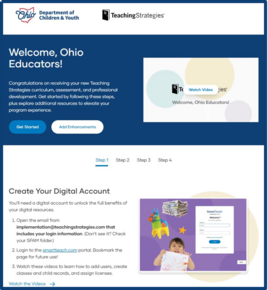
Teaching Strategies ® Tips and Tricks, Getting Started
Has your Teaching Strategies® curriculum request been approved? Are you unsure what to do next?
Once curriculum requests are approved, while you’re awaiting your print copies of The Creative Curriculum®, Guided Edition, Teaching Strategies® will provide you with information to begin exploring your program’s digital subscription.

|
|
Upcoming Webinar: Getting Started
with GOLD® + Finch Formative Games
Join Teaching Strategies® for Getting Started with GOLD webinar for an overview of the key assessment tools used. Topics will include reviewing how to effectively use the Objectives for Development and Learning, learning to guide your observations, entering documentation, and completing the GOLD® assessment. In addition, participants will also be introduced to Finch, an interactive game-based assessment connected to the GOLD assessment.
September 4, 2025 10:00 a.m. to 11:00 a.m. Join Webinar
OR
September 10, 2025 1:00 p.m. to 2:00 p.m. Join Webinar
Understanding SUTQ: Who Needs to Be Rated?
Step Up To Quality (SUTQ) is Ohio’s quality rating and improvement system for early childhood education programs. It’s designed to recognize and promote programs that go above and beyond in providing high-quality care and education to young children.
As part of ongoing efforts to ensure excellence in early learning, it’s important to understand which programs are required to participate in SUTQ and which may choose to opt in.
Who Is Required to Be SUTQ Rated?
Programs must be rated if they meet any of the following criteria:
-
PFCC Participation: If a program provides Publicly Funded Child Care (PFCC) to 25% or more of its licensed capacity, it must be rated.
-
ECE Grant Recipients: Programs that receive an Early Childhood Education (ECE) grant are required to maintain a high rating, either Silver or Gold.
-
Multiple Classrooms or Funding Types: If any classroom within a licensed program receives PFCC or ECE funding, the entire program must be rated and meet all applicable standards.
Who May Choose to Be Rated?
Some programs are not required to participate in SUTQ but may voluntarily opt in and demonstrate their commitment to quality:
- Type A or Type B Family Child Care Homes
- Programs that receive preschool special education funding but do not receive PFCC or ECE grants
Participating in SUTQ is a meaningful way to showcase your program’s dedication to providing exceptional early learning experiences. Whether required or optional, being rated helps families make informed choices and supports continuous improvement across Ohio’s early childhood system.
Welcome Back to School! Supporting Transitions, New Beginnings, and Strong Partnerships
As we kick off a new school year, the DCY's Preschool Special Education Team is excited to welcome all educational agencies and preschool students back to school. Whether your child is beginning preschool, transitioning from early intervention services, or simply adjusting to a new school environment, we’re here to ensure every student starts strong. We are also here to support our educational agencies in understanding the procedures and practices that ensure all children learn and grow. Our goal is to partner with educational agencies to help ensure every child has access to the general education classroom and instruction.
To help educators and parents build confidence in special education procedures, the DCY Preschool Special Education Team has developed the Preschool Special Education 101: From Rule to Implementation video series. We’re committed to making the process clear and empowering. From evaluations and meetings to understanding parent rights, our approach emphasizes individualized planning and active family engagement. For those new to special education, we offer guidance through Child Find evaluations and provide universal support videos that break down the special education process step-by-step.
The short videos are designed to help both parents and educational agencies:
- Understand Child Find, a federal requirement for identifying and evaluating children who may have a disability
- Stay informed about parental rights in the special education process
- Understand the purpose and structure of the Evaluation Team Report
- Learn who is involved and how decisions are made
- Know what to expect during meetings and evaluations
- See how the process aligns with the Individuals with Disabilities Education Act (IDEA)
|
|
Family Support & Stabilization |
|
|
Focuses on enhancing the resources and supports available to parents and families.
🧩 Support Your Parents with Trusted Resources
As professionals, many of us are also caregivers—or know someone who is. The Ohio Children's Trust Fund provides a wealth of resources designed to support parents in building stronger, healthier families. From caregiver centered supports and insightful peer supports, to community events, these tools can help reduce stress and foster deeper family connection.
🔗 Explore resources here: Ohio Children's Trust Fund
|
|
|
Fatherhood Conference at Grafton Correctional Facility Featured in News Story
Several DCY team members participated in the third annual Fatherhood Conference at the Grafton Correctional Institution last month.
Passages, the non-profit mentioned in the Spectrum News 1 story, receives grant funding from the Ohio Commission on Fatherhood to administer programs like this one.
Nearly 200 incarcerated dads participated in this event.
|
|
Children Services, Foster, Kinship, and Adoption |
|
|
Children Services, Foster, Kinship, and Adoption programs provide caregivers with support via resources for their individualized needs.
|
|
🎓 Boosting Educational Stability for Ohio’s Foster Youth
Ohio is strengthening support for children in foster care by improving coordination between schools and child welfare agencies. New laws require the Ohio Department of Education and Workforce to issue annual guidance to help districts better serve students in custody of a Public Children Services Agency (PCSA) or Private Child Placing Agency (PCPA).
🏫 Key Updates Include:
- Schools must assess educational needs and share service recommendations when a foster child enters a new district.
- PCSAs and PCPAs must complete DCY Form 01442 and share key info with the new school within five days of enrollment.
These changes, along with updates to OAC rule 5180:2-42-90, reflect Ohio’s commitment to educational stability and stronger collaboration for children in care.
Ohio CRPs Release 2024–2025 Report
The Ohio Citizen Review Panels (CRPs) have released their 2024–2025 annual report, submitted to the Ohio Department of Children and Youth (DCY) on May 15, 2025. These federally mandated panels, established under the Child Abuse Prevention and Treatment Act (CAPTA), play a vital role in evaluating Ohio’s child protective services (CPS) system and recommending improvements.
Each year, CRPs conduct in-depth reviews of key issues affecting children and families, offering actionable, measurable recommendations to strengthen CPS policies and practices. The latest report outlines each panel’s focus area, review process, and proposed changes. As part of their mandate, CRPs also engage in public outreach to ensure community voices are heard. Stay tuned for DCY’s response to the recommendations—expected within six months—and learn how Ohio continues to advance child welfare through citizen-led oversight.
|
2025 Child Welfare Worker Appreciation Week Toolkit
Child Welfare Worker Appreciation Week is September 8-12, 2025. To honor those workers who provide such invaluable services to their communities, the Ohio Department of Children and Youth has compiled this toolkit of ideas for your organization’s use.
- Consider holding a picnic where children services workers (and their families) in your agency or entire county have a chance to relax and be recognized for their hard work.
- Offer a self-care activity your team can do together or in groups. As an alternative, offer a time when children services workers can share personal stories about themselves or self-care tips that work for them. You may choose to highlight the self-care tips in your internal newsletter.
- Ask elected officials and/or community leaders to make public statements of support for children services workers. These can include proclamations, speeches, or blogs, highlighting the important work they do and why continued funding for that work is so important.
- An agency or county leader can share a personal, heart-felt video message on social media, thanking children services staff for their service to children and families. This message can be released in conjunction with a press release to local newspapers and T.V. and radio stations, highlighting the life-changing work of the county’s children services workforce.
- Use the attached social media templates to feature your child welfare workers.
- Present your caseworkers with a token of appreciation such as a hand-written note. This could stand alone or be given along with a gift card, a bouquet of flowers, or another small, meaningful gift.
-
Ongoing activity: On a quarterly or yearly basis, ask for success stories from staff and maintain a “library” of these meaningful stories to share, with permission and names changed, not necessarily to feature the individual caseworker, but the entire profession. It will also show the resiliency of the children and families you serve.
|
|
|
Programs are designed to provide support for teens and young adults who either are in foster care or have aged out of foster care systems and need assistance.
|
|
Independent Living Regional Meetings – Fall 2025
The Ohio Department of Children and Youth (DCY), Independent Living & Transition Age Youth (IL TAY) team will be holding five in-person regional meetings on the dates and locations below. Topics will include updates on NYTD, independent living funding, updates on the Bridges, Ohio Education and Training Voucher (ETV) and Youth Navigator Network programs, an overview of the independent living practice, and a discussion on Young Adult Services (YAS). DCY’s Technical Assistant Specialists (TAS) will also attend to support PCSAs in identifying ways to strengthen independent living practices in their counties. Please see the Independent Living Regional Meeting memo below for additional details and registration.
🌟 Join Ohio's Independent Living Network
Ohio Independent Living Association (OHILA) connects independent living professionals across Ohio to share strategies, discover resources, and create real impact for youth aging out of care.
What You'll Gain
Quarterly meetings in Columbus bring together PCSA and PCPA workers to exchange proven techniques and innovative programs. Recent highlights include new transitional housing options, Kent State's "Fostering Pathways for Bright Futures" program, and practical tools like successful transition planning questionnaires.
Bonus: Bring youth to participate in concurrent Ohio Youth Advisory Board meetings—networking and advocacy in one powerful session.
Next Meeting
October 16, 2025 | 11 a.m. - 2 p.m.
Ohio Child Care Resource and Referral Association
2469 Stelzer Rd. Columbus, OH 43219
Join the network: Email Stephanie Jackson with "OHILA" in the subject line.
When independent living professionals come together, Ohio's youth win.
|
|
Online Training Available on Independent Living Updates
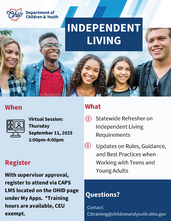
DCY is offering a virtual statewide refresher training on Independent Living Requirements. Registration will take place through CAPS LMS.
The three-hour virtual session will be held on Thursday, September 11, from 1- 4 p.m. and will cover updated rules, guidance, and best practices when working with teens and young adults.
For more info, click the photo.
|
|
|
|
|
|