Why Has the Newsletter Changed?
You may notice that our newsletter looks a little different. That's intentional.
The Gaming Division has transitioned to a new communication system that allows you to choose the information you receive based on your role and interests. Rather than sending the same information to everyone, you can subscribe only to the updates that are relevant to you. This system is not just for our newsletter—it is now our official communication platform for all information distributed by the Gaming Division.
We need your help. Please forward this newsletter to anyone within your organization—or anyone involved in charitable gaming—who should be receiving updates from our office. Our goal is to ensure everyone subscribes directly so they don't miss important information.
Going forward, this will be our primary method of communication. Newsletters, regulatory updates, press releases, memos, training announcements, and other important notices will all be distributed through this system. By helping us spread the word and encouraging others to subscribe, you'll help us close the communication gap and ensure everyone receives timely information from the Gaming Division.
Three Documents Every Gaming Organization Should Understand
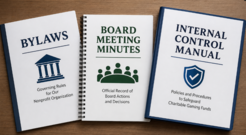
When renewing your charitable gaming license, your organization must submit three important documents: Bylaws, the last two years of Board Meeting Minutes, and the Internal Control Manual. These are more than licensing requirements—they are governance documents that should be developed, approved, and maintained by your organization's Board of Directors.
These documents establish how the board governs and oversees charitable gaming within the organization, how decisions are made, and what safeguards are in place to protect charitable gaming funds. Keeping them accurate and up to date helps your organization remain compliant, prepares you for audits, and demonstrates active board oversight of the charitable gaming operation.
|
Navigating the Portal After License is Approved
Your organization's gaming license has been approved—now what?
The Charitable Gaming Organization Portal has evolved significantly. Today, the portal serves as the central location for your organization's licensing, compliance, and reporting activities throughout the year.
Once your renewal has been approved, the portal becomes your organization's primary tool for managing gaming records and maintaining compliance with North Dakota gaming laws and administrative rules. Many processes that were previously completed using paper forms or email are now submitted directly through the portal.
Organizations are reminded that using the Gaming Portal does not change the reporting deadlines established in ND Admin Code § 99-01.3-01-04. Required changes must still be reported through the Charitable Gaming Organization Portal within 14 days of the change. This includes changes to an organization's primary purpose, the type of gaming offered, the days gaming is conducted, the designated gaming area at an authorized site, employee list, the Gaming Manager, and the Independent Auditor.
Top 10 Lessons We Learned During Our First Year of Online Licensing

The transition to our new online licensing system was one of the biggest changes our Gaming Division and charitable gaming organizations have experienced in years. As with any new system, there was a learning curve for everyone involved. After reviewing more than 300 renewal applications, we identified several common issues that delayed approvals or created unnecessary work for organizations. The good news is that most of these are easy to avoid. In this article, I've highlighted the ten most common mistakes we saw during our first renewal cycle, along with practical tips to help make your next renewal faster, smoother, and less stressful.
-Special Agent Rob Sanderson, ND Bureau of Criminal Investigation
|
What is Required for Bank Deposits and Monthly Bank Deposit Verifications?
It is critical to ensure that your organization’s deposit procedures are adequate. Timely deposits, with well detailed deposit slips, will help to ensure that all cash profit for gaming activities has made it to the organization’s gaming account. Proper bank deposit verifications will ensure, on a monthly basis, that all deposits have been properly made and there are no funds missing.
When do bank deposits need to be made?
Deposits must be deposited into the gaming account by the third banking day following the date of activity. It is critical that deposits are made in a timely manner. If a bank deposit is not going to be deposited immediately, an employee shall safeguard the funds in a safe and secure location.
What information is required on a deposit slip?
Deposit slip information must be traceable to the daily accounting records by properly identifying all required information according to N.D. Admin. Code § 99-01.3-03-10.
What happens when a bank deposit is made?
An employee who did not have access to the cash to be deposited shall verify that the amount recorded on a daily or interim accounting record was actually deposited according to a bank statement. This verification should be completed each month when the bank statement is received. Each verification shall be documented, by handwriting their initials, and recording the date the deposit was verified.
Please refer to N.D. Admin. Code § 99-01.3-03-10 for further information or reach out to the Office of Attorney General Gaming Division for additional training or support.
Trust Account Carry-Over and Trust Account Check Register Balance Reconciliation
Part III of the tax return is intended to reflect the activity in the organization's trust account check register, which should be reconciled to the bank statements. When completing this section:
Line 24 should include any adjustments that increase or decrease the check register balance, such as:
- Voided trust account checks issued in prior quarters
- Interest or dividends earned in the trust account
- Bank fees or check blank orders
Line 27 must equal the reconciled trust account check register balance, not the ending balance shown on the bank statement.
If Line 26 and Line 27 do not balance, the organization must identify the discrepancy before filing the tax return and make a comment on how it is to be resolved.
Organizations are responsible for properly maintaining, reconciling, and reporting their trust account check register. The check register should accurately reflect all deposits, checks, voided checks, interest, and other adjustments.
Repeated inaccurate reporting of trust account activity may result in penalties and/or the issuance of a conditional license due to the organization's failure to properly maintain and report its financial records.
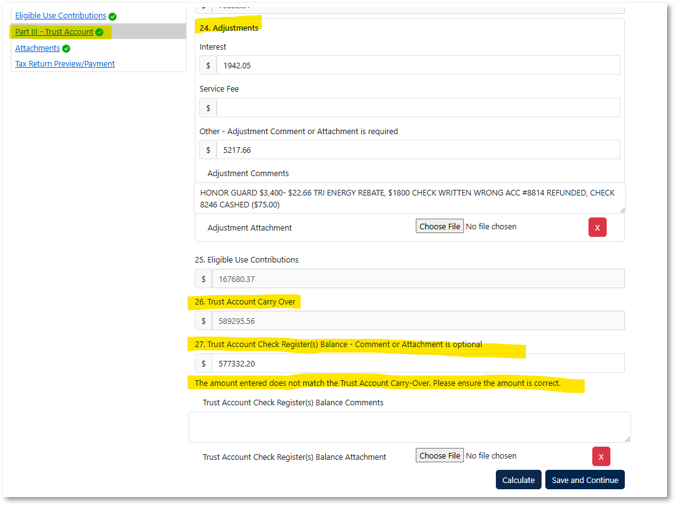 On the Online Charitable Gaming Portal, During Part III - Trust Account, please ensure Lines 24, 26, and 27 are done correctly to avoid incomplete tax returns
Want a Physical Copy of the Complete Set of ND Gaming Laws and Rules?
Rule books will be available soon for purchase from the Gaming Division. Each printed rule book is $15.00. If you would like your order mailed, add $4.35 per book for shipping. To order, complete the order form linked below and either bring it to our office with a check or money order, or mail the completed form and payment to the Gaming Division. Orders will be shipped upon receipt of payment.
Remember, organizations are required to make the applicable gaming laws and rules available in the gaming area for public review. Beginning July 1, 2026, this requirement may be met by either providing a printed copy or by displaying a QR code that links to the Attorney General's prescribed website containing the current laws and rules. This gives organizations the flexibility to choose the option that works best for their gaming site.
|