Ready For Impact
As we start this new school year, I am excited to share the focus for school social work in NC public schools. School social workers are ready to use their expertise, relationships, data, advocacy, and systems knowledge to create visible and lasting change for students, families, and schools.
We are ready for impact. We not only step in when something goes wrong; we help schools anticipate needs, strengthen supports, and prevent barriers from escalating. Our impact is built through trust, consistency, collaboration, and a willingness to understand the full context of a student’s life. School social workers help guide conversations around attendance, mental health, belonging, family engagement, crisis response, and equitable access to support.
Impact does not require doing everything. It means identifying where our skills are most needed and using our time and influence purposefully. Our presence strengthens schools. When school social workers are included, schools are better equipped to understand student needs and respond in compassionate, effective ways.
This is a call to confidence. You have the knowledge and skills to positively impact the entire school community. The work you do matters and has the power to change the trajectory of a student's life. You are ready for impact, and I am proud to serve alongside you as we support the students and families in all of our public schools.
~Pachovia Lovett (pachovia.lovett@dpi.nc.gov)
Please review the email that was sent to all HAC/SMH contacts. The portal links are not in this message, but were sent to all contacts.
DUE BY SEPTEMBER 15, 2026.
------
We are reaching out to share the 2026 the Healthy Active Children and School Mental Health Policies surveys. Please read the following message in its entirety. If you are no longer the correct contact person for this reporting, please forward this information to the correct contact person and notify us of the change.
As you know, all LEAs are required to report their progress on meeting the guidelines set forth by the NC State Board of Education’s (SBE) Healthy Active Children (HAC) Policy, SHLT-000, and in accordance with North Carolina SL 2019-245, SL 2020-7, and SBE SHLT-003 for School-Based Mental Health (SMH) policies. The deadline to submit final responses for the HAC and SMH policy surveys is September 15, 2026. The below information outlines the process for completing the HAC and SMH policy survey questions. In addition to the survey questions, each K-12 school unit (includes Charter school, lab school, LEA, etc.) is required to upload a copy of their School Mental Health Plan for the upcoming school year.
As in previous years, you will be able to complete your reports online. We suggest reviewing the attached Word and PDF versions of the survey questions first, prior to completing the online version, to facilitate ease of completion and to ensure you are able to coordinate answers with your team members. Please submit your final answers and responses in the online version. This will serve as your report on compliance with SHLT-000, SHLT-003, SL 2019-245, and SL 2020-7. Not only do your responses help us measure policy compliance, but they also help us deliver quality professional development, technical assistance, and state-level guidance.
Overall Survey Guidance
Survey completion should take 30 minutes to 1 hour, depending on the length of responses and time spent gathering responses. The progress bar at the top of each survey page will help you track your completion timeframe. The survey platform is set up to allow respondents to leave the survey and resume their progress later, so long as they return on the same browser where they started the survey and do not wait longer than a month to return to the survey. This feature works by placing a cookie on the respondent’s browser that keeps track of the survey progress. While this is a feature, it is strongly encouraged to complete it in one setting to avoid any disruptions in data reporting.
HAC Policy Questions
Charter schools are not required to complete this section, after selecting your PSU, it will bypass to the SMH Plan reporting.
These questions are completed by all LEAs, and you can expect to see questions related to your implementation of the SHLT-000, including the WSCC model, your SHAC, Healthful Living (health education and physical education), physical activity, and other policies. If you have completed this survey before, most questions will look familiar to you; some will be new or revised. Most questions require completion, but there are a few at the end of the HAC policy section that are not required. However, your responses to those questions do greatly help us develop tailored professional development, deliver technical assistance, and craft state-level guidance.
Some of the information needed to complete the HAC policy report will come from your principal attestation forms. All K-8 and 9-12 principals will need to complete and sign the principal attestation form indicating that the information reported is accurate. As the point of contact, you will be responsible for collecting the principal attestation forms, which should be kept on file and readily available for review by your superintendent and/or any state official. The superintendent attestation form must also be signed, confirming that the information reported on the HAC policy report is correct. A signed copy of the superintendent attestation form should be emailed to Ellen Essick, Healthy Schools Section Chief, Ellen.Essick@dpi.nc.gov.
SMH Policy Questions, SISP Annual Report, and School Mental Health Plan
In accordance with North Carolina SL 2019-245 and SL 2020-7 and with State Board of Education Policy SHLT-003, each K-12 school unit (a local administrative unit, a charter school, a regional school, an innovative school, or a laboratory school) is required to upload a copy of their School Mental Health Plan (including a suicide risk protocol and a training plan) and answer the questions in this section.The best contact for questions related to the SMH report and the SISP Annual Report is Pachovia Lovett, School Social Work Consultant, Pachovia.Lovett@dpi.nc.gov.
Upon completion of your HAC/SMH report, you will be redirected to the final Qualtrics survey titled “Specialized Instructional Support Personnel Annual Report - PSU Level." YOU MUST SUBMIT THE SISP REPORT TO BE COMPLIANT WITH THIS YEAR'S REPORTING.
If you have questions or challenges in completing the survey, please reach out to me at Ellen.Essick@dpi.nc.gov.
School Mental Health Training Courses
The new course guide and all course codes are now ready for use and live in Canvas for all PSUs.
|
The purpose of this Canvas LMS Course Training Package is to assist North Carolina Public School Units (PSUs) in providing a Mental Health Training Program as required in SHLT-003:School-Based Mental Health Policy and, more importantly, to promote student mental health and well-being across North Carolina. This training package meets the guidelines of the Model Mental Health Training Program and is a crucial component of the required PSU School Mental Health plans. This is a no-cost, optional training package that PSUs may utilize as they deem appropriate. This training package currently includes all 6 required training areas within SHLT-003:School-Based Mental Health Policy. PSU training teams have the option of utilizing any or all of the courses within the package.
|
|
Currently, this training package includes all 6 required areas of training within SHLT-003:School-Based Mental Health Policy. PSU training teams have the option of utilizing any or all of the courses within the package.
- Suicide Prevention
- Substance Abuse Prevention
- Teen Dating Violence Prevention
- Child Sex Trafficking Prevention
- Child Sexual Abuse Prevention
- Youth Mental Health
|
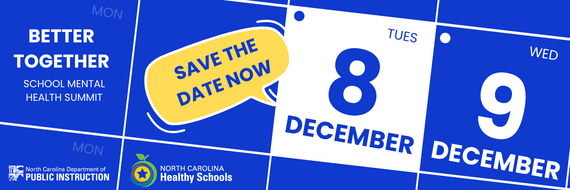 |
Better Together: School Mental Health Summit
Exciting new opportunity from the Healthy Schools section at NCDPI
Save the date for December 8-9 for 2 full days of professional development exclusively for school counselors, school social workers, school psychologists, school-based mental health clinicians, and their supervisors and directors. All of these positions will be invited to register soon. This event will be held in Concord, NC.
Make plans now to attend and stay tuned for more information.
Legislative Updates
 |
View the K-12 Education Office of Government and Community Affairs Update from July 31, 2026.
View here.
|
Instructional Support NCEES Training Opportunities
Specialized Instructional Support Personnel evaluations are unique and sometimes hard to navigate against other teaching roles. This series is meant to help understand their evaluations, provide critical resources, and shape important updates.
August 13, 2026
10:00-12:00
Evaluating Impact: Guide for Admins Supervising Student Support Personnel
Evaluating student support personnel can be challenging when their critical work happens outside traditional classrooms. Hosted by NCDPI State Consultants, this webinar is designed specifically for administrators and evaluators looking to approach the evaluation process for school social workers, counselors, and psychologists with greater clarity and confidence. Participants will explore recent updates to evaluator options, unpack the distinct standards for each discipline, and learn to identify meaningful evidence in areas like crisis response, mental health support, and family engagement. You will leave with practical tools to dispel common misconceptions, lead productive evaluation conversations, and accurately recognize the essential impact of your student support team.
Target Audience: Administrators who evaluate Instructional Support Roles
September 15, 2026
1:00-2:00
Understanding Your Evaluation: A Guide for School Social Workers
This session is designed for school social workers who want to better understand the evaluation tool, updated evaluator options, and recent changes to the evaluation process. Participants will explore how the standards connect to daily school social work practice, identify meaningful artifacts and evidence, and learn strategies for building a strong professional portfolio that reflects their impact on students, families, schools, and communities.
Target Audience: School Social Workers and those that evaluate School Social Workers
Opening Year Resources
Updated School Attendance and Student Accounting (SASA) Manual
This is a must-have resource. Please review and keep as a reference.
Current SASA Manual
New Year, New Goals
As you start to think about what your program/professional goals will be and what data to collect, use this Sample Student & Program Outcomes list to help you organize.
This is also a great list to help you write a data story using the previous year's data, creating a narrative to use during advocacy.
Tips For The New School Social Worker
Are you a brand-new school social worker? Well, welcome to one of the best careers on the planet! The document below has been created to give you the very best foot forward into this new journey. Please review the tips and explore the resources provided. Also, forward this to the new social workers on your team and encourage them to join the DPI School Social Work mailing list to continue to receive updates.
Tips for the NC New School Social Worker
School Immunizations
This NC School Vaccine Fact Sheet is a great resource to keep on hand during the start of this school year. School social workers should work collaboratively with school nurses to prevent student exclusions after the 30-day grace period.
 |
|
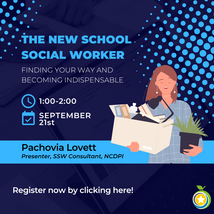
The New SSW Webinar
We will discuss what to know about working in a school setting, the collaborations with SISP and other school staff, evidence-based practices and data collection, and becoming indispensable.
We will also share and connect resources to practice.
This webinar is open to all school social workers who are within their first 3 years of practice in NC public schools (no student interns for this session).
|
Healthy Schools Professional Development
Every Adult, Every Child: Abuse & Trafficking Prevention Training for School Personnel
This session will equip Specialized Instructional Support Personnel (SISP) and SISP leaders and their teams with the knowledge and tools needed to implement mandated child sexual abuse and human trafficking prevention training with confidence, consistency, and fidelity. Participants will gain an understanding of child sexual abuse and child sex trafficking, including prevalence data, risk factors, grooming tactics, trauma-informed practices, and North Carolina-specific reporting requirements. The training will also cover how to recognize and respond to disclosures, concerning behaviors, and suspected abuse, while emphasizing the role of schools in prevention, response, and creating a culture that supports student safety and well-being.
Speakers:
-
Pachovia Lovett, MSW, School Social Work Consultant, NC Healthy Schools, NC Department of Public Instruction
- Additional Speakers: TBA
Audience: This event is for current school nurses, counselors, psychologists, social workers, administrators, and support personnel directors.
Continuing Education: 0.65 Continuing Education Units (CEUs) (equivalent to 6.5 contact hours) have been applied for through the UNC Digital and Lifelong Learning department. A certificate of CEUs will be provided for each attendee at the completion of the evaluation.
Are you a Director of Student Services?
There is a job-alike group for directors of student services and equivalent titles. This is a field-led and organized group that allows for networking, information sharing, and troubleshooting. They meet once a month. This group is not open to lead positions or SISP. While this is not a DPI-led group, DPI representatives typically attend meetings to share important updates.
Email pachovia.lovett@dpi.nc.gov to request information on how to join the group.
|





