|
Montana Laboratory Sentinel
Updates from the MT Laboratory Services Bureau
Phone: 800-821-7284 Fax: 406-444-1802
Lab Website
Lab Manual
(Please reference this for testing or submission questions.)
|
|
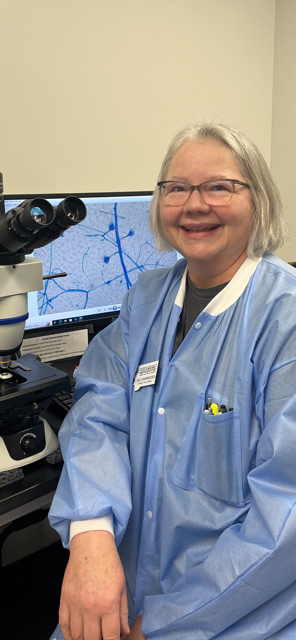
MT PHL Employee Highlight:
Hello! My name is Carla and I have been with the Public Health Laboratory almost three years now. I started my laboratory career in Seattle as a Generalist with focus on Hematology. I also raised three wonderful kids there with my husband of 44 years.
We moved to Helena in 2006 to be closer to my family after our children were grown and doing their own thing. Though we miss the kids (and now four grandchildren!) we love it out here and it is a fun place for them to visit.
I am thrilled to be working in the Mycology and Parasitology Depts in the Lab. I was surprised to find such an unexpected interest in these organisms, every day there is something new!
When not at work I enjoy gardening, camping and fly fishing.
|
|
|
News and Updates
Newborn Screening
-
Newborn Screening Panel Tests Combine into Profile
-
Since there are now three different panels for a standard full newborn screen, we have created a profile that when ordered will add all three panels to the order.
-
Currently facilities order Newborn Panel 1 and a rule adds the other two panels to the order. However, we are experiencing intermittent issues where not all three panels get ordered.
-
We are hoping using the profile will make it easier to know what to order and will ensure all three panels are saved on the order.
- Please click here for more information on ordering this profile.
IT Corner
-
Transition to OKTA for Lab Portal Authentication
-
We are starting to onboard users to OKTA for authentication to the lab portal. OKTA is the authentication method used by the State for access to all state applications. All users will need to create an OKTA account.
-
If you already have an OKTA account for your work e-mail because you access other state applications, you can use your existing account.
-
If you do not already have an OKTA account, instructions for creating one can be found here.
-
Once you have an OKTA account, please notify us by sending an email to HHSLIMS@mt.gov from the email address used for your OKTA account. Each week we will be giving a list to our IT department, and they will add lab portal access to those OKTA accounts. We will then notify you by email that you can begin using the “Sign in with OKTA button” to access the system.
-
Both users and supervisors who request user access for their staff will need to create an OKTA account. In the future, access requests will need to be initiated on-line by a supervisor/manager, and an OKTA account will be required to gain access to the user request form. That process will be announced at a later date. For now, access requests should still come through the LIMS email at HHSLIMS@mt.gov. Forms can be found on our web-site.
-
Eventually access to the system will be limited to the OKTA authentication method only. We will be sending reminders over the next couple months to get all users transitioned. Please create your OKTA account and notify us at your earliest convenience so you don’t risk losing access to the system when that happens, as it could take a couple days to get your access re-instated.
-
Local Administrator Access Eliminated
-
Due to upcoming changes to the user access request process, we have eliminated the option for facilities to designate a local administrator. Current local administrators have been notified their administrative privileges have been revoked and all user setup and maintenance will need to be done by our staff. Requests for changes to user accounts can be emailed to our LIMS inbox at HHSLIMS@mt.gov or submitted by creating a ticket in the lab portal.
Molecular
-
Influenza A Subtyping on Hospitalized Patients
-
CDC is interested in having subtyping performed on all patients who are hospitalized with severe respiratory illness and test positive for Influenza A to determine the strain. If you have the capability of performing seasonal Influenza (H1 and H3) subtyping at your facility, we are only interested in those that are unsubtypable (non-H1/H3) or inconclusive. If you are unable to perform seasonal Influenza subtyping, you can send to the Montana Public Health Laboratory (MTPHL) or the reference lab of your choice.
-
In addition, if your facility is one of our Influenza surveillance sites, you can send these specimens in as part of your normal surveillance. If you have more cases than your surveillance covers, you should order the Influenza A & B PCR, which will reflex to subtyping, but there will be a fee associated. MTPHL does not perform the subtyping without first performing the Influenza A & B PCR.
-
Influenza A & B PCR: $65 (cpt code 87502)
-
Influenza A subtyping: $38 (cpt code 87503)
-
Please note that the patient is hospitalized and positive for Influenza A in the "additional order information" field.
-
There are limited funds set aside to help cover some tests for highly suspect patients, such as those with known exposure to HPAI-positive animals or those with unsubtypable influenza results. In such cases, a consultation with your local health department and/or our epidemiology section will be necessary prior to submission to confirm if the criteria are met and funds are still available.
-
Click here to see the recent Health Alert Network Advisory. Please call if you have any questions. 406-444-3444
-
Pertussis
-
With the increasing number of pertussis cases in our state, the Montana Public Health Laboratory (MTPHL) has received many calls regarding pertussis testing.
-
The MTPHL provides pertussis PCR testing Monday through Friday. If we receive the specimen before 10:00 a.m., you should have the result that same day. Specimens received after 10:00 a.m. will be run the following day. Specimens received after 10:00 a.m. on Friday or over the weekend will be run on Monday.
-
For testing, please collect a nasopharyngeal (NP) swab in a sterile container without transport media. We cannot accept NP swabs in viral transport or other transport media. The specimen should be transported at ambient temperature or 2-8°C.
-
To order, select the Bordetella spp. Multiplex PCR on the online portal. The CPT code is 87801, and the cost is $115.
-
Note: PCR testing should only be performed on symptomatic patients; a positive PCR in an asymptomatic patient does not meet the standard CDC case definition and is not considered a case of pertussis. PCR testing may detect B. pertussis 3 to 4 weeks post-onset.
Preparedness
-
Focus on Francisella tularensis Identification
-
Francisella tularensis can be confused with Pasteurella multocida. Both organisms grow on Chocolate agar and do not grow on MacConkey agar. P. multocida grows better on sheep blood agar than does F. tularensis.
-
F. tularensis key characteristics: very small gram-negative coccobacilli/coccoid (the gram stain appears to be an amorphous mass), catalase weakly positive or negative, oxidase and indole negative.
-
P. multocida key characteristics: small gram-negative coccobacilli (the gram stain shows distinct organisms), and catalase, oxidase, and indole positive.
-
Click here for colonial growth and gram stain morphology comparison.

Dear Lab-by
Every winter, from November to February, our newborn screening unsatisfactory specimen rate increases. What’s up with that?
Sincerely,
Frustrated in Phlebotomy
Dear Frustrated,
As temperatures drop here in Montana, you might start to notice your skin getting drier or your lips getting chapped. The cold air can’t hold as much moisture, so our relative humidity gets very low. The chilly temperatures, combined with low humidity, can make collecting the newborn screen very difficult because you just can’t seem to get those nice, big drops. Luckily, I have a few tips for easier collection!
If possible, plan to collect the newborn bloodspot screen just after baby has been fed. A fed baby is a hydrated baby, and that can increase blood flow. If mother is breastfeeding, it also helps to have her increase her fluid intake. You also want to make sure baby is nice and warm before collection. Heel warmers work great if you have access to them. If not, try using warm, wet heat. This could be in the form of a warm washcloth wrapped around the heel. You can even fill up a glove with warm water and place it on baby’s heel before swaddling for a few minutes! This warmth will increase baby’s circulation for better flow after you poke.
Don’t hesitate to contact the folks at the Montana Public Health Laboratory; they love to help!
Sincerely,
Lab-by
|
|
|
Reminders:
-
Lab Portal Information
-
All of our lab portal procedures and access paperwork can be found on our website. Here is the link to the direct page with all of our forms and procedures: https://dphhs.mt.gov/publichealth/LaboratoryServices/onlineorderingandresults.
-
There is also a link in our lab portal that will take you directly to this page. This link can be found under quick links. "MT PHL Lab Portal Procedures and Forms".
-
Courier
-
Previous Laboratory Sentinels
- All previous Laboratory Sentinels can be found on our website on the column on the left hand side by selecting "Public Health Laboratory Newsletter". Here is a link to all our previous Laboratory Sentinels.
|
|
|
|
|