Supervisors Summit
Thank you to all who responded to our survey earlier in the year! The results had us looking at the August dates, but since the timeline for Phase 3 is still uncertain, postponing the event seemed like the best course of action. When our new plans come together, information will be sent out for a summit later in winter 2020 or spring 2021!
|
|
 |

Is Your CD looking for a Sweet Ride?
The DNRC Surplus Ripe to Swipe items are for state use and CDs have been approved to purchase these vehicles when they come available. These vehicles are for office use only and cannot be taken home for personal use.
There is a 2010 Ford Escape that’s looking for a new home. It’s a 5 door small SUV, 4 cyl engine, 4WD, Auto transmission, has 120K miles, and it’s in fair to good condition. Vehicle pictured above.
For more information on the price, availability to view or just general questions, please contact Mary Dykstra, Accountant with DNRC at 406-444-6729 office, 406-439-0870 cell or by email.
|
 |
|
Zoom line available
CD Bureau has a Zoom pro subscription that CDs can use for meetings. If you want to use, just let us know and we can schedule it and send you the meeting details after.
|
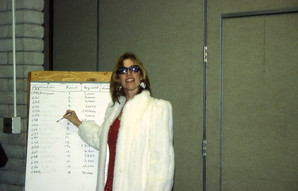
Don't think for a minute that your voice or ideas don't count
by Laurie Zeller, Bureau Chief
It is hard for me to believe that this month marks my 40th year working for DNRC and conservation districts. While there have been many changes over the years, the key to conservation district success has not changed. That that key is you. I firmly believe conservation district supervisors and administrators that know what they want to accomplish, keep their eye on the prize, never take no for an answer, and never give up can accomplish any goal, big or small.
The difference doesn’t seem to be money. Even though money helps, money without leadership means nothing. Major accomplishments (and small ones, too) always start with just one person asking, “what if” or “is there a better way?” What if we built a water system to provide clean drinking water to our area? What if we operate an AIS inspection station? Can we help landowners reclaim land during drought, or after a fire or flood? Can we do a better job improving soil health? What if we banded together on a difficult issue to make our voices heard?
Conservation districts have been quietly doing their job since Montana’s first district was formed in 1940 and that hasn’t changed. Questions have been asked and answered with real local common solutions. I am not sure what the next 40 years will look like but do know local leadership will be the key to solving any natural resource issue Montana will face. Don’t think for a minute that your voice or your ideas don’t count.
|
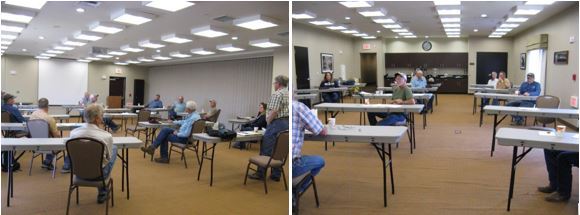 Custer County CD practicing social distancing at a board meeting. Photo provided by Carol Watts.

COVID Phase 2 - the gradual reopening of business
Many of you have had questions about the recommendations about safely phasing back to work. Visit https://mt.gov/ for the changing guidance, but in a nutshell, here are a few answers to questions we have been receiving.
Can we return to the office? The decision to return to work should be between the conservation district employee and the conservation district board. Vulnerable individuals should continue to adhere to the say home guidelines. Where feasible, working from home is still encouraged. If the decision is made to return to work, protective measures should continue to be taken by keeping distance from others. Clean doors, desks, phones, your hands, etc. regularly. Conservation district supervisors should discuss this with employees and consider what it takes to make sure employees are protected from incoming customers.
Can we start having regular meetings again? The new recommendation is to limit gatherings to 50 people, and only do so if that can be done with safety measures in place to limit close contact with others. Check with your county health department, as they may have different guidance pertaining to your county that is more stringent that the state guidance.
Can we make decisions via phone call with supervisors? Open meeting laws and the public's right to participate still apply. Decisions can be made only if a meeting was advertised and the public has a way to participate.
* Of course, the ability to open conservation district offices depend on federal guidelines for those CDs that are co-located.
* Non-essential travel guidelines remain the same as Phase One for individuals coming into Montana and for Montanans returning home from out of state travel.
|
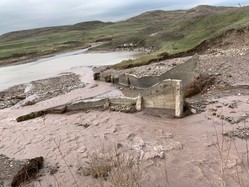
The Lifeline of the Hi Line
by Karl Christians, CD Specialist
Photo source: Bureau of Reclamation (BOR)
The Milk River is reliant on the St. Mary project. As you may have heard, the St Mary’s project drop structure 5 failed on May 17. This water supply system feeds the Milk River, which is the Life Line of the Hi Line.
I worked with the Milk River Watershed Alliance and we had a video developed explaining the system and ramifications of failure. We knew it was only a matter of time that a failure would occur in one aspect or another. Below is a link to a full length version of the video. Also below are links to 3 shorter videos that are specific to Agriculture, Fisheries and Wildlife, and Municipalities. These videos are very informative. I encourage you to view them as well and share them with friends and family. Ironically, one of the videos is the actual drop 5 that ended up failing. Visit www.milkriverwatershedalliance.com for more information.
Youtube link for all the videos
These videos were produced by Banik Communications thru a 223 grant. The MRWA has also been busy interviewing and educating the general public on the impacts that a system failure can have.
Also: Great interview with John Tubbs and Jeff Pattison regarding Saint Mary's.
|
Permissive Levy Reminder
The Permissive Levy is an avenue to levy a tax to pay for group benefits for district staff. The Board must decide this. The first year, prior to implementing the permissive levy, the board must have agreed to pay a group benefit. It must have started being paid to staff by July 1, 2019, for your CD to be eligible to implement the permissive levy this year. This one-year time frame is how you set the “base”. The base has to be a minimum of $10/per month.
If your CD has implemented the permissive levy last year, don’t forget must implement again this year in order to receive levy funds. Once your board has proposed the amount of group benefits to provide, there are step that need to be taken. The first is to hold a public hearing which has notice requirements of:
- Twice at least 6 days apart
- Date, time, place
- Brief statement
- Address and telephone of person to be contacted
- Must keep proof of publication
- Newspaper requirements – not newsletter
Once you hold your public meeting, be sure the board takes into consideration any public comments, moves and approves an amount to implement, and then note that motion in your board meeting minutes.
The last step is to submit the determination of Permissive Levy for Group Benefits to the county in Early August.
If you have questions or need an example of a notice, feel free to contact me!! There is a webinar and pdf of a presentation I did last year on our DNRC website that may be of help as well!!

Garfield CD in the news again!
What a day for watercraft inspectors in eastern MT!
From Montana Outdoor Radio's angelamontana
Posted: 5.26.2020
We received a message from Liz Lodman with FWP that shows being an AIS inspector means you have to persevere!
Last Wednesday, the Flowing Wells station, which is just south of Fort Peck, was quite an “eventful” day for the watercraft inspectors. After a storm actually took out the power out for an unknown time frame (possibly days), the wind also ripped off the station signs. The crew was forced to sit in their vehicle to recharge their tablet. Stories from other people in the area involved being surprised there was still a roof on the shed because the wind was so strong. To top it off, a vehicle pulling a boat trailer left a memento as it pulled into the station (see photo above)–a big ol snake!
So, kudos to these eastern Montana watercraft inspectors for being so tough and resilient, and just know they are still open for business! Be sure to show them a “little love” this weekend!
Source: Montana Outdoor
Just another exciting day in the life and times of Dusty Olson and the Flowing Wells AIS Inspection Station!
|

457b Deferred Compensation Plan
by Mary Hendrix, CD Specialist
The State of Montana 457(b) Deferred Compensation Plan is a retirement savings plan designed to help you save and invest for your future. While your pension and Social Security benefits provide a great start, they may not provide enough income for you to maintain the lifestyle you want when you’re retired. You may need to save more on your own — and the 457 can help!
For those Conservation Districts who may not participate in the Public Employees Retirement System (PERS), the Montana Public Employee Retirement Association (MPERA) has confirmed that district employees can sign up for the 457b plan without participating in PERS. The advantages to the employee is institutional savings options that can cut down on fees over investing as an individual.
The benefit to the districts is to provide an investment option with no cost to the organization. MPERA assumes the fiduciary responsibility that the district may otherwise carry with other investment providers. This could include an employer match, but could also be just a way for employees to save more.
Learn more at the links below:
Contact Brett Fisher, Empower Retirement for more information: Phone: 406-897-3436 direct / 406-449-2408 office Email: brett.fisher@empower-retirement.com
|

Zoom Fatigue is Real
Zoom and other virtual meeting rooms are trending now that many people are working from home while practicing physical distancing. But at the end of another busy day with as many as three consecutive Zoom meetings, I pondered if Zoom fatigue was a thing and went searching on Google. Sure enough, there are plenty of articles to support that this phenomenon is real!
What is Zoom fatigue, and why we're all feeling it?
"One reason video chatting can be more tiring is because we have to work harder to interpret non-verbal communication. “When we interact with people face to face, we're not only listening to their voices and looking at their faces—we're picking up on social cues, like hand movements, body movements, and even a person's energy,” Brian Wind, PhD, co-chair of the American Psychological Association and adjunct professor in Vanderbilt University’s psychology department, tells Health." More at Article link
Modern life is stranger than fiction
"We used to take breaks from people by spending time on our gadgets. Now, we take breaks from our gadgets by seeking out real, live human connections."
Managing Zoom fatigue:
There is some good news, though. Dudley has tips for managing Zoom fatigue:
- Disconnect when you need to.
- If you can, schedule time in between virtual meetings. Figure out what you need in that moment and do that. If you need time alone, take it. If you need time with a real, live person, seek out the opportunity while keeping safe. If you just need to move around a bit, do that.
- Practice mindfulness. Meditate. Do yoga.
- Have compassion for yourself and for others.
- Establish daily routines. Your day should be different from your evening, and your weekday should be different from your weekend.
- When your meeting ends, ask yourself what you need,” Dudley says, “and don’t forget to show yourself some compassion.” More at Article link
Whether you continue to use Zoom or others in Phase 2 and beyond, I think virtual meetings are here to stay. Just something to be mindful of to avoid burnout!
|
 |
|
Grant Awards for April 2020
by Linda Brander, CD Specialist
The HB 223 grant awarded to:
- Gallatin Conservation District: $14,000
- Lewis & Clark Conservation District: $14,000
- Powder River Conservation District: $ 5,398
- Treasure County Conservation District: $15,000
HB223 Award Project Statements
The District Development grant awarded to:
- Custer County Conservation District: $10,000
- Ruby Valley Conservation District: $10,000
District Development Project Statements
|

Fiscal 2021 Grant Deadline
HB 223, District Development, & Mini-Education Grants are due:
- July 15, 2020
- October 14, 2020
- January 13, 2021
- April 7, 2021
Pollinator Grant Deadline
- Still first come, first served
Visit the DNRC grants and loans page for more information
|
 |
|
If you received this CDB "Notes", please share it with your Supervisors and fellow Employees. Additionally, if they find the information valuable, ask them to subscribe at the link below. THANK YOU! |
|