|
The Legislative-Citizen Commission on Minnesota Resources
is accepting proposals through May 15 for grants from the Environment and
Natural Resources Trust Fund, which is funded with Minnesota Lottery and
investment proceeds. The commission expects that $50 million will be available
for projects that start in July 2018.
 Funding priorities for 2018 include:
- Foundational natural resource data and
information;
- Water resources;
- Environmental education;
- Aquatic and terrestrial invasive species;
- Air quality, climate change, and renewable
energy;
- Methods to protect or restore land, water, and
habitat and
- Land acquisition for habitat and recreation.
The commission is responsible for making funding recommendations
to the Minnesota Legislature. The full Request for Proposals is available on the commission’s
website. Since 1991, the fund has provided about $500 million
to 1,000 projects around the state.
|
The Minnesota Pollution Control Agency (MPCA) has extended the
application period to Feb. 17 for federal Clean Water Act Section 319 grants. The
MPCA anticipates about $2.5 million will be available this year for projects
that
reduce nonpoint source pollution in Minnesota’s lakes and streams. The agency
has clarified eligibility criteria in
the request for grant application. See details on the MPCA website.
The Minnesota Dept. of Agriculture is requesting proposals for
research to quantify the effectiveness of agricultural conservation practices
related to impaired waters and for development and evaluation of best
management practices to protect and restore water resources.
Proposals must be received no later than 3 p.m. Feb. 10.
Additional information regarding the Request for Proposals, including research
priorities, is available in the Jan.
3 State Register (see page 846 or 22).
Proposals should:
- Quantify agricultural conservation practice effectiveness
related to nutrient source reduction, off-site movement, and treatments
- Focus on the water quality effects of individual conservation
practices and/or the cumulative effects of multiple conservation practices
Proposals must include a cost effectiveness component, as well
as an education and outreach plan to benefit Minnesota residents.
For proposal instructions and application materials, please
e-mail Heidi Peterson, impaired waters technical coordinator for the ag
department, at Heidi.Peterson@state.mn.us.
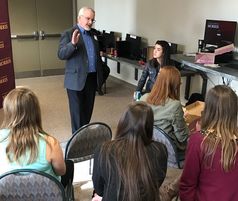
More than 500 people attended the Governor's Water Summit
Jan. 27 at the University of Minnesota-Morris. The summit focused public
attention on the serious challenges facing Minnesota’s water supplies — in both
rural and urban areas of the state — and continued statewide dialogue around
steps that must be taken to address those challenges. It brought
together local government leaders, farmers, students, environmentalists,
businesses, and a wide variety of other stakeholders.
The summit was the second large public forum during Gov.
Dayton’s Year of
Water Action. In
February 2016, Governor Dayton convened the first ever Water Summit to bring
attention to the challenges Minnesota faces to protect and improve water
quality across the state. More than 1,000 Minnesotans participated in the event
– the first of its kind in the nation. Read key findings from Governor Dayton’s
2016 Water Summit here.
Above right, MPCA Commissioner John Linc Stine talks water
with University of Minnesota-Morris students at last week’s summit.
|
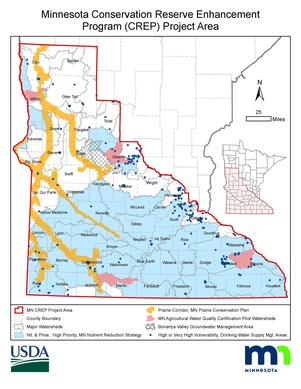
Gov. Mark Dayton recently signed an
agreement with the U.S. Department of Agriculture (USDA), securing $350 million
in federal funding to protect and improve waters in 60,000 acres across 54
Minnesota counties. The new state-federal effort, the Minnesota Conservation
Reserve Enhancement Program (CREP), will target areas of southern and western
Minnesota facing significant water quality challenges, to protect and improve natural
resources for future generations.
“Minnesota
is at a critical juncture in addressing our state’s serious water quality
challenges,” said Dayton. “Through this landmark agreement, Minnesota will be
better able to protect and improve our waters for our families, natural
habitat, and our future. Clean water is everyone’s challenge, and everyone’s
responsibility.”
Through the Minnesota CREP, farmers
and agricultural landowners can voluntarily enroll land in the Conservation
Reserve Program (CRP) and Reinvest in Minnesota (RIM) Reserve easement program
to create buffers, restore wetlands, and protect wellheads for drinking water.
Farmers and other landowners who voluntarily participate in the program will be
eligible for $350 million in federal funds for direct payments to farmers.
The Minnesota CREP will invest a total of $500 million
in Greater Minnesota. To leverage the full $350 million in federal funds, the
state of Minnesota must commit $150 million, of which $54.8 million has already
been appropriated in past legislative sessions. The rest is proposed in the
governor’s 2017 Jobs Bill and through the Clean Water Fund, Legislative-Citizens
Commission on Minnesota Resources, and Lesssard-Sams Outdoor Heritage
Council.
|
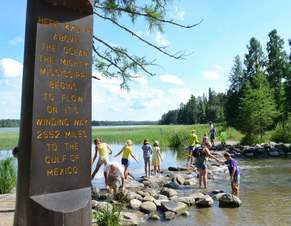
The upper Mississippi River, which starts at Lake Itasca (photo at right) in northern
Minnesota, is in great shape until pollutants flow in from farmland and cities.
By the time it reaches Minneapolis, it no longer meets water quality standards
for river life and recreation. Results from a new study by the MPCA highlight the need to protect wetlands and
forests in the iconic river’s northern areas while taking action to curb
pollution in its southern reaches.
The river is nearly pristine as it flows through forests, wetlands and lakes
until the land changes to cropland and cities. South of St. Cloud, pollutants
start to pour in with runoff, drainage and tributaries. These pollutants
include sediment that clouds the water; nutrients that cause algal blooms; and
bacteria that can make the water unsafe for swimming.
“What we do on the land is reflected in the water,” said MPCA Commissioner
John Linc Stine. “This study underscores that point.”
The study shows the northern reaches of the upper Mississippi are healthy,
thanks to the forests, wetlands and lakes that hold and filter the water
flowing to the river.
“But these areas face increasing threats like forest or other land
conversions for agriculture and development. Whenever land goes from a stable
and vegetated state without protections in place, water quality will go down.
That’s the lesson of history,” said Stine.
While the upper reaches need protection to keep the river healthy, the lower
reaches need large-scale changes to reduce pollutants. After the Crow River
flows into the Mississippi, phosphorus and nitrate pollution double in levels.
The Crow drains a heavily farmed area and makes up about 15% of the total land
area draining to the upper Mississippi in Minnesota.
“Thanks to groups like the Crow River Organization of Water, watershed
districts, and soil and water conservation districts, work has already started
to curb this pollution. But we all need to do more. We need more buffers,
better use of fertilizer and manure, and more conservation on farmland and
urban land,” said Dana Vanderbosch, manager of lake and stream monitoring for
the MPCA.
The study also highlights the need to protect the upper Mississippi as a
source of drinking water. Nitrate can make water unsafe for drinking. While
levels are currently well below the threat level, water monitoring shows a
trend of increasing nitrate levels, a concern for the 1.2 million Minnesotans
who depend on the upper Mississippi for drinking water, as well as millions
farther downstream.
It’s important to continue efforts to decrease mercury levels in
Minnesota waters. Mercury levels in fish and in the water in the entire upper
Mississippi violate the consumption standard. This means guidelines will remain
in place on how much and what size of fish to eat.
Many projects are underway at the state and local levels to ensure that the upper Mississippi meets the standards for river life, recreation and fish
consumption.
About the study
As part of assessing the health of major watersheds across Minnesota, the
MPCA studied the 510 miles of the upper Mississippi from Lake Itasca to St.
Anthony Falls in Minneapolis. Scientists measured levels of pollutants such as
sediment, nutrients, bacteria and mercury. They also studied populations of
fish and other aquatic life such as insects. Using data from nearly 200
monitoring stations along the upper Mississippi, from many partners and spanning
10 years, the agency determined whether several sections of the river met water
quality standards.
|
The MPCA recently submitted
Minnesota’s 2016 proposed Impaired Waters List to the U.S.
Environmental Protection Agency (EPA) for approval.
The MPCA posted a draft version
of the list for public viewing in July 2016. After a series of public meetings
and a formal comment period, the agency made a few changes to the draft list
based on public input. These changes consisted of removing three impairments
from the list and adding six. This modified list was submitted to the EPA for
its approval. This process of posting, revising, and submitting the Impaired
Waters List occurs every two years, as required by the federal Clean Water Act.
Contents of the public
meetings, the public comments, the MPCA responses to comments, and the updated
Guidance Manual were all sent to EPA along with the 2016 proposed list for
review.
 A retirement open house is scheduled Wednesday, Feb. 8 for long-time
MPCA staff member Wayne Anderson. It will be from 1:30 p.m. to 4 p.m.
in the public lobby of the DNR headquarters on Lafayette Road in St.
Paul. Anderson began his career at the MPCA in 1973 as one of only two
people working on the early stages of the feedlot program. He helped
launch the county feedlot program,
in which 51 counties today partner with the state to provide service at
the county level. Back then, feedlots received a "certificate of
compliance" if their operations met requirements for protecting water
quality, many of which bore his signature. In the 1980s as the MPCA
began moving beyond industrial pollution issues, Anderson helped with
the development of a non-point source pollution program. Starting in the
1990s he worked on Minnesota River issues and the Gulf of Mexico hypoxia task force.
For about eight years he was designated the MPCA's ag liaison. More
recently, he helped with the statewide Nutrient Reduction Strategy,
related to the hypoxia task force. Upon his retirement Feb. 1, Wayne
plans to stay active in support for the University of Minnesota through
the Department of Bioproducts and Biosystems Engineering and
professional organizations such as the Soil and Water Conservation Society.
|
|




