Thursday, February 11
The state has identified 470,803 cases of COVID-19 as of today, with 456,849 of these patients no longer required to be isolated. 6,343 deaths have been reported. For more information on the current situation, visit the Minnesota Department of Health website.
At the bottom of this email, you will find Met Council workforce statistics related to COVID-19 leave that have been reported to the Employee Resource Center.
Do you have thoughts or concerns on the content or frequency of these COVID-19 update emails? We would love to hear your feedback through the online COVID-19 form, so we can make sure these emails are providing the most useful and timely information to staff.
|
At a glance
What you need to know this week:
- State continues to administer the vaccine to those in phase 1A.
- Met Council leaders have not yet received confirmation of employees who will be in phase 1B.
- CDC now recommends double masking with tightly fitting cloth and medical procedure masks.
- New allocation tool connects patients with COVID-19 medications in limited supply.
Reminders: Stay safe. Mask up, get tested, stay home when you're sick, practice safe hygiene, and stay six feet from those outside your household.
Read on for more about these updates.
Vaccine availability for Met Council employees
We have no update at this time regarding vaccine availability for our employees.
State officials are not yet ready to officially begin vaccinating groups identified in phase 1B. Met Council leadership have advocated for our frontline employees, particularly those in transit, wastewater treatment, and housing operations, to be in the 1B group. As soon as we receive confirmation about who will be in phase 1B, we will communicate next steps out to staff, including specific access to the vaccine for Met Council employees.
State still working through phase 1A
The state of Minnesota is still administering vaccines primarily to individuals in phase 1A categories and is only vaccinating phase 1B groups prioritized by the federal government. As of Tuesday (Feb. 9), 599,218 Minnesotans have received at least one vaccine dose and 177,239 people had completed the vaccine series, meaning they have received two doses and are considered fully vaccinated. For up-to-date information on vaccine availability and distribution, visit the Minnesota Department of Health vaccine dashboard.
Right now in Minnesota, you are eligible to get vaccinated if you are a:
- Minnesotan age 65 or older,
- Health care worker,
- Long-term care resident or staff member,
- Pre-kindergarten through Adult Basic and Community Education school staff member, or contracted school staff member, or
- Child care staff member at a licensed and certified child care center or program.
Minnesotans age 65 and older can get vaccinated through the state's community vaccination program, by finding vaccine opportunities on the state's Vaccine Locator map, or via their regular health care provider. Learn more about how each of the other eligible groups can get vaccinated on the Who's Getting Vaccinated page.
At this point, demand for vaccines in Minnesota far exceeds supplies that are available, in spite of a modest increase in supplies from the federal government.
The vaccine is one tool in reducing the spread of COVID-19, and even after the vaccine is available, you should continue staying home when you're sick, wearing a mask indoors and outdoors, washing your hands frequently, and staying six feet away from others.
CDC now recommends double masking
As new, more transmissible variants of the coronavirus spread, the Centers for Disease Control and Prevention (CDC) recommends wearing a cloth mask over a surgical mask to provide increased protection.
This follows new research that finds that a mask that fits snugly against your face with at least two layers provides optimal protection. They also recommend tying knots on the ear loops of surgical masks. The new information does not alter the CDC's guidance on who should wear a mask and when.
Double masking isn't recommended for all masks. Don't use two disposable masks as they won't fit tightly together and don’t layer another mask on top of a KN95.
Remember that anyone using transit must wear a properly fitted face mask while waiting for and riding transit under a new federal requirement that took effect this month.
Wearing a mask indoors and outdoors is one tool in reducing the spread of COVID-19, and you should continue staying home when you're sick, washing your hands frequently, and staying six feet away from others.
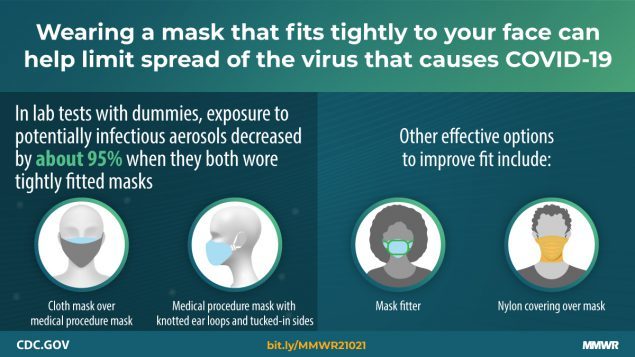 Wearing a mask that fits tightly to your face can help limit the spread of the virus that causes COVID-19.
New allocation tool connects patients with COVID-19 medications
The Minnesota Resource Allocation Platform is a new online tool that connects patients and health care providers with COVID-19 medications that are in limited supply. The platform also helps to distribute these medications in an equitable way when there is not enough for everyone who needs them.
COVID-19 patients, their caregivers, or their health care providers can use the MN Resource Allocation Platform to find out which medications are available, whether they will help the person with COVID-19, and whether the person is able to get medication.
To get these medications, you must have COVID-19 symptoms and proof of a positive COVID-19 test (saliva or nasal swab). You also need to fill out the MN Resource Allocation Platform Screening Form to see if you may be able to get one of the medications.
If you can get a COVID-19 medication, the MN Resource Allocation Platform passes along information on your behalf to a health care facility that can give it. A final decision about whether you can get a medication is up to the health care provider at that facility.
Learn more at Minnesota Resource Allocation Platform for COVID-19 Treatment.
Check the MetNet pages, FAQs
For the most current information related to the COVID-19 outbreak, visit the MetNet page and be sure to review the FAQs for staff and managers. They are updated as we have new information to communicate.
For Metro Transit work instructions and daily updates on new COVID-19 cases reported at each worksite, visit the Metro Transit MetNet page. For job aids and facilities updates for Environmental Services related to COVID-19, visit the Environmental Services page.
If you have questions, talk to your manager or supervisor or submit a question or concern in the online COVID-19 form.
Check out the latest issues of our internal newsletters: Feb. 5 Insights, Feb. 9 Wire, and Feb. 11 HR Connect.
For those who cannot easily access MetNet and/or would like a printable PDF of the FAQs, here are the most recent versions of these pages:
Met Council workforce statistics
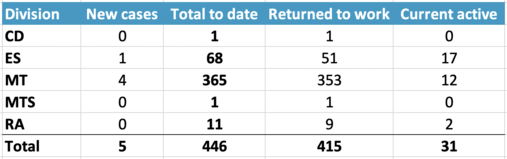
The following statistics related to COVID-19 have been reported to the Employee Resource Center. The "active positive COVID-19" number is the number of employees who currently have a positive COVID-19 diagnosis. The "cumulative" number marks the total number of employees who received a positive COVID-19 diagnosis since the pandemic began. The second table breaks down the positive cases by division for Community Development (CD), Environmental Services (ES), Metro Transit (MT), Metropolitan Transportation Services (MTS), and Regional Administration (RA).
Employees with positive COVID-19 diagnosis (February 11):

Employees with positive COVID-19 diagnosis by division (February 11*):
*These division numbers are reported weekly. These tables reflect changes week over week.
|