|
Having trouble viewing this email? View it as a webpage.
Sept. 17, 2026
Check out the latest edition of Cannabis Insider
In this issue:
News and Updates
Government Relations Report
Resources and Reminders
News and Updates
More than $250 million in retail cannabis sales since statewide launch of adult-use market one year ago
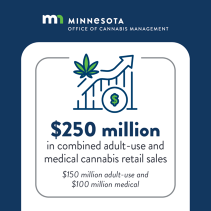
Consumers and patients have purchased more than $250 million in combined adult-use and medical cannabis products from Minnesota businesses since the launch of legal sales at state-licensed businesses across the state one year ago, according to a press release issued by OCM this week. The milestone comes at a time of significant growth for Minnesota’s emerging cannabis market as the state works to foster an equitable cannabis industry that prioritizes public health and safety, consumer confidence, and market integrity.
State-licensed businesses across the state began retail sales of adult-use cannabis one year ago this week, on Sept. 16, 2025, following the beginning of cannabis retail sales on Tribally regulated lands shortly after the passage of the original cannabis bill in August 2023. Over the last year, consumers and patients have purchased approximately $150 million in adult-use cannabis products and $100 million in medical cannabis products, totaling more than a quarter of a billion dollars in sales.
|
"After visiting with business owners, local officials and community members around the state this year, I am more enthusiastic than ever about how Minnesota's cannabis market is taking shape," said OCM Executive Director Eric Taubel. "More than 300 new cannabis businesses have launched in the last year bringing with them new jobs and opportunities for Minnesotans. Doing something right takes time, and we are building a market that is sustainable and supports the opportunity for success for businesses all along the supply chain."
When combined with sales of lower-potency hemp edibles and beverages (LPHEs), this has generated $45.6 million in tax revenue for the state for the 10-month period from September 2025 to July 2026, the latest figures available from the Minnesota Department of Revenue (DOR). Sales of LPHEs are not required to be tracked in the state’s seed-to-sale monitoring system, so sales figures for those products are not available.
Looking back at the last 12 months, Minnesota has made notable progress in establishing the cannabis market, and the evidence shows up in a variety of ways.
Learn more about one year of adult-use cannabis sales in Minnesota. Download the infographic (PDF) pictured below and social graphics (ZIP) offering data points that illustrate the state's work to launch its legal cannabis industry.
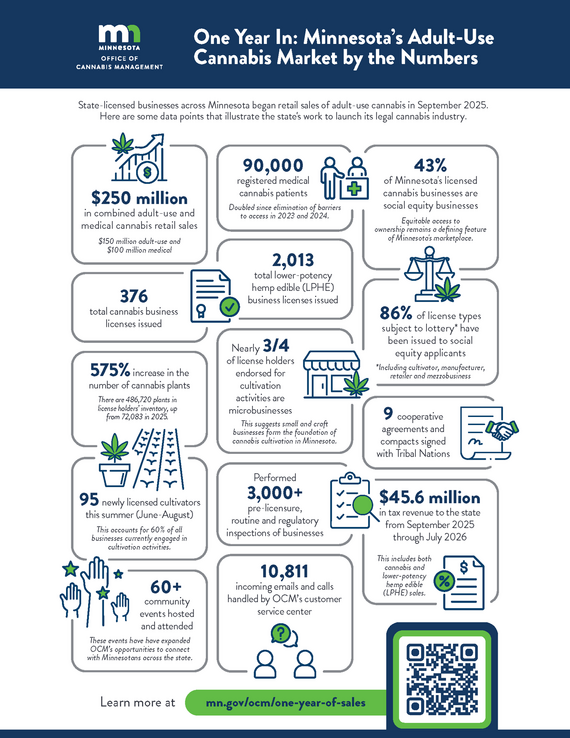 Select image to open accessible PDF.
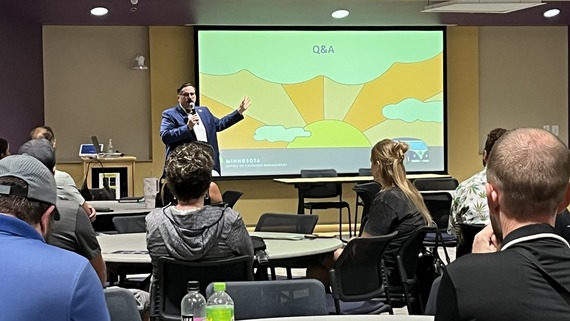
Connecting with Community Listening Tour goes to Mankato
In June, OCM went to Mankato for the fourth stop on the statewide Connecting with Community Listening Tour. OCM staff began the day by visiting Island Pezi, the first off-reservation dispensary operated by the Prairie Island Indian Community. The team also visited Voyager Cannabis Co. to learn more about the owners’ experience accessing vertical integration opportunities available through the microbusiness license.
OCM met with City of Mankato staff to understand opportunities and challenges in launching the adult-use market from a local government perspective. Topics included zoning, building code enforcement, and ideas around meaningful community engagement. Later that evening, OCM hosted the public listening event at Minnesota State University – Mankato, where attendees asked a wide array of questions ranging from public health to additional information about craft cultivation.
Changes to the federal definition of hemp
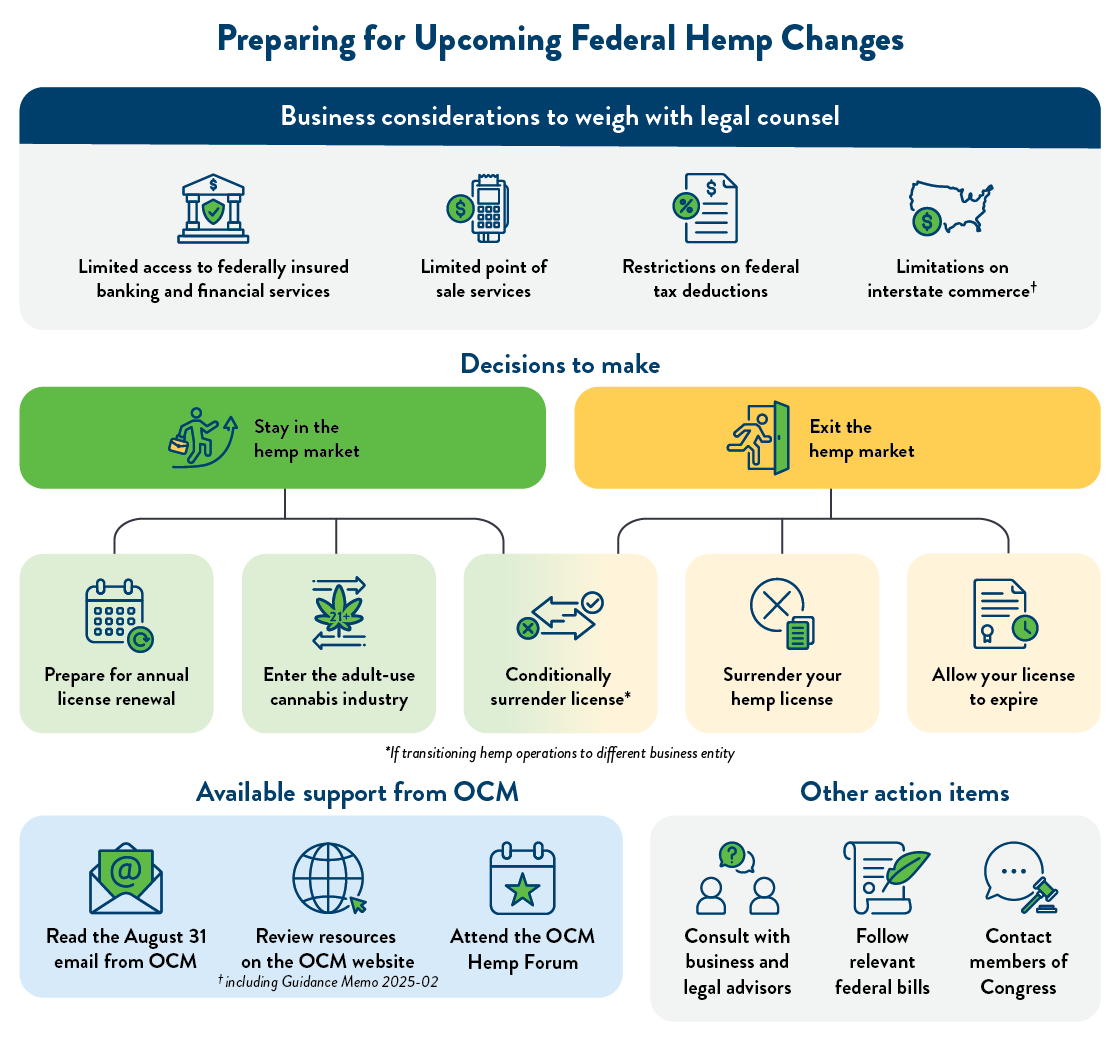
In November 2025, President Trump signed a federal spending bill that changed the definition of hemp under Title 7, Section 1639o. This change to federal law—which effectively bans hemp products containing more than 0.4 milligrams (mg) of THC per package—will take effect on Dec. 11, 2026, unless other federal action occurs.
The new federal definition clarifies what is federally legal as industrial hemp. The following products are excluded from the new definition of hemp, and therefore will become federally illegal:
-
The hemp plant and plant parts (including seeds) with more than 0.3% total THC concentration, including THCA (the previous definition included only delta-9 THC).
-
Intermediate hemp-derived cannabinoid products with more than 0.3% total THC.
-
Final hemp-derived cannabinoid products containing more than 0.4 mg total THC per container.
This federal definition change does not change how Minnesota law defines LPHE products and LPHE retailers, manufacturers and wholesalers, or the legality of those products in the state. LPHEs are defined in Minnesota Statutes, section 342.01, subdivision 50, and are allowed to be manufactured and sold under state law. Minnesota’s definitions of LPHE licenses and product types will not change after the federal definition changes on Dec. 11, 2026.
However, under the new federal definition, many products compliant under Minnesota law (e.g., packages containing more than 0.4 mg of THC) will become federally noncompliant. We recognize this will have a variety of impacts on businesses currently selling LPHE products. For example, similar to complexities currently faced in the cannabis industry, the federal change could result in:
-
Limited access to federally insured banking and financial services
-
Limitations on point-of-sale services
-
Restrictions on federal tax deductions
-
Limitations on interstate commerce
 Select image to view accessible PDF
Join us in Rochester on Oct. 1

You are invited to the next stop in the OCM Connecting with Community Listening Tour! The listening tour is designed to provide the general public with an overview of the OCM’s work and explain how the office regulates the cannabis industry in Minnesota. Most importantly, the event will allow our office to answer questions and gain valuable insights from local communities across the state.
-
An overview of the role of OCM
-
A regulatory and cannabis market update
-
Listening portion followed by Q&A with OCM staff and executive director
Who should attend: Everyone! The listening tour is a great opportunity to learn more about the current state of the cannabis market or to ask any cannabis-related questions you have been curious about. We’re in the process of planning additional stops on the listening tour. If these locations aren’t convenient for you, stay tuned for future dates and locations around the state where you can join us in conversation.
|
OCM Resource and Hiring Fair
OCM will host a hiring and resource fair on Thursday, Oct. 22, 2026, at UROC in North Minneapolis. This event will bring together grantees, community partners, applicants and resource providers for a day of connection, learning and community‑centered support. The fair will highlight grantee progress, investment impacts, local capacity‑building, workforce development opportunities, and resources available to communities preparing for participation in Minnesota’s cannabis industry.
Date: Thursday, Oct. 22, 2026
Location: Robert J. Jones Urban Research and Outreach-Engagement Center (UROC) The Plymouth Room (Room 105), 2001 Plymouth Ave. N., Minneapolis, MN 55411
More details, including registration information and a full agenda, will be shared on the OCM website.
[Back to top]
Government Relations Report
Upcoming opportunities to hear more about high-medical-need cannabis products
OCM is preparing to implement legislative changes passed in May 2026, streamlining the medical and adult-use cannabis supply chains. The new law requires the office to identify and publish a list of all high-medical-need products. Beginning Jan. 1, 2027, cannabis businesses with a medical cannabis retail endorsement must carry every product on that list.
The office has been working to develop the list of products, including through engagement with patients, providers, medical advocates and licensed businesses. Over the coming weeks, OCM will broaden that conversation. The office plans to connect with additional groups, including license holders authorized to manufacture cannabis products, medical cannabis combination businesses (which will transition to the cannabis macrobusiness license type under the new law), medical cannabis patients and providers, and others.
If you are part of one of those groups, watch for an invitation from OCM. Anyone who would like to share input in the meantime can reach the office at cannabis.info@state.mn.us.
The office expects to publish a guidance memo with the completed list of high-medical-need products in the coming weeks, with guidance to follow. To learn more about this and other recent legislative updates, visit our website.
|
Federal hemp bills to watch
Following passage of the change to the federal definition of hemp last November, there have been many discussions across the hemp industry and members of Congress about the potential for further changes before the law goes into effect. As part of these discussions, several bills have been introduced as Congress and various federal agencies are considering additional changes to the federal status of hemp and cannabis. The introduction or consideration of bills does not mean that they will pass, and it is difficult to anticipate the likelihood of further federal action and the implications for state license holders. However, businesses may wish to monitor and engage with their federal elected officials on these current proposals:
Lawful Hemp Protection Act
-
This bill would establish a federal regulatory framework for hemp-derived consumer products. It would limit the legal definition of hemp to 1% THC; establish cannabinoid limits; prohibit synthetic cannabinoids; restrict under-21 sales; establish packaging, labeling, and testing requirements; establish a distribution system for hemp beverages similar to alcohol; and impose a tax on products. It has not received a vote in either chamber.
Beverage Regulatory Parity Act
-
This bill exempts hemp beverages from the federal definition change—it would establish cannabinoid limits; prohibit synthetic cannabinoids; restrict under-21 sales; establish packaging, labeling, and testing requirements; establish a distribution system for hemp beverages similar to alcohol; and impose a tax on products. It has not received a vote in either chamber.
|
Aug. 1 Minnesota cannabis law changes in effect

On Aug. 3, OCM sent out this updated guidance to incorporate the laws that took effect on Aug. 1. More information and relevant links can be found in the guidance document.
[Back to top]
Resources and Reminders
Subscribe to OCM's newest newsletter: Seed Link
The OCM Division of Community and Economic Development has a newsletter, Seed Link! The first edition went out on July 31. Seed Link includes updates from the division, including resources for cannabis businesses, event invitations, data from OCM, and more. If you want to get these updates in your inbox, subscribe to the Seed Link newsletter.
[Back to top]
|