|
|
Welcome to OCM's newest newsletter, Seed Link! As we build up our mailing list, we are sending this first edition to our social equity applicant email list. If you would like to receive future editions, please sign up for our Seed Link mailing list.
In this issue:
-
Staying grounded
-
Connecting communities
-
Opportunity outlets
-
Monthly sparks
-
Plug in
-
Charging ahead
|
|
 |
|
Staying grounded
|
|
|
A new chapter: Equity beyond licensure
When people hear "social equity," the first things they often think about are business licenses.
That made sense in the early days. Building an equitable licensing process was one of the first and most visible responsibilities of our division. It mattered—and it still does. Today, approximately 43% of Minnesota's licensed cannabis businesses are social equity businesses, demonstrating that equitable access to ownership remains a defining feature of Minnesota's marketplace. Further, the vast majority (85%) of license holders endorsed for cultivation activities are microbusinesses—nearly half (47%) of those businesses hold social equity licenses—evidence suggesting that it is small and craft businesses who form the foundation of cannabis cultivation in Minnesota.
But if licensure is where equity begins, it should never be where equity ends.
When I accepted the opportunity to lead this division, I didn't move to Minnesota simply to issue business licenses. I came because Minnesota had a broader vision—one that recognized cannabis legalization as an opportunity to invest in people, strengthen communities, and build long-term economic mobility for those disproportionately impacted by prohibition.
That's the work we're doing now.
As we move fully into implementation, our division is evolving into the Division of Community and Economic Development because that's what the Legislature and community who advocated for legalization asked us to build. Our responsibility isn't simply to help people enter the cannabis industry; it's to help social equity eligible communities thrive because of our work. That has always been the law's intent. Our new name reflects that broader mission.
That means investing in neighborhood organizations through CanRenew, expanding access to affordable capital through CanGrow, building technical assistance for entrepreneurs, creating workforce pathways for Minnesotans, strengthening our ombudsperson services, and using what we learn from communities to shape better policy and stronger regulatory systems.
I've often said there are a thousand ways to participate in this industry, and owning a cannabis business is only one of them. Success also looks like securing a good-paying job. It looks like a neighborhood organization receiving resources to address long-standing disparities. It looks like a farmer finally accessing capital. It looks like a small business owner receiving the technical support they need to succeed. It looks like communities becoming more stable, prosperous, and resilient.
As the Division of Community and Economic Development, we'll continue to champion equitable licensure. But we'll also focus on what comes next—because the true measure of equity isn't how many licenses we issue. It's whether legalization creates opportunity that lasts for generations.
I'm excited for this next chapter, and I'm grateful you're on this journey with us.
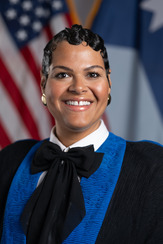
— Jess Jackson, M.Ed, MBA Director, Division of Community and Economic Development
|
|
|
 |
|
Connecting communities |
|
|
Starting a cannabis business requires more than obtaining a license. Entrepreneurs need the knowledge, skills, and confidence to navigate a highly regulated industry. To better understand and support that journey, the Office of Cannabis Management developed the Continuum of Readiness—a framework that helps prospective business owners assess where they are today and identify the knowledge and experience needed to move toward operating a successful, compliant cannabis business.
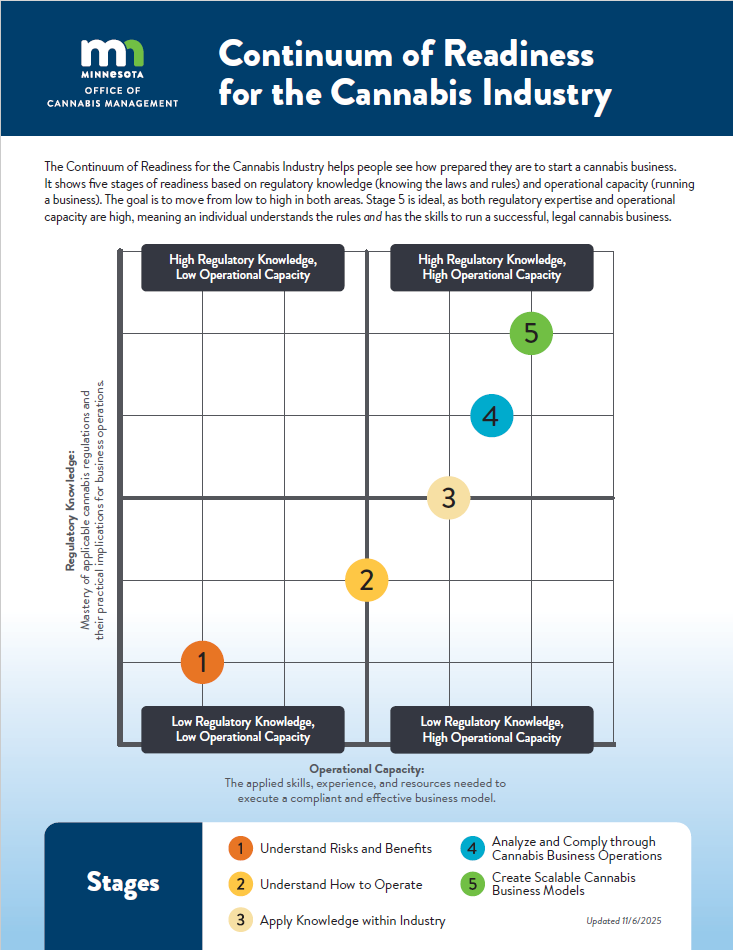 Select image to access accessible PDF
We’ve used this continuum to measure the effectiveness of our social equity mixer series. Since launching the program, OCM has hosted mixers across Minnesota that have engaged more than 250 participants, including prospective license applicants, community-based organizations, technical assistance providers, local government representatives, and other stakeholders interested in Minnesota's adult-use cannabis market. The Continuum of Readiness allows OCM to evaluate whether participants are actually increasing their preparedness over time. Before and after each Social Equity Mixer, participants complete a readiness assessment measuring growth in both business skills and experience and understanding of Minnesota cannabis regulations.
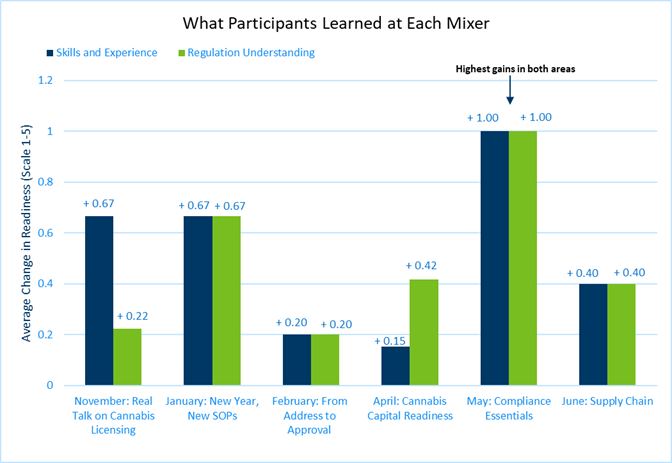 Change in readiness by learning area (business skills and regulatory understanding)
Every Social Equity Mixer held to date has produced measurable improvements in participant readiness. While the degree of growth varied depending on the topic, every session increased participants' confidence and understanding. The May Compliance Essentials mixer produced the strongest outcomes, with participants reporting an average one-point increase in both business readiness and regulatory understanding—the largest gains observed across the series.
Since launching the program, OCM has hosted mixers across Minnesota that have engaged more than 250 participants, including prospective license applicants, community-based organizations, technical assistance providers, local government representatives, and other stakeholders interested in Minnesota's adult-use cannabis market.
Each mixer addresses a different stage of the cannabis entrepreneurial journey. Measuring readiness across these diverse topics helps OCM identify where entrepreneurs gained readiness and where additional education may be needed.
These findings from participate data share a clear picture—readiness to operate in the cannabis industry is not a single milestone but an ongoing process. Building successful cannabis businesses requires access to reliable information, practical tools, trusted relationships, and repeated opportunities to learn as Minnesota's cannabis market continues to mature. By measuring learning outcomes at every mixer, OCM continues to improve its educational programming while ensuring entrepreneurs are better prepared to build compliant, sustainable businesses.
Following the latest mixer at the state capitol in July, the Division of Community and Economic Development will resume in-person social equity mixers with supplemental virtual sessions this fall.
Upcoming efforts will also include the Hiring and Resource Fair on Oct. 22, 2026, at the Urban Research and Outreach-Engagement Center (UROC) in North Minneapolis and subsequent quarterly in-person mixers. Sign up for updates on future events.
Watch recorded sessions from the Social Equity Mixer Series on YouTube:
More details will be shared in future issues of Seed Link.
|
|
 |
|
Opportunity outlets |
|
|
CanRenew grant program announces community restoration investments
 OCM continues to advance community restoration through the CanRenew community restoration grant program, which supports eligible organizations investing in communities disproportionately affected by the enforcement of cannabis laws.
CanRenew funding is designed to strengthen local capacity, support community-based projects, and expand opportunities in areas where residents may qualify as social equity applicants.
For fiscal years 2026–2027, $10.9 million was available for CanRenew projects through a competitive grant process. The program uses a tiered funding structure to help reduce barriers for smaller and newer organizations while also supporting larger-scale community investments.
-
Tier 1: Awards range from $2,500 to $10,000 and are designed for organizations newer to state funding.
-
Tier 2: Awards range from $50,000 to $2 million and support larger projects with enhanced risk assessment and monitoring requirements.
The 2025–2026 funding cycle supported organizations across Minnesota, including groups focused on youth development, workforce readiness, economic development, education, community services, and cultural programming.
Awardees included Affinity Care MN, Beltrami Area Service Collaboration, Better Futures MN, Girls Dream Code, Hired, Ignite Afterschool, InTENtions, Metropolitan Economic Development Association, United Way of Steele County, Vermilion Country School, Walker West Music Academy, and World Youth Connect.
Applications for the current cycle of CanRenew closed Jan. 12, 2026, and advanced 56 finalist organizations of 145 applications through final review, representing a statewide investment.
Funding distribution by region
- Metro: 43 projects - $8,935,000
- Southeast: 5 projects - $885,000
- Northeast: 5 projects - $575,000
- Central: 4 projects - $410,000
- Northwest: 3 projects - $310,000
- Statewide: 2 projects - $495,000
Note: due to multi-region projects, the total number of projects is more than 56 and the funds awarded are duplicated across categories.
Priority areas represented by finalists
The finalist pool reflects strong alignment with the program’s community restoration priorities established in statute.
-
Youth development was identified by 68% of finalists as a priority area, including 41% identifying it as a primary priority
-
Social determinants of health was identified by 64% of finalists as a priority area, including 13% identifying it as a primary priority
-
Economic development was identified by 57% of finalists as a priority area, including 23% identifying it as a primary priority
Additional projects support work in:
- Violence prevention
- Re-entry services
- Civil legal aid
- Substance use disorder prevention and recovery support
Learn more about CanRenew and social equity qualifications.
|
|
 |
|
Monthly sparks |
|
|
Legislative update: Cannabis omnibus bill signed into law
 With just six hours left in the 2026 legislative session, the Minnesota Senate took the final vote to pass the cannabis omnibus bill (SF 4401), which Governor Tim Walz signed into law on May 26. The final bill contains the majority of OCM’s 2026 legislative policy proposals, as well as SF 4542, a bill to restructure event licensing, and proposals put forward by legislators. OCM’s proposals directly reflect engagement with interested parties and legislators, and many provisions address pain points and areas of improvement identified by members of the state’s cannabis and hemp industry.
Some key provisions include:
- Allows a true party of interest on a cannabis license to control up to 33% of up to four social equity cannabis licenses (effective Aug. 1)
- Qualified applicant status expires after six months, and preliminary approved applicants can receive a six-month extension for preliminary (effective Aug. 1)
- Allows businesses serving the medical market additional capacity for cultivation, manufacturing, and retail based on the medical endorsements they obtain
(effective Jan. 1, 2027)
Many other legislative changes will go into effect on Aug. 1, 2026 including:
- Updated endorsements for current license holders and applicants preparing their final plans of record
- The end of the of the prohibition on owning both a cannabis and hemp license
- Updates to packaging and labeling requirements for cannabis and hemp products
- Allows hemp-derived topical products to include less than 0.3% THC
- Clarifies the role of local governments and applicants in the local approval process
- Updates to the office’s legislative reporting requirements
License holders and applicants can expect to see updated guidance materials on OCM's website in early August.
|
|
 |
|
Plug in |
|
|
Save the date: OCM resource and hiring fair
 OCM will host a hiring and resource fair on Thursday, Oct. 22, 2026, at UROC in North Minneapolis. This full‑day event will bring together grantees, community partners, applicants, and resource providers for a day of connection, learning, and community‑centered support. The fair will highlight grantee progress, investment impacts, local capacity‑building, workforce development opportunities, and resources available to communities preparing for participation in Minnesota’s cannabis industry.
Details
Date: Thursday, Oct. 22, 2026
Location: Robert J. Jones Urban Research and Outreach-Engagement Center (UROC)
The Plymouth Room (Room 105), 2001 Plymouth Ave. N., Minneapolis, MN 55411
To attend this event, complete the registration form. Organizations interested in promoting cannabis‑related jobs or sharing resources can submit their information through the OCM Resource and Hiring Fair Interest Form.
More details, including registration information and a full agenda, will be shared on the OCM website.
|
|
 |
|
Charging ahead |
|
|
Help shape future social equity resources by taking this survey
 OCM is inviting social equity verified applicants and classified license holders to complete a short, anonymous survey about their experience with the licensing process, business readiness, regulatory understanding, and resource needs.
Feedback from this survey will help OCM better understand what applicants need as they prepare to participate in Minnesota’s cannabis industry. Responses will also help inform future resources, mixer topics, technical assistance, communication methods, and support systems.
The survey asks about topics such as:
- Social equity verification status and license type
- Licensing process challenges
- Business ownership experience and concerns
- Understanding of chapter 342, compliance, Internal Revenue Code 280E, local rules,
and operations
- Resource needs and preferred mixer locations
- Connection to other cannabis entrepreneurs
- Optional demographic information
Participation is voluntary, and choosing not to complete the survey will not affect your relationship with OCM. Survey responses are anonymous and will only be used to help improve OCM’s social equity resources and support.
|
|
 Learn more about community and economic development at
|
|
|
|
|