|
OCM issues record number of licenses for cultivation activities in June
Twelve months ago, OCM issued its first cultivation license. Since then, the office has issued a total of 75 licenses to businesses engaged in cultivation activities, including 64 microbusinesses, two mezzobusinesses, seven cultivators, and two medical cannabis combination businesses. During the month of June, as of this morning, OCM has issued twice the highest number of cultivation licenses issued in a single previous month – and there are still a few hours to go!
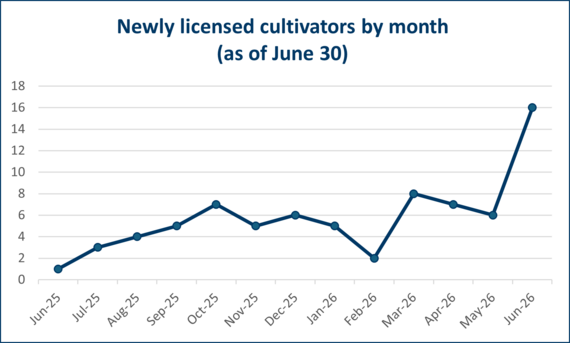 OCM has issued 16 licenses in June to businesses engaged in cultivation activities – nearly twice the number issued in any previous month (the office issued eight in March).
Legislative changes – what to know!
With just six hours left in the 2026 legislative session, the Minnesota Senate took the final vote to pass the cannabis omnibus bill (SF 4401), which Governor Tim Walz signed into law on May 26. The final bill contains the majority of OCM’s 2026 legislative policy proposals, as well as SF 4542, a bill to restructure event licensing, and proposals put forward by legislators. OCM’s proposals directly reflect engagement with interested parties and legislators, and many provisions address pain points and areas of improvement identified by members of the state’s cannabis and hemp industry.
OCM is already working to implement these changes, including updating guidance materials and the website. Keep an eye on resources like this newsletter and guidance memos to stay on top of updates.
Check out the most recent issue of the Cannabis Insider for more details and learn more about the 2026 legislative changes to Minnesota’s cannabis law, chapter 342, by reading OCM’s summary.
 [Back to top]
|
|
Lower-potency hemp edible (LPHE) businesses
Requirements for lower-potency hemp edible (LPHE) retailers to sell at off-site events

Per Minnesota Statutes, section 342.40, an LPHE retailer may participate as an authorized retailer at a licensed cannabis event hosted by a cannabis event organizer license holder. Under Minnesota Statutes, section 342.40, subd. 6, a licensed cannabis transporter must be used to transport LPHEs to a cannabis event. Note that alcohol is not permitted at cannabis events hosted by a cannabis event license holder.
LPHE retailer license holders who also hold an on-site consumption endorsement are permitted to sell LPHE beverages for on-site consumption at an off-site non-cannabis event (such as a music festival) if:
-
The event has been authorized by the local unit of government exercising jurisdiction over the event.
-
The event organizer holds an on-sale license issued under chapter 340A.
-
The event does not exceed four days in length.
[Back to top]
|
|
|
Cannabis and LPHE businesses
Remediation request process
OCM is charged with ensuring that all cannabis, cannabis products, and hemp-derived products sold in Minnesota are safe to consume and not a risk to public health or safety. As part of these efforts, the law requires all products be tested and pass minimum acceptance criteria.
If a product fails initial testing, the license holder may request approval for a product remediation request plan. The office will review each submission on a case-by-case basis. Explicit approval by OCM is required prior to product remediation.
If a license holder would like to request remediation of a product, the following form must be used in order for OCM to review the request: Remediation Request Form.

|
|
Stability package storage options

Due to storage concerns of testing facilities, OCM has approved two storage options for stability studies. It is the license holder’s responsibility to communicate with the testing facility to determine which storage option is best. Each stability timepoint in the study must be packaged separately. Please refer to Metrc Support Bulletin 53 and Metrc Support Bulletin 54 for details.
|
|
|
Cannabis businesses
Medical cannabis rescheduling and medical endorsements

On April 23, the acting United States attorney general signed an order reclassifying state-licensed medical cannabis as a less-dangerous drug, shifting licensed medical cannabis from Schedule I to the less strictly regulated Schedule III. The federal government has not yet released additional guidance regarding the full impact of this order.
With this news, businesses may be considering adding medical endorsements to their license or application. As a reminder, under the current law and regulations in Minnesota’s licensing system, medical cannabis and adult-use cannabis are distinct and separate and a cannabis business licensed/endorsed for both would have to maintain separate supply chains. The recent changes made to the law in the 2026 legislative session will streamline and merge the supply chains, but these changes do not go into effect until Jan. 1, 2027. License holders who wish to add an endorsement can follow the steps outlined below and on the Making Cannabis Business Changes webpage.
A licensed business may apply to add new endorsements and/or business activities to their license through Accela.
-
As a first step, the license holder must submit a new site registration in Accela and upload an amended final plan of record which focuses only on the new endorsement and/or business activity to be added.
-
Next, the license holder emails ocm.licensing@state.mn.us to inform OCM that updates have been made in Accela with the proposed changes.
All applications for new endorsements and/or business activities are subject to OCM review, approval, and inspection, as well as local approval of the new site registration. OCM will notify the license holder once/if new endorsements and/or business activities are approved or denied.
|
|
|
Reminders of final requirements to receive your license

Applicants continue to make significant progress in their journey toward licensure. As the office finalizes its review of applications and prepares to issue licenses after successful inspections, there are a few final requirements for documentation that applicants must ensure are completed. The most common missing items in the final steps toward licensure include Tax ID information and proof of workers’ compensation insurance (or a valid exemption attestation).
To avoid delays in receiving their license, applicants should regularly monitor communications from the licensing team (sent through Accela at NoReply@accela.com) and respond promptly to any outstanding requests.
|
[Back to top]
|
|
Statewide Inventory Tracking and Management (Metrc)
OCM has partnered with Metrc to administer Minnesota's statewide seed-to-sale inventory tracking system, which includes planting, harvesting, processing, testing, transportation and retail sales. All licensed cannabis businesses must register and use this system (including software, tagging, and labeling tools). Metrc is a complex system and as more businesses come online and begin using the system the office will continue to provide helpful information for navigating the tool.
|
|

Metrc Support Bulletins
Metrc bulletins are official communications issued to license holders from Metrc to provide critical updates on system functionality, enhancements, and compliant workflow changes. They serve as step-by-step guides, offering industry operators clarity on data entry practices and technical requirements.
|
It is important that every business maintains accurate records and ensures their processes result in daily inventory tracking. At the end of each business day, a cannabis business is required to ensure that all Metrc inventory counts are accurate and are identical to the physical quantity of product within the facility (Minnesota Rules, part 9810.1302, subp. 6).
[Back to top]
|
|
Important updates and reminders

-
Temporary transport allowance to testing facilities has been extended through Feb. 1, 2029, review updated guidance memo for details (GM-2025-06)
-
Find data around cannabis cultivation, sales activities, and cannabis licensing in the state of Minnesota on OCM’s dashboard, Cannabis Market Monitor!
-
Bookmark the OCM Guidance Memos webpage to keep up with important decisions from the office.
|
Annual petitions process
Starting in July 2026, OCM will open its annual online petition process for the following topics:
- Approval of a new medical cannabinoid product
- Approval of a new medical delivery method for a cannabinoid product
- Approval of a new product category
- Approval of the use of a cannabinoid in lower-potency hemp edibles
- Approval of the manufacture and use of an artificially derived cannabinoid
- Declaration of a cannabinoid as nonintoxicating
Per Minnesota Rules, part 9810.1003, subp. 2, petitions will be accepted during the month of July, specifically between the first and last business day of that month each year. This process is governed by Minnesota Rules, chapter 9810, and Minnesota Statutes, chapter 342.
To prepare for the submission window, interested parties should review the Petition Process: Submission Guidance and Review Criteria. Check out the Petitions Process webpage for more information.
 [Back to top]
|
|
|
|
|