2024
From Jan. 1, 2024, through Dec. 31, 2024, 3,860 individuals arrived in Minnesota as refugees, Special Immigrant Visa holders, asylees, Afghan parolees, or certified victims of human trafficking. The majority (3,358) of these arrived with a refugee visa. The most common countries of origin among these arrivals were Somalia (1,490), Afghanistan (603), Ethiopia (272), and Burma (242).
Among these 3,860 arrivals, 3,718 were eligible for a post-arrival refugee health assessment (RHA) and 3,680 (99%) received a health assessment. Select results from the RHA are highlighted in the table below.
In addition to the arrivals above, the Minnesota Department of Health Refugee Health Program (MDH RHP) was notified of 719 Ukrainian Humanitarian parolee arrivals and 23 Cuban/Haitian entrants who arrived in Minnesota during 2024. While these individuals are eligible for refugee benefits, MDH RHP does not receive systematic notification of these arrivals. Those who are referred to MDH RHP are then referred to local public health and screening clinics for required post-arrival testing and a post-arrival refugee health assessment.
Health summaries and additional demographic information for 2024 refugee arrivals will be posted on our website in early November.
Health Status of New Refugees, Minnesota, 2024
|
Health condition
|
Number infected among screened (%)
|
|
TB infection*
|
597/3,477 (17%)
|
|
Hepatitis B infection**
|
99/3,564 (3%)
|
|
Hepatitis C antibody
|
48/3,397 (1%)
|
|
Parasitic infection***
|
692/2,651 (26%)
|
|
Syphilis infection
|
21/3,002 (1%)
|
|
HIV infection
|
22/3,514 (1%)
|
|
Elevated blood lead****
|
81/1,434 (6%)
|
|
Positive mental health screening*****
|
242/1,977 (12%)
|
Total number of health screenings: 3,680 (99% of 3,718 eligible refugees)
* Arrivals with LTBI (QFT+ or ≥ 10mm induration with normal CXR) or suspect/active TB disease
** Positive for Hepatitis B surface antigen (HBsAg)
*** Positive for at least one intestinal parasite infection
****Children <17 years old (1,516 screened); Lead Level ≥5 ug/dL
***** Adults 18+ years old (NMinnesota= 2,090 screened); Screened positive for mental health concerns using any mental health screening tool(s)
2025
From Jan. 1, 2025, through Sept. 30, 2025, 488 individuals arrived in Minnesota as refugees, Special Immigrant Visa holders, asylees, Afghan parolees, or certified victims of human trafficking (these data are preliminary). The majority of these arrived with a refugee visa (311) or Special Immigrant Visa (135). The most common countries of origin among these arrivals were Afghanistan (170) and Somalia (133). Sixty-six percent (N=323) of the 488 arrived in January 2025, with much smaller numbers arriving in subsequent months.
WE-Check
Mental health screening is an integral part of the Domestic Refugee Health Assessment for all refugee arrivals. This screening is intended to help determine who would benefit from a referral to specialty care, ongoing management at primary care, and/or formal diagnostic testing. For adults 18 and older, the MDH RHP recommends the use of the Minnesota Well-being and Emotions Check (WE-Check). This five-question screener is designed to be asked verbally by the clinician with an interpreter (if indicated) and is a tool to help gauge mental health distress and make a plan for follow up, if indicated. Multiple translated versions are available on our website for ease of interpretation.
Because the WE-Check was developed to assist in gauging general mental health distress, it is a more thorough screening tool than targeted tools like the PHQ-2 or GAD-7, which may not accurately reflect other mental health concerns than depression or anxiety, respectively, unless used in conjunction with other screeners.
Many assessment clinics have integrated the questionnaire into the EMR flowsheets to allow for easy data entry and tracking. If you would like to speak with a clinician who has implemented this, please reach out to us at refugeehealth@state.mn.us.
More details on the WE-Check, including a 2022 webinar on mental health screening guidance, are available on our website:
Survey of Wellbeing for Young Children
The Minnesota Center of Excellence in Newcomer Health, in collaboration with the University of Minnesota, translated the Survey of Wellbeing for Young Children (SWYC) into Dari and Pashto. Per TEAM UP for Children, the SWYC is a freely available, comprehensive screening instrument for children under 5 years of age. The SWYC was written to be simple to answer, short, and easy to read.
A workgroup composed of subject matter experts was formed to facilitate the translation and cultural adaptation of a developmental screening tool in Pashto and Dari for Afghan newcomers to the U.S. This process ensured linguistic and cultural accuracy of the SWYC for the Afghan newcomer community, making it more accessible and relevant for caregivers. They completed a literature search of best practices around translating materials to determine a process. A professional translation service was hired to complete the initial translation of the SWYC from English into Dari and Pashto. After the translated versions were received by the workgroup, they were culturally validated to ensure linguistic and cultural accuracy for the Afghan newcomer community.
To this end, Afghan caregivers of children aged 0-5 were recruited to participate in one or both of two focus groups (Dari and Pashto). An expert on the language team facilitated each focus group in reviewing that language’s SWYC translation, with the goal of identifying all language that was ambiguous or difficult to understand by Afghan caregivers in the context of their children’s development and behavior. In addition to facilitating, the language team expert took notes and revised the translated SWYC according to the focus group feedback. These culturally validated SWYCs and the focus group feedback were brought to the entire workgroup to review and verify that the changes made during the group sessions achieved the intended purpose of the original English version.
Find the SWYC in Dari, Pashto, and many other languages:
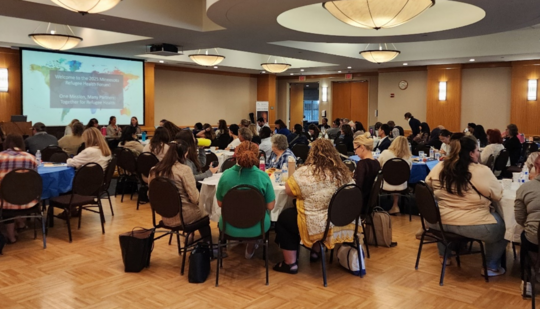
 Thank you to all who joined us for the 2025 Refugee Health Forum: “One Mission, Many Partners: Together for Refugee Health.” It was a delight to see some of those many partners in person, and we were grateful that many were able to join virtually for the morning sessions as well. Individuals from community-based organizations, local public health, clinics, and more were able to join us for a day of community and learning.
- The day kicked off with Minnesota State Refugee Coordinator Rachele King, who shared updates on the latest refugee resettlement policies, and continued with the Minnesota Refugee Health Program team, which presented the most recent state refugee health data, activities, and resources.
- A local public health panel, featuring Marie Maes Voreis (Scott County), Carley Harvey (Anoka County), Jodi Johannessen (Olmsted County), and Marin Jaszewski (Washington County) discussed the roles of public health nurses in refugee health and the complexities, variety, and rewards of this work.
- Dr. Peter Ladner and Dr. Uyen Truong from Gillette’s Complex Care Clinic shared their work and how their team is equipped with the skills, resources, and compassion to serve newcomers with complex medical needs.
- Finally, the community voices panel, including Iryna Borbol (Ukrainian American Community Center), Mahdi Surosh (Center for Victims of Torture), and Tri Tang (Vietnamese Community of Minnesota), shared insights on their own experiences navigating the health care system and the important work they are doing to advocate for and promote refugee health in Minnesota today.
Thank you again to all who made the 2025 Minnesota Refugee Health Forum such a lovely event. A special thanks is owed to our former colleague, Marge Higgins, who wrapped up our day in song, providing us all with a chance to raise up our voices and end on a high note. We look forward to seeing you all next year, and in the meantime let us remain – Together for Refugee Health!
Celebrating 10 years of MN COE

September 2025 marked the completion of the 10th year and second fiscal cycle of the MN COE. Many of our Minnesota local public health and clinic partners have actively engaged and helped us advance our work reaching over 9,500 people around the U.S. the past 10 years. None of this would have been possible without the support and input from our wonderful network!
In these most recent five years, MN COE has:
|
You can read more about some of the MN COE’s latest resources and updates in the Minnesota Center of Excellence in Newcomer Health Updates: September 2025 newsletter!
Tool Spotlight: LanguageRef
Check out the MN COE resource, LanguageRef, a directory of rare language interpreting service providers!
To use this tool, you simply type the name of the language(s) in the search bar and results will filter by keywords to show relevant languages.
 Once you select the language you are looking for, a list of vendors will appear.
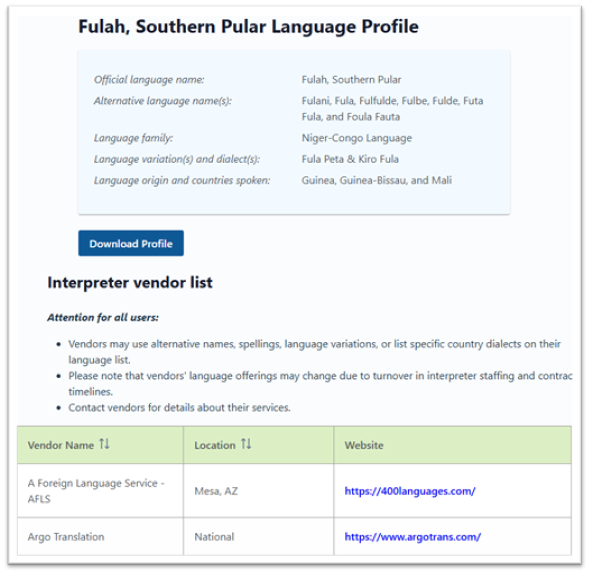 If you can’t find a language or know of vendors offering interpretation services for rare languages that are not listed, you can request the addition of the language(s) and vendor(s) to the directory using the LanguageRef Request Form.
|