|
View this as a webpage
Complete your well-being program by October 31 and get $70 off your deductible next year. If you are using Virgin Pulse to participate in our well-being program, make sure you update your account to reflect your completed activities prior to October 31. You need 300 points by the end of October to qualify for the discount on your deductible in the 2023 plan year. There’s a variety of activities you can do, but you can get 300 points by completing your health evaluation and recording flu shots and COVID-19 booster shots that you received between November 2021 and October 2022.
What should our HRD SharePoint pages look like? We’d like to make our HRD SharePoint home page more useful for staff, and update it to use the Modern view that other MDH sites use. But we could use some help to understand what information would be useful to staff. If you have ideas for how we could make our pages better, please share them with your supervisor so that they can be passed on to the Senior Leadership Team; you can also leave them anonymously in the HRD Feedback Box.
2023 Open Enrollment is Oct. 27 – Nov. 16: This year, enrollment is open for medical, dental, vision, life, and long-term disability insurance, and pre-tax savings accounts. The State Employee Group Insurance Program (SEGIP) will be holding meetings to review options for employees, or you can call their Service Center (651-355-0100 (Metro) and 800-664-3597 (Greater MN)) for more information. Check the Intranet link above for more information and details about the meetings.
SSIS Release Cycle has begun; please use the SSIS Worker Pilot icon: Staff who use SSIS for their work should use the pilot application whenever SSIS is in the period between a pilot release and the full statewide release, which means you should use it until the end of the workday on Tuesday, November 29. The next morning, November 30, you will use “SSIS Worker Production.” You will continue using that until the next release cycle starts on January 25, 2023. If you have any questions, please reach out to Matt Heffron.
Congratulations to the Case Mix team for the successful completion of the CMR application upgrade project. Over 50 distinct changes were identified, tested, and implemented. A big thank you to Lori Hagen for gathering the requirements over many years and launching the project.
HRD is under contract to review the incoming resident records submitted by nursing homes to Centers for Medicacare and Medicaid Services (CMS). HRD retrieves the data from CMS every day. The information submitted by the nursing home determines the daily rate a nursing home charges Medicare and private pay residents based upon the level of care the resident received. DHS sets the rates annually. In addition, HRD staff audit a portion of the records submitted to ensure the information provided is accurate. The CMR application is the tool HRD uses to review records as well as identify resident records for audit.
The changes made noticeable improvements to the application by removing non-value add activities. They included updated logic, re-labeled data fields, improved reporting and display screens to make things more clear for staff. “These changes have simplified my work,” said Olivia Jimenez. In addition, Sierra Aimua noted, “The application now focuses our time on the cases which need review and attention.”
The project could not have been completed without the participation of Jen Spalding, Sarah Lane, Lori Hagen, Olivia Jimenez, Sierra Aimua, Robin Lewis, Nadine Olness, and Mary Halet. We are appreciative of our MNIT partners, including Haritha Kethineni and Selim Yucel, for making these changes possible.
 The Office of Enterprise Sustainability in the Department of Administration will be hosting an all-employee lunch and learn event on Tuesday, November 1, from 12 to 1 p.m. via Teams.
This year’s event is focused on the impact of transportation on greenhouse gas emissions in Minnesota, and includes speakers from the Minnesota Pollution Control Agency (MPCA), the Department of Transportation (MNDOT), the Department of Natural Resources (DNR), and a recorded message from Lt. Governor Peggy Flanagan.
You can add the invite to your calendar by clicking here: Our Minnesota Climate: The Role We Play, or see the full agenda in the attached PDF: The Role We Play – Virtual Event flyer 2022.pdf.
Thanks to Fernando Nacionales for sharing this event with us! If you have an event you think HRD should know about, please send the information to Health.HRDCommunications@state.mn.us and we’ll make sure it gets into the next issue of Have You HRD?
Last week we started discussing how to read the MDH Retention Schedule and looked at the Table of Contents as an introduction. To recap, the retention schedule is divided into record series, which are grouped into categories to help more easily navigate them.
You can use the links in the Table of Contents to find the series you’re looking for, or you can search the document if you’re not sure what series you need but have some keyword ideas. In our example, we’re trying to figure out what we should do with some documents related to our programs’ advisory councils.
The record series that covers documents related to advisory councils is in the “General Office Operations” category, because teams across the agency have these kinds of documents. If you look at the categories in the document, you’ll see that they start out with general groups that are applicable agency-wide, and then further down, there are more division- and program-specific categories.
Reading the schedule fields
The schedule is laid out as a table with each column showing a piece of metadata for the record series:
- Citation: Some types of documents have statutory requirements for how long we need to keep them, which will be shown here.
- Description of Records: This field includes the name and number of the record series, as well as a brief description you can use to help determine if the record series is applicable to the documents you’re working with.
- Examples: A non-exhaustive list of the types of documents that might fit within this series. If you don’t see what you’re looking for, check with Chris Johnson or Siobhain Rivera.
- Retention: The amount of time we have to keep something for. This is a floor – we can (and do) keep things for longer when there is a need, but we should also be cognizant that keeping things for longer can be risky, particularly for sensitive materials. If we receive a data request for an item that should have been destroyed, but we still have it, we have to provide that information to the requestor.
- Disposition Action: How we dispose of the item. Often, this is just that the record should be destroyed. However, some records have historical value and are sent to the Minnesota Historical Society for archiving.
- Designation: This field has information about whether a particular group of records should be archived, whether they are essential (would MDH need these to recover from an emergency?), and who is responsible for managing the records.
Here’s what the page for record series 1.2.3 Council, Committee, Task Forces, and/or Advisory Meetings looks like (it’s page 25):
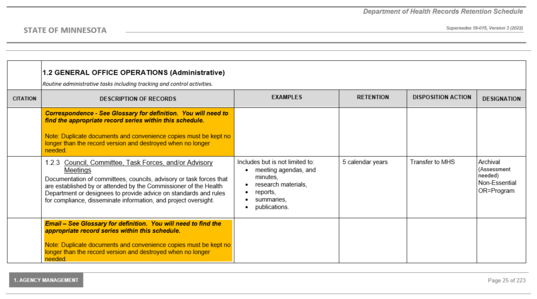 Our example documents are meeting minutes and agendas for advisory councils from 1995 to 2021 hosted by HRD’s programs, which is a match for this series. According to the schedule, we should keep these records for 5 years, and then transfer them to the Minnesota Historical Society (MHS). They are designated as archival (hence, the transfer) and non-essential. The office of record, or owner, (OR) is the program that created them, so they are the ones responsible for making sure that they are disposed of correctly.
Now what?
We’ve figured out that some of our records have met their schedule, and are ready to be disposed of. The records that have not yet met their 5-year requirement should be saved in a safe place that is accessible to the team who owns them (not someone’s home drive or computer), and we can come back to them later.
For records that need to be destroyed, the process is fairly straightforward; we need to document the records that we are destroying in a Records Destruction Report (available in the RIM Forms library of the MDH RIM SharePoint site), and send the report to the MDH RIM office.
Our records need to be transferred to MHS, which is a bit more involved, but the process is basically the same – we need to make a list of all of the records, and then we upload them to a special SharePoint library, where they will hang out until the MDH RIM office sends them over. Once they’re in that library, they’re no longer our responsibility, and we can delete any copies of them that we have.
That’s it! The hardest part is figuring out which record series a document belongs to; once you know that, it’s just a matter of filling out a few forms. Next week, we’ll be going more in depth about the HRD-specific parts of the schedule, particularly the changes that were made to our record series and how those will affect our work. Siobhain will also be doing a presentation on Friday, November 4 at 2 p.m. about the changes, followed by a Q&A time where you can ask any questions you have about how to handle records your team produces. Find the calendar invite in the HRD Team’s Calendar tab so you can join us.
This week, we have the following positions available, and more are coming soon. Please share them with anyone that you think would help make HRD a better place to work!
-
Survey and Review Unit Supervisor (Federal Operations), Job ID: 58792: This position will supervise the Metro A federal evaluation team, a unit of surveyors responsible for the evaluation of health care provider organizations to ensure regulation compliance and the provision of quality care. Closes October 28, 2022.
-
Policy and Rules Coordinator (Shared Services), Job ID: 60058: These two positions will provide legislative and policy research and analysis to support HRD in fulfilling regulatory responsibilities; they will also oversee the development, promulgation, and adoption of rules related to HRD’s work. Closes October 31, 2022.
-
Assistant Division Director, Job ID: 60113: The Health Assistant Division Director is part of a three-person management team in the HRD Director's office accountable for the planning, development and implementation of HRD’s regulatory responsibilities, policies, legislative goals, and strategic direction, all with the common objective to protect the public. Closes November 14, 2022.
-
Nursing Evaluator (Federal Operations), Job ID: 59463, 59461, 59420, 59421, 59383: These positions provide surveillance and evaluation of healthcare providers to confirm compliance with federal and state laws and rules related to the provision of nursing and health services. These postings will be used to fill positions based in the St. Cloud, Marshall, Rochester, St. Paul, and Duluth offices. Closes December 30, 2022.
These positions are open to internal and external candidates. If you would like to apply, please follow the steps below:
- Sign into Employee Self Service
- On My Homepage, click on Careers and enter the Job Opening ID in the Search Jobs box and click >> (Search).
- Click on the Job Title to view the job posting.
- Click Apply for This Job in the top right-hand corner.
This week, HRD welcomed the following people to the division. Send them a message to say hello!
- Tiffany Baxter, Federal Operations (Evaluation)
|