|
May 12, 2026
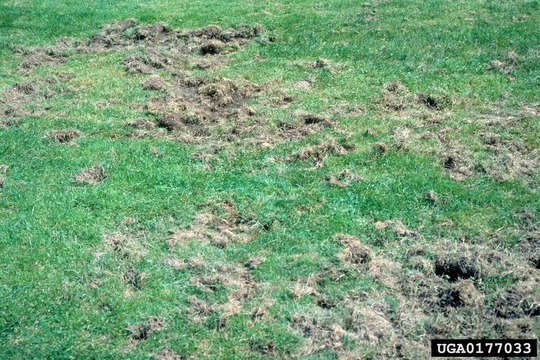 Grass turf damaged by Japanese beetle larvae, with grubs dug up by animals. Photo by M.G. Klein, USDA Agricultural Research Service, Bugwood.org.
Do you have patches of dead grass in your yard this spring? One common cause of this damage may be caused by white, or C-shaped, grubs. These are the immature stage of several invasive and native beetle species, including European chafer, Japanese beetle, and May/June beetles. The larvae feed on turfgrass roots, weakening or killing the grass.
In early spring, grass that is killed by grubs will pull up very easily, often revealing the insects in the top 1–3 inches of soil. You may also notice areas where the yard appears dug up by animals such as raccoons or skunks searching for the larvae for food.
Identifying which species of grub you have can be difficult, but it can also be important for determining management strategies and timing of control. Grubs are typically creamy white larvae with brown heads. They can be distinguished by their raster pattern, which is a series of short hairs and spines on the underside of the tip of the abdomen. For example, Japanese beetle grubs have a distinctive V-shaped raster, European chafer grubs have a pattern that looks more like a Y, and May/June beetle grubs have a zipper-like pattern and are generally larger than the other species. These raster patterns can usually be seen with a hand lens.
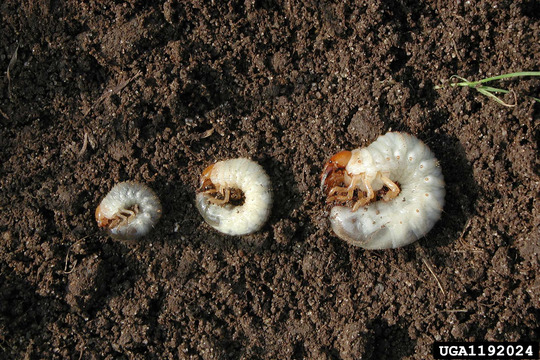 Three species of white grub. From left to right: Japanese beetle (Popillia japonica), European chafer (Amphimallon majalis), and June bug (Phyllophaga sp.). Photo by David Cappaert, Bugwood.org.
It is also possible that the damage to your yard is not caused by grubs at all, but by another common spring turf problem. Winterkill often results in irregular dead patches, especially in exposed or poorly drained areas. Unlike grub damaged turf, winter injured grass may appear brown and does not lift easily from the soil, and no grubs will be present.
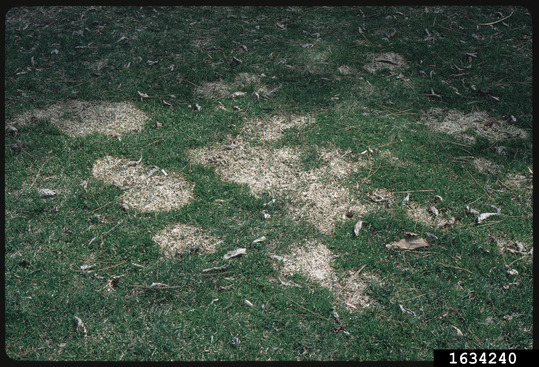 Snow mold on turf grass. Photo by Penn State Department of Plant Pathology & Environmental Microbiology Archives , Penn State University, Bugwood.org
Fungal diseases can also be mistaken for grub damage. In these cases, the grass does not pull up easily and may appear bleached or patchy. These areas may have visible fungal growth or more circular or ring-shaped patterns in the grass. Proper diagnosis by a trained professional is the best way to determine the appropriate management strategies.
For more information about managing grubs, please visit Managing White Grubs in Turfgrass.
Keep an Eye Out for Lily Leaf Beetles
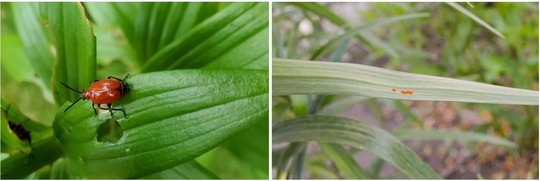 The image on the left shows an adult lily leaf beetle. The image on the right shows lily leaf beetle eggs laid in line on the underside of leaf. Photos by the MDA.
Lily leaf beetle adults are now active and may be spotted in gardens as temperatures warm and lilies emerge. These bright red beetles feed on true lilies and can quickly cause significant leaf damage. Adults are also laying eggs on the undersides of leaves. Gardeners should begin inspecting plants regularly and remove beetles when they are found. Early detection makes management much easier throughout the season. If you see lily leaf beetles, please report them to EDDMapS or Report a Pest.
Emerald Ash Borer Awareness Week is May 17-23
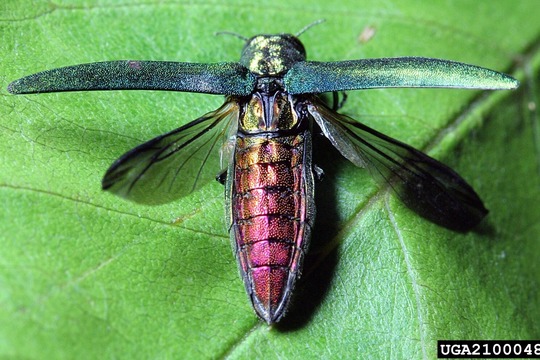 Adult emerald ash borers have a bright metallic red back (dorsal). Photo by David Cappaert, Bugwood.org.
Emerald Ash Borer (EAB) Awareness Week (May 17–23, 2026) is a reminder for Minnesotans to take action to slow the spread of this destructive invasive insect. With EAB now confirmed in 60 counties across the state, including a new detection in Todd County, continued awareness and prevention efforts are critical.
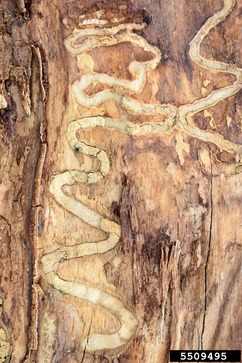
EAB was first discovered in Minnesota in 2009. Its larvae kill ash trees by tunneling beneath the bark and feeding on the tissue that transports water and nutrients. Infested trees often show visible signs, including:
- Increased woodpecker activity
- Splitting bark
- Distinctive S-shaped galleries beneath the bark
Emerald ash borer larvae carve S-shaped tunnels under the bark. Photo by William M. Ciesla, Forest Health Management International, Bugwood.org.
What You Can Do
You can help limit the spread of EAB:
- Don’t move firewood. Buy it where you burn it.
- Check ash trees for signs of infestation.
- Report suspected EAB to the MDA's Report a Pest.
- Share information with neighbors and your community.
Not sure if what you’re seeing is EAB? Some native insects look similar. Review Insects in Minnesota Confused with Emerald Ash Borer.
More information about emerald ash borer, including identification and management resources, is available on the MDA website.
New Smarty Plants Episode - Garden Smarter, Not Harder
Smarty Plants is a podcast exploring invasive insects and noxious weeds that threaten Minnesota’s natural and agricultural resources.
After our long Minnesota winter, many of us are itching to get outside and work on our gardens, or put some new plants in the ground. Set yourself up for success this gardening season with this episode of Smarty Plants, featuring tips and tricks from MDA staff Michelle Grabowski, Plant Disease Specialist and Allen Sommerfeld, UMN Extension Master Gardener and MDA Communications Director.
Subscribe to Smarty Plants today so you don’t miss an episode!
Plant It Forward: Seed Sharing Tips & Rules
Seed libraries and seed swaps help communities share seeds and gardening knowledge. These programs are typically volunteer-run and free to the public. In Minnesota, seed libraries are often located in public libraries, garden clubs, and nature centers.
Participants may:
- Take or "borrow" seeds to plant at home
- Donate seeds to share with others
Many seed libraries and swaps have their own guidelines and best practices for borrowing and donating seeds. These programs support local food production and native landscaping.
Recommended Best Practices for Non-Commercial Seed Sharing
While not required, these best practices help protect participants and strengthen seed-sharing programs:
- Clearly label the event or space as non-commercial seed sharing.
- Label seed packets with helpful information, such as:
- Plant name (common and/or scientific, include variety if known).
- Identify hybrids, if applicable.
- Year the seed was harvested.
- A reference for traceability, such as a lot number.
- Name and city (or address) of the seed library, swap, or organizing group.
- Label treated seed according to applicable laws. Learn more on the Seed Program webpage.
- If collecting large quantities of seed for redistribution, consider testing for Prohibited and Restricted Noxious Weed seeds.
- Post signage at seed sharing locations stating that:
- Seeds may not meet germination or varietal purity standards established under state seed law.
- Patented seed or varieties protected under the U.S. Plant Protection Act should not be accepted or distributed without permission from the certificate holder.
MDA Inspectors may visit seed libraries and seed swaps during routine checks to ensure requirements are being followed.
For more information, view the Seed Library and Swaps Factsheet.
For questions or guidance on best practices, please contact the MDA Seed Regulatory Program.
MDA Launches Annual Spongy Moth Survey
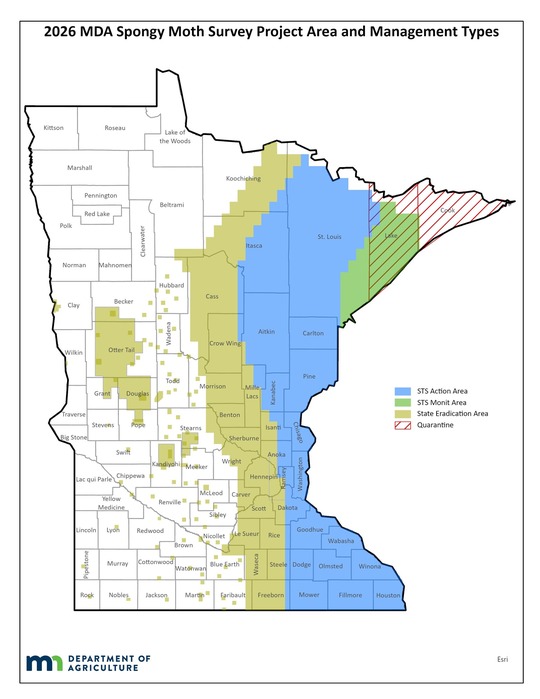
Map showing the different management types within the Minnesota survey project area.
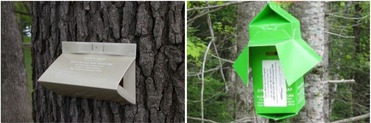
The Minnesota Department of Agriculture (MDA) has launched its annual spongy moth (Lymantria dispar) survey, setting nearly 20,000 pheromone-baited detection traps across the state to help detect and slow the spread of this destructive tree pest. Most traps will be delta traps, but milk carton traps will be placed in Lake County and southeastern St. Louis County, where trap catches are expected to be slightly higher than in other parts of the state.
Left: delta trap. Right: milk carton trap.
Survey Timeline and Regional Details
Trap placement will begin in late May and continue through mid-July. Traps will be removed at different times depending on the region.
-
Southern Minnesota: Trap placement starts in late May and continues through early June; traps are typically removed by early September.
-
Northern Minnesota: Trap placement begins in early June and continues through mid-July; traps are typically removed by mid-October.
This survey is part of a nationwide effort known as the Slow the Spread (STS) program. Minnesota’s planned trap sites account for 21% of the 94,594 total traps planned across all participating STS states in the nationwide project area, which extends from Minnesota to North Carolina.
Purpose of the Survey
The MDA’s trapping program plays a crucial role in early detection of spongy moth populations. Rather than attempting to trap every moth, the program identifies potential infestation hotspots, helping guide future treatment and management strategies. This proactive approach helps protect Minnesota’s forests and urban landscapes by delaying the damaging effects of the pest.
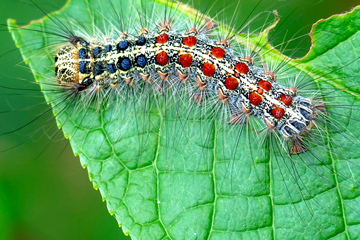
Spongy moth caterpillars feed on the leaves of over 300 tree and shrub species, especially oak, poplar, birch, and willow. Repeated infestations can defoliate and eventually kill trees. When populations are high, caterpillars can also become a nuisance to people.
Spongy moth caterpillars have five pairs of blue spots near the head followed by six pairs of red spots.
In addition to annual detection trapping surveys, the MDA has proposed aerial mating disruption management in select areas of the Slow the Spread (STS) project area (shown in blue on map) to help manage spongy moth populations. This method involves releasing a synthetic version of the spongy moth’s sex pheromone, the same one used in traps, into the air. By flooding the area with this scent, male moths become confused and are unable to locate females to mate with. As a result, reproduction declines and population growth slows. Aerial management typically occurs in June and July, depending on insect development and weather conditions.
To learn more about spongy moths and the MDA’s efforts to slow their spread, visit the MDA’s spongy moth webpage.
In the Field: Plant Disease Surveys
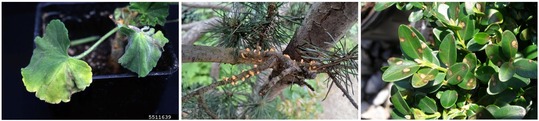 Left to right: Geranium with yellowing and wilting leaves (southern wilt). Photo by Margery Daughtrey, Cornell University, Bugwood.org. Pale orange fungal structures emerging from the bark of a pine branch (Scots pine blister rust). Photo by © René Jarling via iNaturalist (CC BY-NC). Boxwood leaves with round, tan leaf spots with a purple margin (boxwood blight). Photo by the Minnesota Department of Agriculture (MDA).
A survey to look for invasive plant diseases and insect pests in nurseries began on May 4, 2026. The survey is conducted by the Minnesota Department of Agriculture (MDA) Plant Protection. MDA Nursery inspectors are looking for invasive pests identified by the United States Department of Agriculture (USDA) and the MDA as risks to agriculture and natural plant communities in Minnesota. This work is funded by the USDA Plant Protection Act.
Nursery inspectors will be looking for the following plant diseases this spring:
Southern Wilt (Ralstonia solanacearum r3bv2)
Southern wilt is caused by a bacterial plant pathogen that can cause wilting and death in tomato, potato, eggplant, and other important agricultural crops. Although this strain does not occur naturally in the United States, it does occur in tropical and subtropical countries that produce geranium stems shipped to the U.S. for annual flower production. Nursery inspectors are looking for geraniums with wilting leaves and yellow, wedge-shaped leaf discoloration.
Scots Pine Blister Rust (Cronartium flaccidum)
This fungal plant disease can infect and kill the branches and trunk of mugo, Scots, Austrian, and ponderosa pines. It is found in Europe and northeastern Asia but has not been reported in the U.S. Pine trees native to Minnesota are believed to be resistant to Scots pine blister rust.
Boxwood Blight (Calonectria pseudonaviculata)
Boxwood blight is an invasive fungal plant pathogen that has spread to many states in the U.S. but has not been reported in Minnesota. Infected boxwood plants develop brown leaf spots, thin black stem lesions, and drop leaves, resulting in bare branches.
Contact Report a Pest if you suspect southern wilt, Scots pine blister rust, or boxwood blight.
May Weed of the Month: Butterburs
Common and giant butterburs are in a 3-year nursery phase out
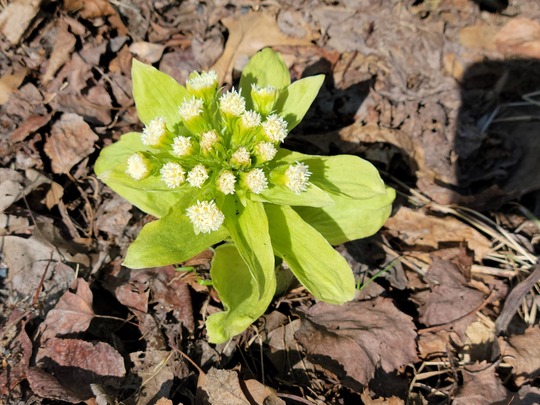 Giant butterbur has yellowish white flowers.
By Emilie Justen, Minnesota Department of Agriculture: Two species of butterburs, common (Petasites hybridus) and giant (Petasites japonicus), were added to the Noxious Weed List in January 2026. Butterbur plants grow aggressively and quickly replace native vegetation important to maintaining healthy ecosystems near river and streambanks. Their large leaves shade out other plant species, which can leave the soil bare and contribute to soil erosion. They also have tuberous, fleshy, creeping roots which can produce new plants from root pieces. These root pieces can spread downstream during flooding events. Read more
Help Protect Minnesota Forests from Invasive Pests
Look for the MDA certified logo.
Moving untreated firewood can spread harmful pests like emerald ash borer, spongy moth, and Asian longhorned beetle, species that have destroyed millions of trees across the United States. Even native pests like carpenter ants and bark beetles can hitch a ride on firewood and cause problems for homeowners.
Help stop the spread:
- Buy firewood where you burn it! Locally sourced wood is less likely to carry invasive pests.
- Use MDA certified firewood with the official seal. View the list of Certified Firewood Producers in Minnesota.
- Avoid transporting hardwood firewood across county or state lines. It is illegal to move hardwood firewood out of Minnesota quarantined counties unless it is MDA certified. Violations can result in fines of up to $7,500 per day.
Visit the MDA's Buying Firewood webpage for more information.
Explore the Minnesota Grown Directory

Planning your garden this season? Start local. The Minnesota Grown Directory connects you with nurseries, garden centers, farmers markets, community supported agriculture (CSA) farms, and more across the state.
Find the plants, seeds, and local expertise you need and support Minnesota growers while you’re at it. Visit minnesotagrown.com to explore the directory and start planning.
|
|