|
August 15, 2025
Spotlight on Smarty Plants Podcast: The Power of Participatory Science
Smarty Plants is a podcast exploring invasive insects and noxious weeds that threaten Minnesota’s natural and agricultural resources.
This month we're spotlighting an episode of the Minnesota Department of Agriculture’s Smarty Plants podcast that explores how public involvement strengthens invasive species management. Angie Ambourn (MDA Entomologist) and Angela Gupta (University of Minnesota Extension Educator) discuss the value of participatory science, highlight successful citizen-led efforts, and share ways you can get involved.
Listen now and learn about how your participation can make a real impact!
Learn more about participatory science and how to get involved.
APHIS Declares August is “Tree Check Month,” Asks Public to Check Trees for Signs of Asian Longhorned Beetle
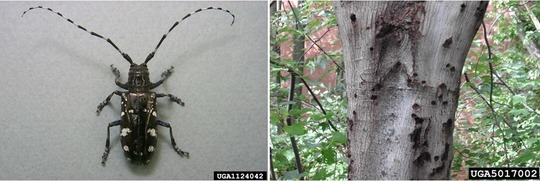 Left to right: Adult Asian longhorned beetle photo by Donald Duerr, USDA Forest Service, Bugwood.org; Tree showing exit holes caused by the Asian longhorned beetle photo by Pennsylvania Department of Conservation and Natural Resources - Forestry , Bugwood.org.
The U.S. Department of Agriculture’s Animal and Plant Health Inspection Service (APHIS) is calling on the public to be on the lookout for the Asian longhorned beetle (ALB). This destructive pest is most active in August,making now the ideal time to inspect your trees. Checking for ALB and other invasive insects or diseases can make a significant difference in protecting our forests.
Read the USDA APHIS Tree Check Month press release for more information.
View the Asian longhorned beetle Tree Check Infographic from USDA APHIS for a quick guide on what to look for.
Early detection is key to successful management. You can help by reporting possible Asian longhorned beetle sightings through the Report a Pest online form.
Spotted Lanternfly: An Invasive Pest on the Move
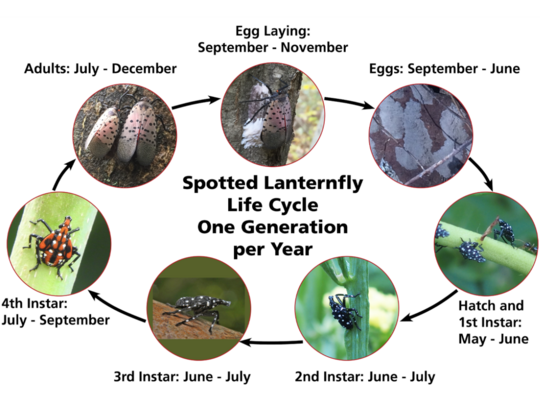 The spotted lanternfly has one generation per year, progressing through four nymph stages, an adult stage, and overwintering as egg masses. Nymphs begin to hatch in May and June. Adults appear by late summer, mate starting in August, and lay eggs from September until the first hard freeze. Image by Cornell CALS.
The spotted lanternfly (Lycorma delicatula) is an invasive insect spreading across the eastern United States, causing both environmental and economic damage. Although it has not yet been detected in Minnesota, it has been found in neighboring states including Iowa, Illinois, and Michigan. If spotted lanternfly becomes established here, it could impact grape, apple and nursery production. Early detection will be critical to preventing and managing its spread.
The invasive tree of heaven, a prohibited–eradicate noxious weed in Minnesota, is the primary host for spotted lanternfly. This plant has also caused significant environmental and economic damage in the United States. Documented occurrences of tree of heaven in Minnesota are limited, but early detection remains essential to stopping its establishment.
If you suspect either spotted lanternfly or tree of heaven in Minnesota, report it immediately through the Report a Pest online form.
August Weed of the Month: Progress on Knotweed Mapping and Management
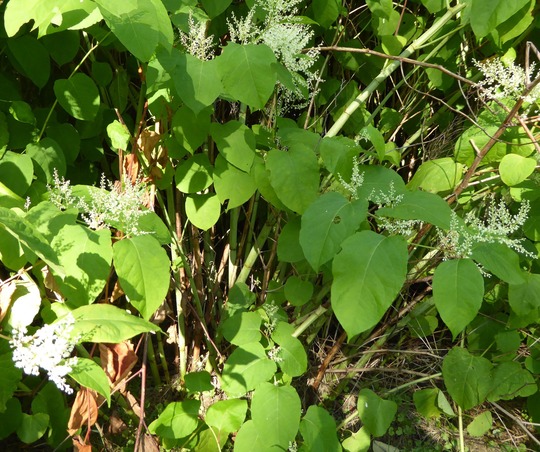 Knotweeds are sometimes called “bamboo” because the stems are hollow and look like bamboo.
In 2018, there were 493 mapped knotweed infestations in Minnesota. Now, there are 3,374 mapped infestations.
By Monika Chandler, Minnesota Department of Agriculture -
Knotweeds (Polygonum x bohemicus, P. sachalinese and P. cuspidatum) are a group of tough to manage plants on Minnesota’s Noxious Weed List. Knotweeds are herbaceous perennial plants that grow approximately 7 – 15 feet tall. They can grow into concrete and asphalt resulting in damage to buildings and roads. They grow quickly by seed, fragments and underground stems that send up new shoots. This allows them to overtake other vegetation.
Across the state, many groups, organizations and individuals have come together to work on knotweed infestations. Together, there’s been a lot of progress with knotweed mapping and management.
Read more
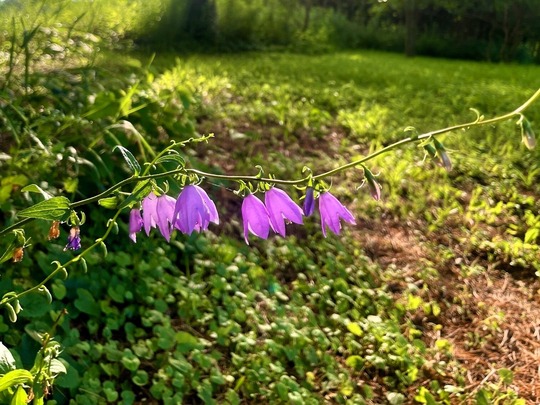 Creeping bellflower is commonly found growing in metro residential yards.
Creeping bellflower, Campanula rapunculoides, is receiving a lot of attention in the metro area this summer. It is a flowering perennial plant native to Europe and western Siberia. The purple flowering plant was brought to North America as an ornamental then escaped cultivation.
Creeping bellflower is now a common plant in metro residential yards growing in turf and gardens. A single plant can produce up to 15,000 seeds annually. It can also spread by underground stems. In addition to underground stems, there are underground storage tubers that can send out new underground stems. The high seed production combined with extensive underground parts makes this plant difficult to control.
For information about identification and management please see University of Minnesota Extension’s creeping bellflower page.
In the Field: What MDA Staff Are Seeing
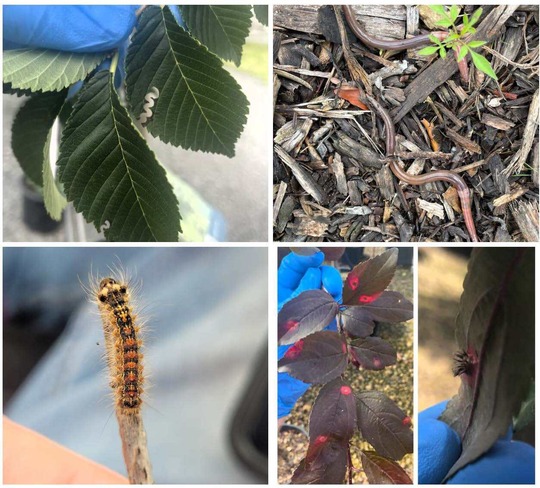 Top row, left to right: signs of elm zigzag sawfly; jumping worm. Bottom, left to right: spongy moth caterpillar; red star rust on crabapple tree.
MDA staff have found several invasive pests and diseases across Minnesota this month. Feeding damage from the elm zigzag sawfly appears on leaves in the form of distinctive zigzag patterns. Jumping worm activity continues to increase in garden and woodland soils, where these invasive worms alter soil structure and impact native plants. Spongy moth caterpillars actively feed on plant foliage from late spring through mid-summer. In addition, a recent inspection found red star rust on a crabapple tree, and laboratory testing has confirmed the diagnosis.
Keep an eye out for these pests in your area and report any sightings using the Report a Pest online form. Early detection and reporting help protect Minnesota’s landscapes.
Bugs, Weeds & Big Wins: Join the MDA at the State Fair!
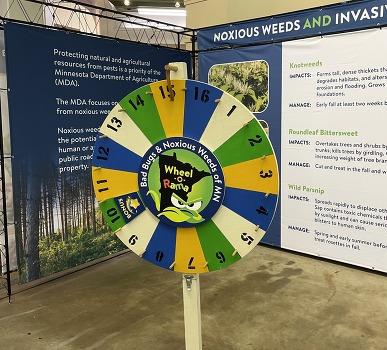
Visit the Minnesota Department of Agriculture in the Agriculture Horticulture Building at the Minnesota State Fair from August 21 through September 1! Get expert insights on identifying invasive insects and managing noxious weeds that threaten landscapes and nursery stock. Spin our trivia wheel for a chance to win prizes, and let your young bug lover try to win a junior entomologist kit. Whether you're a backyard gardener or in the nursery industry, stop by and learn how to protect your plants and our state’s natural resources.
Help Protect Minnesota Forests from Invasive Pests
Look for the MDA certified logo
Moving untreated firewood can spread harmful pests like emerald ash borer, spongy moth, and Asian longhorned beetle; species that have destroyed millions of trees across the United States. Even native pests like carpenter ants and bark beetles can hitch a ride on firewood and cause problems for homeowners.
Help stop the spread:
- Buy firewood where you burn it! Locally sourced wood is less likely to carry invasive pests.
- Use MDA-certified firewood with the official seal. View the list of Certified Firewood Producers in Minnesota.
- Avoid transporting hardwood firewood across county or state lines. It is illegal to move hardwood firewood out of Minnesota quarantined counties unless it is MDA certified. Violations can result in fines of up to $7,500 per day.
Visit the MDA's Buying Firewood webpage for more information.
|