|
July, 2017
Gypsy Moth Discovered in Minneapolis - Quarantine Implemented
A significant gypsy moth infestation was discovered in the Lowry Hill neighborhood of Minneapolis in late June after a resident noticed and reported gypsy moth caterpillar activity. When the Minnesota Department of Agriculture (MDA) followed up on the report, it discovered thousands of gypsy moth caterpillars and a number of defoliated trees. The infestation was likely begun by the movement of wood or another outdoor item that came from a gypsy moth infested area and was contaminated with egg masses. A single gypsy moth egg mass can contain 500-1,000 caterpillars.
Due to this infestation, an area of about 10 blocks has been quarantined (see map). This means that trees and woody material such as firewood and tree trimmings cannot leave the area. In addition, items that are stored outside should be inspected and any gypsy moth egg masses removed before moving the item out of the quarantine. The MDA expects to treat the area for gypsy moth in May/June, 2018 and to lift the quarantine after.
Read more about gypsy moth at the MDA website
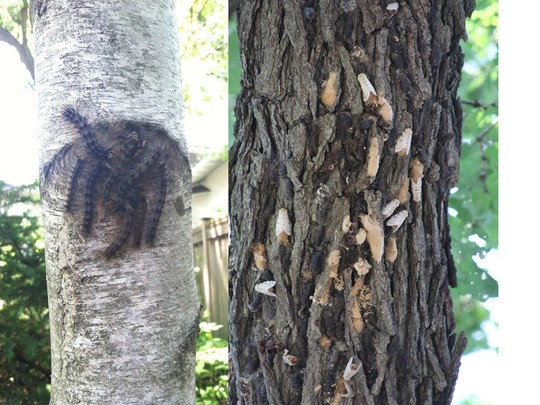 Clulster of gypsy moth caterpilars on tree trunk (left) and tree stem covered with pupae (brown) and moths (white) laying egg masses (tan) at right.
Poison hemlock is an invasive weed which was first reported in Minnesota in 1992 and until recently was only known to be present in isolated pockets of Minnesota. The Minnesota Noxious Weed Advisory Committee is currently evaluating this plant to determine if it should be regulated as a noxious weed. Knowing that poison hemlock was increasing in Minnesota, the MDA issued a press release in June to call attention to this plant and asked citizens to report potential infestations. The media were instrumental in communicating this message and the public response was tremendous with hundreds of reports coming in through MDA's Arrest the Pest. Staff have been working to verify these reports and while many were identified as other species, a significant number have been confirmed as poison hemlock. While it is unfortunate that this weed is distributed more widely than previously known, many of the new finds were still in the early stages of invasion and were controlled. The MDA continues to be interested in poison hemlock reports.
Learn more about poison hemlock on the MDA website
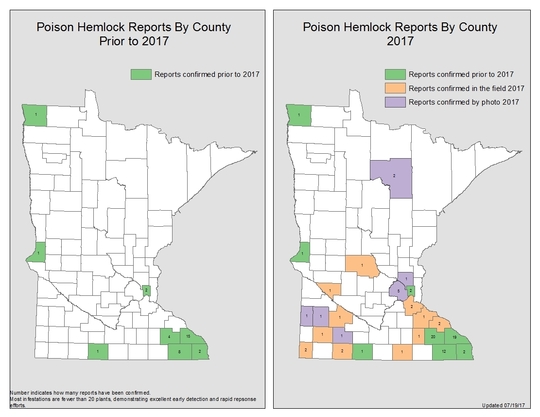 Known Minnesota distribution of poison hemlock before 2017 (left) and at present (right).
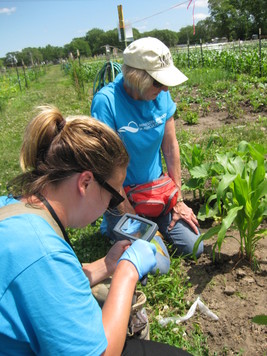 MDA staff are busy again monitoring community gardens and small farms in
and around urban areas of Minnesota for invasive pests and pathogens.
This is the fourth year that MDA has implemented this project, referred
to as the "Pathway Survey", which focuses on agricultural areas at high
risk for introduction of invasive species. Urban areas concentrate many
pathways along which invasive species move and thus gardens and farms in
and near urban areas provide excellent opportunities for early
detection.
Each year of the survey has resulted in the detection of a
new organism or a better understanding of the distribution and impacts
of pests and pathogens that threaten production and / or market access
for Minnesota fruits and vegetables. Most recently, the Swede midge was found for the first time in Minnesota in Ramsey and Hennepin Counties during 2016. The MDA is monitoring for the Swede midge and about twenty other insects and pathogens through this project during 2017. This work is funded by the USDA
through the 2014 Farm Bill and by an MDA Specialty Crop Block Grant.
Read more about this project at the MDA website
|
An MDA Nursey Certification Program Update was published last week and contains new information on Japanese beetle, Lirula needle blight and regional reports from MDA Nursery Inspectors. The Update is available online. |
|
 |
 |
|
The July Pest to Arrest is the lily leaf beetle which has been found very near Minnesota but never documented in the state. Read more about this insect at the MDA website and report potential sightings to the MDA at Arrest the Pest. Photo by Kenneth R. Law, USDA APHIS PPQ, Bugwood.org |
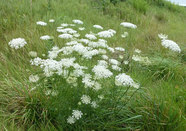
The July Weed of the Month is wild carrot. Read more about it at the MDA Website. |
|
 |
|