D1 - I-535 Blatnik Bridge in Duluth: 2027 construction
 
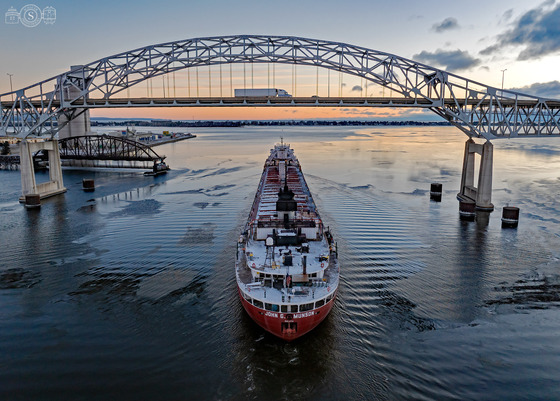 Photo courtesy of Schauer Photo Images
After more than five years of project development and environmental work, the Blatnik Bridge replacement project has a major milestone this month. Project letting, as engineers call it, is typically the day bids are opened.
The Blatnik project is using the design-build method, which was described in the December 2026 issue of The Connector. MnDOT uses a best-value system for design-build projects that combines a bidder’s technical score and price into a single adjusted score. The lowest adjusted score at project letting determines the winner.
The formula is: Adjusted score = bidder’s price ÷ technical proposal score
How it works
Proposals are evaluated and assigned a technical proposal score (e.g., out of 100 points). The bidder’s price (in dollars) is then divided by that technical score. The team with the lowest adjusted score is considered the best value and is selected.
The technical proposal score reflects qualitative factors such as design innovation, project approach, schedule, team experience and other evaluation criteria outlined in the request for proposals. The approach ensures both technical quality and price competitiveness influence the final outcome.
The contractor’s technical proposals were due on June 2 and are being evaluated and scored before the project letting on June 23. When the bids are opened, the costs and technical scores will be entered into the formula and the apparent low bidder will be posted on the website: Post-Letting (Bid Results) - Bid Letting - MnDOT.
The process doesn’t end there. The contract must be awarded and then executed.
While information on the best-value team, their technical score and their bid cost is open to the public June 23, content of their technical proposal is not. Information on the type of bridge and other details remain confidential until the contract is officially awarded later in the summer. It is anticipated that the contract will be fully executed in early September.
The contractor will then begin final design for the project and begin the required construction to mitigate traffic impacts caused by the eventual closure of I-535 and the Blatnik Bridge for this project.
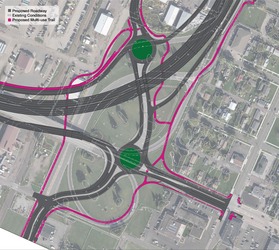
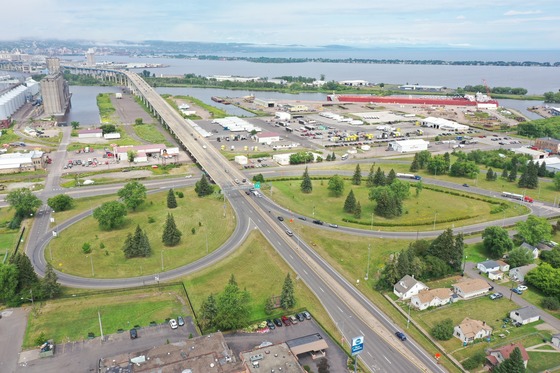 A bird's eye view of the Superior interchange. Below: A rendering of the new interchange. Gray is roadway, green is roundabouts and pink is multi-purpose trails.
Questions about the proposed alignment of the new Blatnik Bridge are nothing new. The Minnesota and Wisconsin Departments of Transportation evaluated more than 25 alternatives and narrowed the list to five for deeper review.
Ultimately, replacing the bridge on its existing alignment was selected as this option will cost less, take less time to construct, minimize environmental impacts and help reduce construction delays/hazards for the traveling public.
Prior to the start of construction of the original bridge in 1959, there was debate about the location of the Wisconsin terminus of the Blatnik Bridge. In 1951, Hammond Avenue was proposed by consulting engineers hired by the Duluth-Superior High Bridge Commission to study construction of the bridge, according to news clippings from Duluth and Superior newspapers.
Back then, other approaches considered included Garfield Avenue in Duluth to Main Street in Superior; Garfield to Tower Avenue in Superior; and Garfield over Connors Point to Tower in Superior.
In October 1951, the Superior planning commission adopted a report concurring with the Superior landing to be located on Hammond Avenue. The report, commenting on the engineers’ recommendation, said the firm of Howard, Needles, Tammen & Burgendoff (HNTB) of Kansas City, Mo., studied possible locations from two main standpoints: “The effect of the location and design on the ability of the people to build a bridge at all, that is, the cost and ability to pay, and the effect of the location on serving people using the bridge,” according to an Oct. 23, 1951, article in the Duluth News-Tribune.
In November of that year – 1951, the Superior City Council voted 6-0 approving a resolution fixing the bridge terminus at Hammond Avenue.
The proposed terminus was met by opposition from people in Superior, including merchants feared business loss, and several petitions were circulated over the years asking for the terminus to be on Tower Avenue.
The new construction of the Wisconsin interchange includes a direct connection to Hwy 53 and includes two single-lane roundabouts. Located near the bridge's Wisconsin approach, these roundabouts will direct local traffic that’s either entering or exiting the interstate from or into the local roadway network.
|
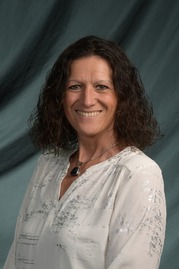
Being from northwest Wisconsin, crossing the High Bridge was a part of my childhood, looking out the car window at the ships, grain bins, trains and lift bridge, being in awe of the “bigness” of it all. I know that millions of people have crossed this bridge over the years and have a similar fondness for not just the sites but for the Twin Ports as a community and a working port.
To many, this bridge is more than just “a bridge.” But everything in life has a “time,” and the High Bridge’s time has come. The bridge needs to be replaced, and for many people, this replacement is not just about the inconvenience of construction, it’s the end of an era.
I am so proud to be part of this team that sees this structure the same way as I do - as a part of the community. The team is working tirelessly to ensure the new bridge and roadways fit perfectly together in the existing landscape, and the new structure becomes just as iconic as the High Bridge. That it offers not just commuters a way to cross the river to go to work or for ships to traverse below for commerce and recreation, but for generations to come to look out their car windows while crossing the bridge to see all that the Twin Ports has to offer.
Maybe one day another random kid from northwest Wisconsin will find themselves on the team that replaces this new bridge. ~ Beth Cunningham, WisDOT project manager
|
Why do we need two bridges?
Two bridges between Duluth and Superior are important for reducing traffic backups, accommodating freight movements and aiding in emergency response. Having two bridges also minimizes disruptions to traffic in the event one bridge is closed due to an emergency or needed maintenance. More information on why two bridges. (PDF)
Will the new bridge still be called the Blatnik Bridge?
When the bridge first opened to traffic in December 1961, it was known as the High Bridge. The bridge was named in honor on U.S. Rep. John A. Blatnik, who championed the project, on Sept. 24, 1971. Blatnik died a little more than 30 years after the structure was opened.
John A. Blatnik was born in Chisholm and worked as a chemistry teacher there after college. From 1940-44, he served in the Minnesota State Senate, and in 1946, he was elected to Congress representing Minnesota’s 8th District in the northeastern part of the state. Re-elected 13 times, he was active in transportation, serving as chairman of the Public Works Committee (now known as the Transportation and Infrastructure Committee) and shepherded the Federal Water Pollution Control Act, or the Clean Water Act, to passage.
Because a new bridge is being constructed, the name could be changed. If a bridge crosses state lines or connects federal highways - the Blatnik Bridge does both - it requires cooperation between multiple states and the federal government. Renaming this structure requires a formal Act of Congress or a joint resolution passed by both Wisconsin and Minnesota legislatures. For example, when high-profile federal bridges are renamed, the bill is typically drafted and voted on by the U.S. House of Representatives and Senate.
For more FAQs, visit the project website.
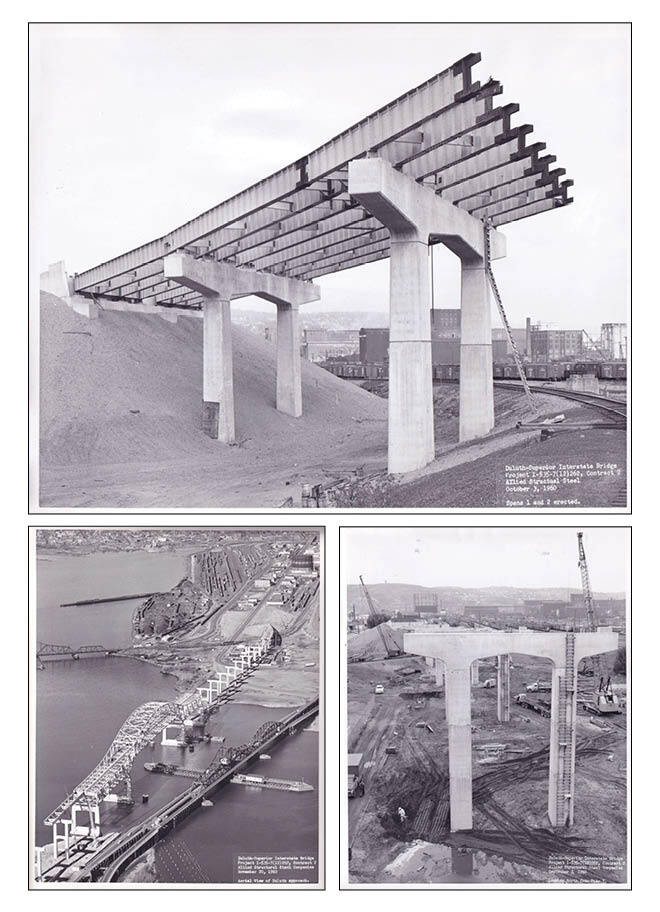 Top: Spans 1 and 2. Taken Oct. 3, 1960.
Bottom left: Aerial view of Duluth approach. Taken Nov. 20, 1960.
Bottom right: Looking north from pier 7. Taken Sept. 2, 1960.
More information
For more project information, please visit the project website.
Have a story idea or a question you'd like more information about? Email us.
Sign up for project email updates.
|