An uptick in forest tent caterpillars in north, central Minnesota
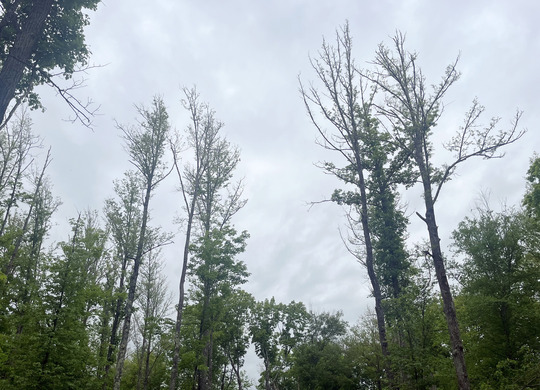 Basswood trees with heavy defoliation from forest tent caterpillars.
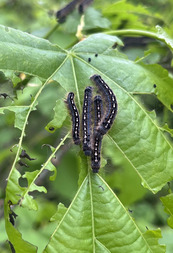
Forest tent caterpillars have become increasingly common in parts of northern Minnesota the last few years. These caterpillars are colloquially known as “armyworms,” but that name can be misleading—true armyworms are a different species that primarily feeds on crops and grasses. Forest tent caterpillars, in contrast, feed on various hardwood trees. They prefer basswood, but will consume leaves of oak, birch, aspen, and other hardwoods.
So far, over 60,000 acres of defoliation have been mapped in Aitkin and surrounding counties, though aerial surveys are still underway. This is up from last year’s approximately 41,200 acres.
Tree mortality doesn’t usually result from defoliation, but continuous heavy feeding over multiple years can cause dieback and in some cases death, especially for trees already stressed by drought or other factors. Healthy trees with defoliation will typically produce a second set of leaves by mid-July.
Although the defoliated area grew in 2026 , it still pales in comparison to the 7.7 million acres mapped in 2001. Historically, the forest tent caterpillar has had these massive outbreaks every 10-15 years. The last large outbreak was in 2013, with 1 million acres of defoliation (although it was generally very light).
We are currently in that 10–15-year window for another large outbreak. Only time will tell if another intense, massive outbreak develops like it did from 2000-2003, but we do expect even more defoliation in 2027.
The bright side? They provide food for wildlife, and heavy defoliation provides more sunlight to understory conifers.
Image: Mature forest tent caterpillars.
|
EAB now heavily impacting some central Minnesota wet forests
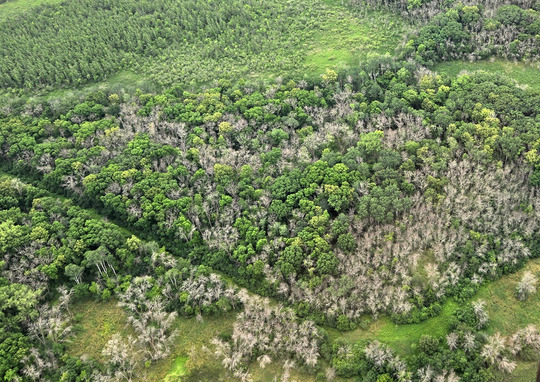 Ash killed by EAB between Chisago City and Forest Lake, shown in July 2026.
Tracking the spread of emerald ash borer (EAB) is important for a variety of reasons: it saves people and communities money by informing them when protective insecticide treatments are needed, shows forest managers where the most at-risk ash forests are to help prioritize diversification projects, informs agency personnel where releasing biocontrols makes sense, and helps researchers find appropriate study sites.
The best reporting tool is the Minnesota Department of Agriculture’s Report a Pest website. However, as EAB encroaches into less populated, more heavily forested areas, there are fewer people watching for early signs. That’s where the forest health team’s aerial surveys come into play.
Just this summer, between Chisago City and Mille Lacs Wildlife Management Area, we mapped about 12,500 acres of ash-dominated forest heavily damaged by EAB. This is an underestimate for this area, since our surveys cover roughly half of the landscape. Some of these infested forests are wet forests dominated by black ash with dead tops from prior flooding.
Since 2016, we’ve mapped over 40,000 acres of ash-dominated forest heavily damaged by EAB in southeastern Minnesota and from northern Anoka County to Mille Lacs Wildlife Management Area. As federal funding continues for landscape-scale forest health surveys, we will periodically survey to update the total forested landscape that’s heavily impacted by EAB.
Positive initial results from mature oak health survey
Over the past few years, oak decline has become a very common forest health concern reported by Minnesota landowners. It’s a complicated issue involving a native insect and disease as well as tree age, drought and site conditions. Many of these reports have involved bur oaks (particularly in northwestern Minnesota), but red oaks are also impacted across the state.
These ongoing questions and our own observations prompted us to begin a widespread oak decline survey this summer. Our team is visiting older oak stands on state forest lands to assess tree health and measure the extent of decline.
So far, the news has been encouraging. Based on initial surveys, we have not found severe oak decline in the forest stands we have visited. Though the study is still in its early stages, these observations suggest that oak decline is not currently having a major impact on Minnesota's oak forests.
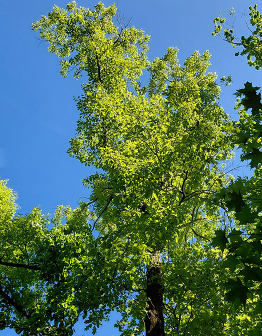
That doesn't mean the issue has disappeared. Oak decline continues to be a concern for trees growing in yards, along roadsides, on golf courses, and in other open, non-forested settings, where environmental stress can be much higher than that found in a forest. Find some general prevention tips on our oak decline management page.
Look for a summary of our survey results in our 2026 annual report, which will publish in early 2027.
Right: A fairly healthy northern red oak in Birch Lakes State Forest. It only has minor canopy dieback.
|
Training foresters on wind damage, bark beetle risk, and more
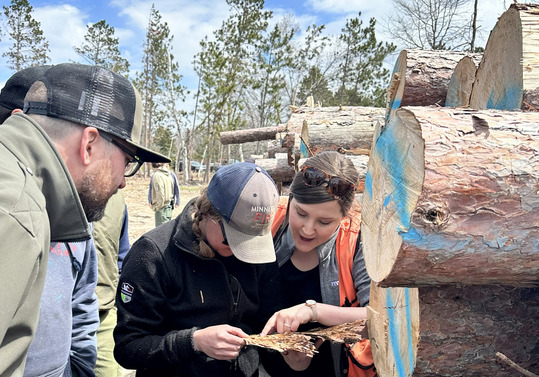 Forest health specialist Rachael Dube, right, shows foresters signs of pine bark beetle damage.
After a major event such as a storm or fire that leaves large numbers of trees damaged, forests often experience increased activity from native insects that take advantage of damaged or stressed trees. To help DNR foresters recognize and respond to forest health issues like these, the forest health team conducts trainings.
In recent field training sessions, foresters learned what to expect following a blowdown event like the June 2025 derecho in Bemidji, observed insect activity at the site of a recent fire, learned about how to prepare for oak wilt, and reviewed common forest health concerns.
By equipping foresters with the knowledge to recognize forest health issues in a variety of situations, we support informed management decisions, provide accurate information to landowners, and promote resilient forests.
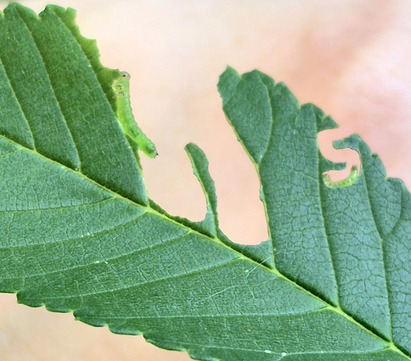
Elm zigzag sawfly defoliating elms
Characteristic feeding of elm zigzag sawfly. Can you see the green sawfly larva?
The Minnesota DNR and Minnesota Department of Agriculture (MDA) received reports of heavy defoliation on elms in Brainerd, Little Falls, and St. Cloud this July. The culprit? A relatively new invasive sawfly, the elm zigzag sawfly.
Fortunately, heavy leaf feeding for only one year won’t kill elms. They should re-leaf within a few weeks, and if not, will do so by the following spring. Deciduous trees can tolerate a couple of consecutive years of heavy leaf feeding. The best thing you can do for defoliated trees is to water them during droughts and avoid fertilizing them.
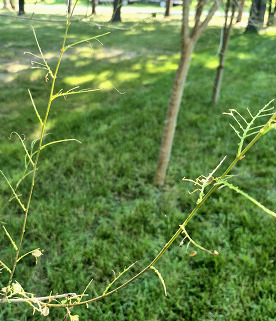
More information can be found in our good agency friend’s recent newsletter, the July Plant Pest Insider edition. As they wrote, if you suspect elm zigzag sawfly, please report it through Report a Pest.
Left: All but the leaf veins have been eaten by the elm zigzaw sawfly.
|
|