|
Sept. 19, 2025
A quick look at forest health conditions from 2025
A lot has happened in Minnesota’s forests since our last newsletter. On the positive side, our dry May meant very little leaf disease relative to 2024, and nearly all areas of the state received enough precipitation in the summer to keep healthy trees healthy.
Even though there was a silver lining to the dry May, those dry conditions facilitated significant wildfires in northeast Minnesota, some of which were amplified by prior spruce budworm damage. The second major negative forest health event so far this year was the June derecho that devastated the Bemidji area.
The most curious tree health problem was die-off of mostly boulevard ornamental trees, planted roughly 5 to 10 years ago, in some communities in spring 2025. A second somewhat unusual event was a sizeable population of greenstriped mapleworms northwest of Ely.
The long-running eastern larch beetle and spruce budworm outbreaks continue, both damaging trees on well over 150,000 acres this year.
Look for a final and thorough summary of 2025 forest health conditions in our 2025 annual report, coming in early 2026.
Let’s get into it.
Curious spring die-off on some ornamental trees
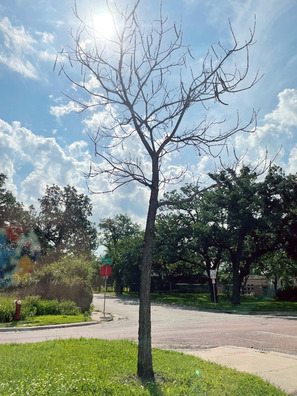
Urban foresters in several Twin Cities area communities, Rochester, and Moorehead noted a concerning die-off this spring of many catalpas, Kentucky coffeetrees, and redbuds, primarily planted in boulevards 5-10 years ago. These trees either didn’t leaf out this spring, leafed out and then died, or developed severe dieback. They were all healthy-looking last year. Older representatives of these species were unscathed. The Forest Health team also received a few reports of similarly aged crabapples and maples leafing out and dying.
There were a couple reports of 2024-planted trees dying, but those situations were less common.
This catalpa in Hennepin County didn't leaf out in spring 2025. (MN DNR)
Given the fact that different tree species showed the same symptoms across a large area, we know the cause was environmental. Several weather events challenged trees in impacted areas between summer 2024 and summer 2025: fall 2024 was amongst the driest and warmest, mid-March 2025 had a heat wave, and winter 2024-2025 was essentially snowless.
The very dry and warm fall followed by a snowless winter are the probable causes of this spring die-off. Snow acts as an insulator, protecting roots from freezing and dying. Snowless winters (with below normal or near-normal temperatures) are well-known for killing tree roots and causing landscape level declines of certain, susceptible species.
Experts hypothesize that the older trees weren’t affected because they had large enough root systems to partially escape some of the freezing damage and to supply the needed energy for leaf-out in the spring.
If you have one of these younger trees, and if over 50 percent of the crown is still dead, it's unlikely to fully recover.
|
Derecho in the Bemidji Area
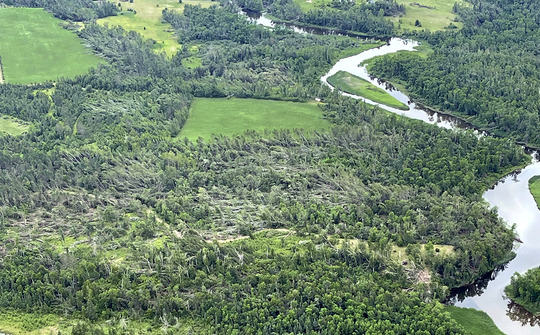 An aerial image shows an area of forest damaged by the derecho. (MN DNR)
The June 2025 derecho in the Bemidji area was devastating. Minnesota DNR issued a news release afterward providing tips on dealing with damaged trees.
Trees that are severely damaged by wind in June often are attacked by opportunistic diseases and insects. In most cases, these problems don’t spread to nearby undamaged trees. There are some pests that, once they infest all of the damaged trees, spill over to adjacent undamaged or slightly damaged trees. Pine bark beetles and twolined chestnut borers are infamous for doing this. As long as severe drought doesn’t occur, the spillover will be minimal.
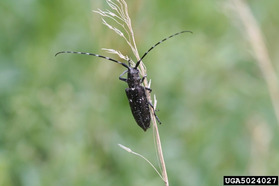
Another pest that takes advantage of damaged conifers is the whitespotted sawyer. This insect is not a threat to healthy trees. People will hear the larvae chewing through wood in spring and summer 2026, and they might notice a lot of adults flying around in June and July 2027, looking for more damaged conifers to infest.
Expect to see a lot of whitespotted sawyer adults in 2027. (W. Cranshaw, Bugwood.org)
The last concern with wind damage in June is oak wilt. Though we know of no oak wilt near the derecho’s path, we'll keep our eyes and ears out for signs of it next June and July in the 2025 derecho’s footprint. Hopefully no oak wilt was present.
|
Spruce budworm, fire, and the ongoing outbreak
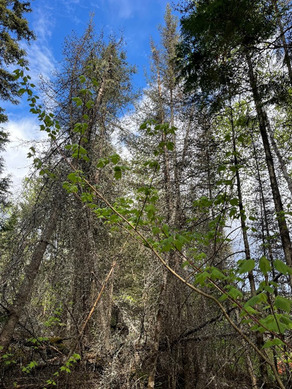
Right: Wildfire fuel buildup due to spruce budworm in an area northeast of Ely. (MN DNR)
Spruce budworm is a native moth whose caterpillar has a big appetite for older balsam fir and white spruce, and northern Minnesota has a lot of balsam fir to feed this caterpillar. We have mapped defoliation from spruce budworm each year going back to the beginning of the record (i.e. 1954). The lowest amount of impacted acreage ever mapped was in 1966 where 15,000 acres with defoliation were mapped. On average, 235,000 acres of Minnesota forest sustain some level of spruce budworm defoliation each year. Watch this webinar to learn more about spruce budworm and their role in Minnesota’s spruce-fir forests.
We just finished our aerial survey for this year. Skies were smokey, which frequently delayed flights. Due to those delays, and due to smoke when we were surveying, it was more difficult to see and map budworm. Despite that, we still mapped over 180,000 acres of forest with defoliation and mortality from spruce budworm. Over 80 percent of this damage was in Lake and Cook counties in Minnesota’s Arrowhead Region.
After heavy defoliation for three consecutive years, balsam fir will start to die. Research has shown that wildfire risk due to all of these accumulating dead trees peaks about 5-8 years after trees start dying. The May 2025 Camp House Fire and the 2021 Greeewood Fire both started in areas impacted by spruce budworm in this timeframe of higher wildfire risk. Even though spruce budworm didn’t start these fires or create the weather conditions that were conducive for wildfire, it definitely played a part in making the fires easier to start, quicker to burn, and harder to contain. You can hear forest health specialist Brian Schwingle discuss this topic on the KAXE Tuesday Morning Show.
If you own a lot of balsam fir in northern Minnesota, lower your risk of budworm defoliation by reducing the proportion of older balsam fir in your forest, and work at diversifying the forest. For more details, see Eastern spruce budworm management.
If you own balsam fir or white spruce forests, consider attending University of Minnesota’s Spruce Budworm Symposium on November 1 in Grand Marais.
|
Larch beetle outbreak continues
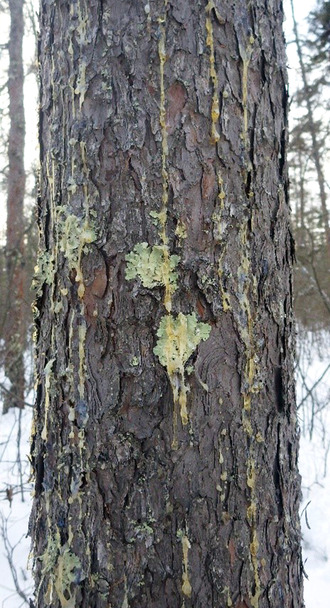
Since 2001, eastern larch beetle has killed a lot, and we do mean a lot, of Minnesota’s older tamarack. This year we mapped roughly 300,000 acres of impacted forest, and of this, 100,000 acres were impacted for the first time. The center of this outbreak now includes Koochiching County and northern Itasca County.
Dealing with this outbreak is extremely challenging, and often there is nothing realistic that landowners or managers can do. Fortunately, researchers are gaining knowledge on some aspects of this insect’s biology, possibly opening the door for individual tree protection in the future, and ecological research has revealed that some heavily hit forests are naturally recovering. To learn more, check out our eastern larch beetle webpages.
Dripping pitch on a tamarack trunk, a good indication that its being attacked by eastern larch beetles. (MN DNR)
Red maple defoliator up north
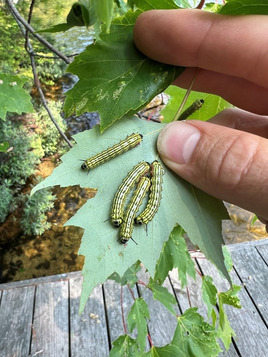
In later July, we realized that a native caterpillar, known as the greenstriped mapleworm, was feeding on a lot of red maple in the Burntside Lake area northwest of Ely. From the air, we mapped 1,500 acres of red maple defoliation, but that is certainly an underestimate of the extent of this picture-worthy caterpillar. It will feed on sugar maple too, and even oak, but we only noted it on red maple.
Later summer defoliation, whether due to leaf disease or a leaf-feeding insect, is almost never a concern for forest trees or healthy ornamental trees. We recommend enjoying the adult form of the greenstriped mapleworm, the rosy maple moth, when it emerges next spring.
Right: Greenstriped mapleworms. (MN DNR)
|
|