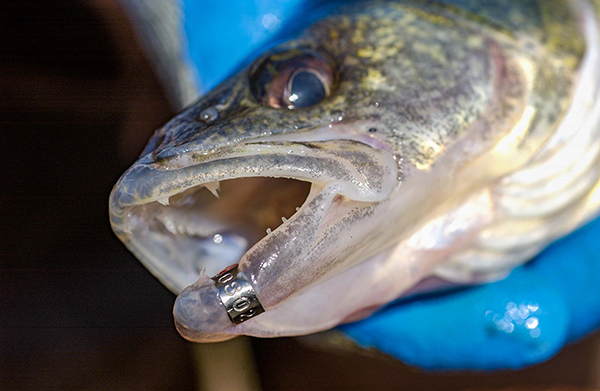
Using genetics to monitor walleye populations
By JENNIFER JOHNSON, fisheries biologist and MARCEE WARDELL, communications specialist
Fisheries Division
Michigan Department of Natural Resources
Walleye fishing is a big deal in Michigan’s Upper Peninsula, particularly in the southwestern end of the peninsula.
Walleye make up nearly 80% of fish stocked in the region, which has a mix of lakes with natural reproduction, where walleye populations are stable or growing without stocking, and lakes where they’re stocked to help meet angler demand.
That’s why the region was selected for a new pilot technique, a parentage-based tagging for walleye stocking evaluation.
In 2025 and 2026, the technique was implemented in the area, funded through the Wilderness Shores Mitigation and Enhancement Fund. This new method for tagging stocked fish is more effective and cost-efficient than traditional approaches and will help fisheries managers better understand how stocking is or isn’t affecting the walleye populations in key lakes.
What is parentage-based tagging?
It’s kind of like Ancestry.com or 23andMe for fish.
Historically, the Michigan Department of Natural Resources used a different system that created a skeletal marking on the treated fish to evaluate stocking. This method involves treating fish with oxytetracycline (referred to as OTC), a chemical that leaves a visible mark on the otolith, the bone inside the ear of a fish.
After a fish is stocked, it may be captured later that fall or the following year by DNR staff, who then examine all fish collected for evidence of an OTC mark to help determine how many stocked fish survived.
Checking for this chemical marker requires sacrificing the fish in order to view the otolith, and marks were not always easy to detect. The quality of the visible marks varied, and environmental factors could lead to degradation of the marks over time, making it more difficult to confirm whether a fish was from a hatchery or produced naturally.
Additionally, OTC marking is labor-intensive.
|
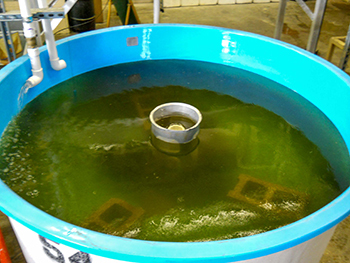
Because OTC is an antibiotic, a prescription from a veterinarian is needed to use it to treat fish. Walleye fry needed to be marked three days after they hatch, so hatchery staff would have to keep the fry being marked separate from other fish, which could be hard to do with limited holding tank space.
During the chemical treatments, the walleye required monitoring from staff throughout the six-hour process, ensuring that the water temperature, oxygen and pH remained at appropriate levels for the young fish.
“Moving away from OTC reduces the workload for hatchery staff and removes some of the complications with tank space at the hatchery,” said Randy Espinoza, fish culture manager at Thompson State Fish Hatchery. “Since the fry are usually stocked only days after they’re hatched, spending additional time marking a portion of the young walleye introduced delays as staff sorted out which tanks of fish needed to be marked and which could immediately move out of the hatchery for stocking into ponds or area lakes.”
Parentage-based tagging, on the other hand, requires less work and is less invasive.
The fish does not need to be sacrificed to check its genetics, and no physical tags (which can be easily lost) are placed on the fish. Instead, it is all done with a small clip that is taken from a fin.
It starts with the adult walleye that are spawned to create offspring for stocking.
|
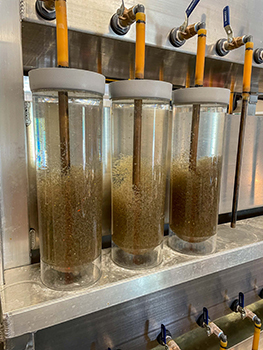
DNR staffers take a small fin clip from each of these broodstock (parent) fish and send them to Dr. Jared Homola’s lab at Michigan State University for analysis.
Once the offspring of broodstock are hatched, they can be stocked with no need for OTC treatment.
Later, when DNR surveys collect walleye from area lakes, the lab uses a small fin clip collected from each captured walleye to determine whether those fish came from broodstock parents.
If the genetics match, biologists can be certain it’s a stocked fish. If not, the fish was produced naturally in the system.
"Using genetics to evaluate stocking is a modern solution to a long-standing fisheries question: Which fish are succeeding, and how much are they contributing to future generations?" Homola said. “Genetics gives us a way to follow the story of stocked fish long after they leave the hatchery. The information we gain will help managers understand when stocking is working, when natural reproduction is carrying the fishery and how to best maintain excellent walleye fishing opportunities into the future.”
How was parentage-based tagging piloted?
To begin the process for the walleye stocking parentage-based tagging pilot, genetic samples were collected from Lake Michigan broodstock at Little Bay de Noc. Then, walleye were raised in the hatchery system, as usual.
|
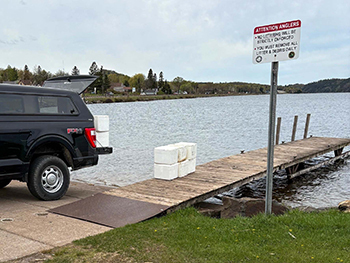
Walleye leave the hatchery as fry (approximately 0.9 centimeters long) in the spring.
Some of them are stocked at this size, and some are placed in rearing ponds, where they grow into spring fingerlings (around 1.5 inches in length) before they’re stocked in local lakes.
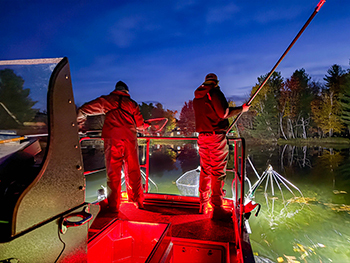
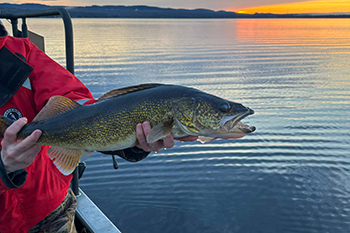
In the fall, fisheries crews conduct surveys on stocked walleye lakes, electrofishing at nighttime. Walleye captured during the surveys had fin clips collected, ages were verified, and the clips were sent off to the lab for genetic analysis.
While in some waters, lots of walleye were sampled, in some lakes, the teams only captured a few fish during their efforts. This could indicate poor natural reproduction or low stocking success, but that is not necessarily the case.
Some lakes are harder to survey than others. Some have lots of woody debris or aquatic vegetation for fish to hide in along the shoreline, or steep dropoffs that allow fish to evade capture.
Further investigation of these lakes where few walleye were captured is needed to determine population levels and stocking results.
While the focus is presently on measuring stocking success at the juvenile stage, because genetics don’t change, over time, biologists will be able to test adult walleye in these waters and compare their genetic data to data collected in their year of hatching to see if stocked fish survived to adults.
What were the results?
Results of this pilot study confirmed some of what biologists expected, though there were also some surprises.
|
Lake Emily in Iron County, for example, is a lake currently stocked with walleye. Genetic results show that 96% of the Age 0 and Age 1 walleye were stocked fish, indicating that the stocking is having its intended effect there.
Hagerman Lake, also in Iron County, was a different story.
The lake was originally stocked with a strain of walleye from Lake Gogebic in the 1980s. After 1987, Hagerman Lake was regularly stocked with Bay de Noc-strain walleye until the early 2000s.
Based on traditional fisheries surveys, that stocking seemed to be working, as plenty of walleye were captured. The lake was stocked briefly from 2011 to 2013 and again from 2017 to 2019, primarily due to angler demand.
As fisheries management best practices evolved, biologists suspected that stocking wasn’t having as much of an effect on the walleye population in Hagerman Lake as previously believed.
The genetic results, however, were striking.
Only 1.7% of the walleye population was related to the Bay de Noc-strain hatchery broodstock. The remaining 98.3% were related to the Lake Gogebic walleye, which had established strong natural reproduction in Hagerman Lake, now confirmed beginning in the 1980s.
Ottawa Lake in Iron County also had a low proportion of stocked walleye, with natural reproduction accounting for 94% of the walleye sampled.
|
Something interesting showed up in the Ottawa Lake genetics that differed from the other lakes studied.
While the fish had some genetic similarities to the Lake Gogebic strain that had been stocked there in the 80s, their genes had started to drift. If the trend continues, Ottawa Lake could come to contain a unique strain of walleye, genetically distinct from populations in Lake Gogebic or Little Bay de Noc.
What does this mean for future stocking and parentage-based tagging?
Fisheries management biologists will use information from parentage-based tagging to decide whether to continue stocking these lakes.
In waters where stocking is not contributing much to the walleye population, biologists may decide to stop stocking and focus resources elsewhere, where stocking is having a greater impact.
With a lean budget, this kind of calculation is more important than ever for the DNR to ensure that limited financial resources are being used as efficiently and effectively as possible.
Given the success of the pilot effort, the DNR will be using the new tagging method statewide for evaluating walleye stocking. In the future, this may expand to stocking evaluations for other species as well.
Right now, the DNR’s use of parentage-based tagging is focused on stocking decisions, but it could be used to answer many other questions that fisheries managers have about fish populations.
|
For example, the technique seems to demonstrate that, in settings with hatchery-reared fish or a lot of natural reproduction, there are often just a handful of successful parents who pass on their genes to the next generation.
Researchers could look at characteristics of parents with many surviving offspring to see what might be contributing to their reproductive success, whether that’s characteristics of the parents, like age or size, or something else entirely.
On Hagerman Lake, Lake Emily, Ottawa Lake and others in the U.P. and across the state, anglers are keen on catching their limit of walleye.
New techniques like parentage-based tagging can help the DNR manage walleye, ensuring that stocking, funded by anglers’ license fees, has the desired impact – more bites and more fishing opportunities.
Check out a presentation by Jennifer Johnson at the Michigan Natural Resources Commission meeting (3 hours, 30 minutes into the recording).
Learn more about how Michigan manages walleye at Michigan.gov/Walleye or learn more about marked and tagged fish at Michigan.gov/TaggedFish.
|
Check out previous Showcasing the DNR stories in our archive at Michigan.gov/DNRStories. To subscribe to upcoming Showcasing articles, sign up for free email delivery at Michigan.gov/DNREmail.
Note to editors: Contact: John Pepin, Showcasing the DNR series editor, 906-226-1352. Accompanying photos and a text-only version of this story are available below for download. Caption information follows. Credit Michigan Department of Natural Resources, unless otherwise noted.
Text-only version of this story.
Walleye-1: A Michigan Department of Natural Resources staffer is shown holding a captured walleye.
Walleye-2: Captured walleye with a jaw tag.
Walleye-3: A Michigan Department of Natural Resources evening walleye electroshocking outing.
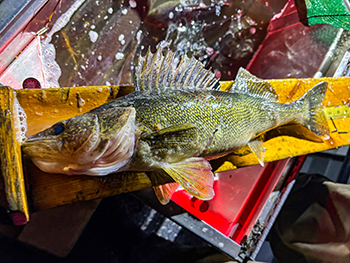
Walleye-4: Walleye on a measuring board.
Walleye-5: A Michigan Department of Natural Resources staffers conducting a nighttime survey for walleye.
Walleye-6: Hatchery staffers are shown preparing an oxytetracycline treatment for walleye tagging.
Walleye-7: (No high-res version photo available) The mark created by oxytetracycline treatment on the otolith of a walleye.
Walleye-8: A tank filled with oxytetracycline treatment for walleye tagging.
Walleye-9: Fry in boxes used to transport walleye fry from the hatchery to rearing pond stocking locations.
Walleye-10: Walleye fry stocking at Teal Lake in Negaunee in Marquette County in 2025.
Walleye-11: Hatching walleye fry at Thompson State Fish Hatchery in Schoolcraft County.
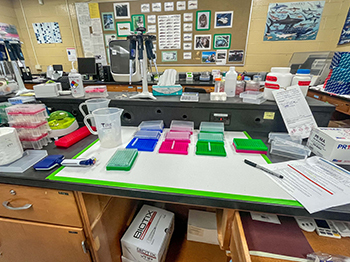
Walleye-12: Setup in Dr. Jared Homola’s laboratory, conducting parentage-based tagging analysis on walleye samples.
Walleye-13: Equipment used in the laboratory to test the genetics of fin clip samples.
Walleye-14: Supplies used for parentage-based tagging genetic analysis of samples.
|