A bridge to adventure
Gordie Howe International Bridge creates international recreation opportunities
By AILEEN KEMME
Communications coordinator, Parks and Recreation Division
Michigan Department of Natural Resources
For centuries, people have found ways to cross the Detroit River.
The first were Anishinaabe travelers, paddling birch bark canoes across its waters.
Next came the steamboat ferries carrying recreation and adventure seekers between the United States (Michigan) and Canada (Ontario) at the turn of the 20th century.
Then, in 1929, cars were able to cross on the Ambassador Bridge for the first time.
Now, there is another way to make the journey: on foot or by bicycle.
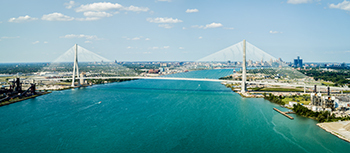
When the Gordie Howe International Bridge opened its pedestrian and bicycle path on Aug. 5, it created something new for travelers — a simple, toll-free way for people to cross between Detroit and Windsor without ever getting behind the wheel.
The bridge’s name honors Gordie Howe, the Canadian-born Detroit Red Wings legend known as “Mr. Hockey.”
Check out a cool video about the bridge.
Its two 720-foot towers are among the tallest structures in the region, and its main span is the longest for any cable-stayed bridge in North America.
The bridge is the newest of four crossing points between Michigan and Canada, and it is the only one that allows people to cross over on foot or by bicycle. The others are the International Bridge in Sault Ste. Marie, the Blue Water Bridge in Port Huron and the previously mentioned Ambassador Bridge in Detroit.
The trip from one country to the other takes about 45 minutes on foot and roughly 20 minutes by bicycle, and unlike for motorists, there isn’t a fee to use the pedestrian bridge.
For adventure-loving, long-distance cyclists and hikers, the bridge represents a missing link between two extensive trail systems that span North America. For those looking for a more casual day trip, the bridge serves as a destination as well as a new way to experience the sister cities of Detroit and Windsor.
|
“The Gordie Howe International Bridge creates a remarkable new connection, linking Michigan’s world-class trail network with our neighbors in Ontario and opening an international gateway for people traveling by foot and bike,” said Andrea LaFontaine, Michigan Trails & Greenways Alliance executive director. “It’s a proud moment for Michigan trails, and a testament to the power of sustained advocacy.”
From Windsor to Detroit: Trails on the Michigan side
For Canadians, the bridge opens the door to a wide range of urban hiking and biking adventures on the Michigan side of the river. Over the past decade, Detroit's riverfront has undergone extensive improvements, with over $1 billion invested to transform former industrial spaces into vibrant parks and extensive greenways.
One of the most accessible destinations for visitors is the Detroit Riverfront, which is home to the Dequindre Cut Greenway, a 2-mile rail-trail dotted with dozens of murals by local and international artists.
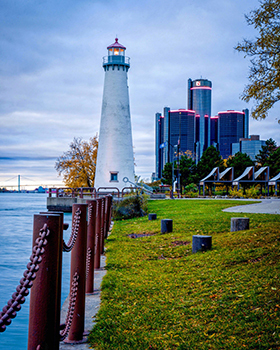
A little farther along the river, Milliken State Park and Harbor provides a place to fish, picnic and simply enjoy the waterfront. Farther down the river still is Belle Isle, an urban gem offering beaches, wildlife viewing and historic attractions like the Anna Scripps Whitcomb Conservatory and Belle Isle Aquarium.
From Detroit to Windsor: Trails on the Canadian side
Michiganders who cross the Gordie Howe International Bridge can find a unique trail network on the Canadian side, with several options for day, weekend or multiday trips.
|
The Waterfront Regeneration Trust assembled a collection of routes connected to the Gordie Howe International Bridge, which include:
-
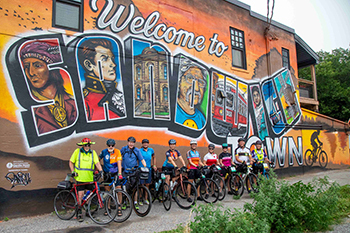
Sandwich Town Loop: A 6.2-mile loop with craft brewery and historic sites, including Sandwich Town First Baptist Church, a prominent stop on the Underground Railroad.
-
Great Lakes Waterfront Trail Lake Erie: Ontario’s signature cycling long-distance route, visiting over 170 communities along the Canadian shores of the Great Lakes, from the Quebec border on the St. Lawrence River to Sault Ste. Marie, with pockets on Lake Superior.
-
Wine Trails: Beginning and ending in Kingsville, the Wine Trails link the communities of Kingsville, Colchester and Harrow, with opportunities to visit several wineries along the way and scenic Colchester Beach over the three- to five-hour ride.
Where two trail networks meet
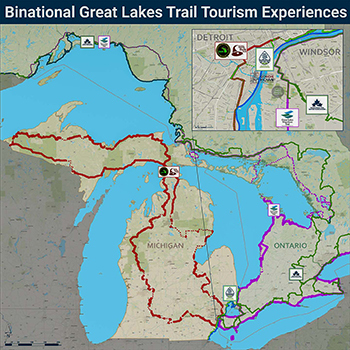
For long-distance hikers and cyclists, the bridge represents something bigger than a way to spend a sunny afternoon. Rather, the bridge offers a chance to incorporate two of North America's major trail networks.
The North Country National Scenic Trail stretches about 4,800 miles across eight northern states, from North Dakota to Vermont. In Michigan, it forms part of the Iron Belle Trail system, whose hiking route stretches from Belle Isle in Detroit to Ironwood in the Upper Peninsula.
|
Across the river, the Trans Canada Trail spans more than 12,400 miles through all 10 provinces and three territories. It connects thousands of communities across Canada and is recognized as the world’s longest recreational trail network.
The bridge doesn't make those two long-distance trails a single, continuous route, but it creates an international connection between them.
For someone planning a multiday adventure, that's significant, because the river that once represented the end of the trail can now be used as part of their route.
“It is a privilege to now be able to welcome even more neighbors onto our incredible trails system,” said Kate Lemon, North Country Trail Association marketing and communications manager. “It’s also a gift to be invited to enjoy what they have to offer.”
A gateway to an international adventure
When the bridge opened last month, 3,400 people crossed on the very first day.
Among them were 100 cyclists from Canada and the United States, who were participating in the 2026 Great Waterfront Trail Adventure, a five-day, 264-mile cycling tour through the region.
The ride was the result of four years of cross-border collaboration among trail and tourism organizations and created a glimpse of what international trail adventures the region could offer, when an international boundary is changed from an obstacle to part of the adventure.
|
Their trip showcased how the bridge has created a new kind of trail experience: a connection between Detroit's growing greenway network and Windsor's trails and, beyond them, a way to access larger systems that stretch across North America.
“The most exciting thing about the bridge is the ability to experience it with others,” said Todd Scott, Detroit Greenways Coalition executive director. “It brings out the best in everyone who's using it.”
The journey across the bridge may take 20 minutes by bike or 45 minutes on foot, but once you reach the other side, your adventure has only just begun.
|
Check out previous Showcasing the DNR stories in our archive at Michigan.gov/DNRStories. To subscribe to upcoming Showcasing articles, sign up for free email delivery at Michigan.gov/DNREmail.
Note to editors: Contact: John Pepin, Showcasing the DNR series editor, 906-226-1352. Accompanying photos and a text-only version of this story are available below for download. Caption information follows. Credit Michigan Department of Natural Resources, unless otherwise noted.
Text-only version of this story.
Aerial: An aerial view of Belle Isle Park, a 985-acre island park located in the Detroit River near downtown Detroit. (Photo credit: Tyler Leipprandt and Michigan Sky Media LLC)
Belle Biking: A rider enjoying Belle Isle’s bicycle lane. The island also has accessible fishing piers, an accessible playground, a swimming area and the oldest marble lighthouse in the country. An interactive tour of the park is also available at Michigan.gov/DNRAccessibility. (Photo credit: Karen Allmond)
Belle Isle: The Anna Scripps Whitcomb Conservatory features an indoor display of plants from around the world, outdoor seasonal flora beds and a lily-koi pond. (Photo credit: Tyler Leipprandt and Michigan Sky Media LLC)
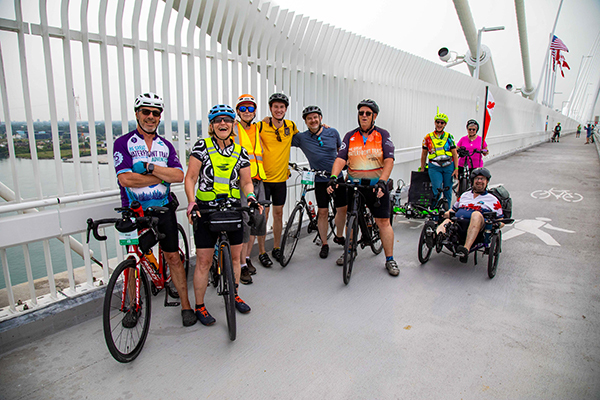
Bridge: A group of riders pausing for a picture on the Gordie Howe Bridge during the 2026 Great Waterfront Trail Adventure. (Photo credit: Martin Lortz and The Waterfront Regeneration Trust)
Dequindre Cut: Once a rail line, the paved Dequindre Cut is one of the many rail trails in Michigan.
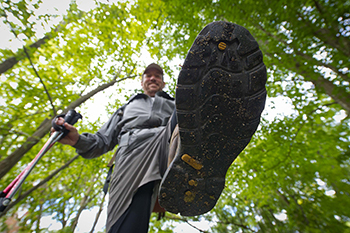
Distance: Hiker Chris Hilliar, who walked the Shore to Shore Trail from South Haven to Port Huron, is one of the long-distance hikers who call Michigan home.
Group: Biking is a popular activity in Michigan, and it adds $16.2 billion in economic value to Michigan every year. (Photo credit: Martin Lortz and The Waterfront Regeneration Trust)
Howe: Named for hockey great Gordie Howe, the Gordie Howe International Bridge spans between Detroit, Michigan, and Windsor, Ontario. (Photo credit: Gordie Howe International Bridge)
Map: The new international connection links the Trans Canada Trail and Great Lakes Waterfront Trail in Canada with the Great Lakes Way and Iron Belle Trail in the United States, creating new opportunities to explore the Great Lakes region across the border. (Photo credit: Trans Canada Trail)
Milliken: At Milliken State Park and Harbor, visitors can view the river and our neighbors in Canada through two color blind scenic viewers, courtesy of the Detroit River International Wildlife Refuge and EnChroma. (Photo credit: Ryan Burger)
Riding: A group of riders passing an example of the signage visitors can expect while enjoying one of the routes curated by The Waterfront Regeneration Trust. (Photo credit: Martin Lortz and The Waterfront Regeneration Trust)
Sandwich: A group of cyclists posing next to a mural in Sandwich, giving a glimpse of the international trail adventures the region could offer. (Photo credit: Martin Lortz and The Waterfront Regeneration Trust)
|