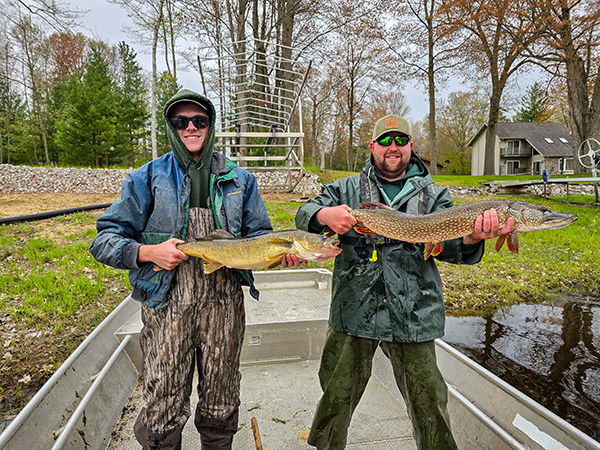
It’s a gold rush for fish!
Fish populations are rebounding in the Tittabawassee Impoundments’ Four Lakes
By APRIL MOREY, fish management biologist
Southern Lake Huron Management Unit
Michigan Department of Natural Resources
Many folks in Michigan remember the dreadful day of May 19, 2020.
Severe weather pushed the Edenville and Sanford dams in Midland and Gladwin counties past their limits, resulting in catastrophic flooding in the area.
These dams, along with Secord and Smallwood dams, on the Tittabawassee and Tobacco rivers create the Tittabawassee River Impoundments, also known as the Four Lakes: Secord, Smallwood, Sanford and Wixom.
The flooding likely displaced many fish downstream into the Saginaw River and Saginaw Bay while also limiting access for anglers throughout the Four Lakes system — an important aspect of the local economy.
Present day
Six years later, the light at the end of the tunnel is approaching for the Four Lakes complex, with Sanford Lake refilled to the legal summer lake level.
Locals have been working tirelessly to restore the area to its former state.
A variety of entities have stepped up to fulfil their responsibilities to the Four Lakes residents and visitors, including the Michigan Department of Natural Resources Fisheries Division.
In their heyday, the Four Lakes attracted anglers from around the state in search of premiere walleye, muskellunge, bass and panfish that didn’t require venturing out to Saginaw Bay or Lake St. Clair.
This is a time that folks still dream of, lost when flooding decimated those desirable fishing opportunities.
Many anglers fear that they might never see Four Lakes like that again in their lifetime.
However, as the local DNR fisheries biologist, I believe the glass is half full when it comes to this important fishery.
Cycles and concepts
In a natural river system, heavy rain and snowmelt result in seasonal flooding that allows fish to move into new habitat to spawn and forage and enables fresh nutrients to be added to the aquatic system – this is called the “flood pulse” concept.
Unfortunately, damming rivers and shoreline development restrict a river’s ability to complete the natural flood pulse cycle, resulting in interrupted nutrient cycling.
|
Dams can block fish passage, preventing them from accessing habitat upstream, and the nutrients, like plants and organic matter, that would typically enter the system through flooding instead remain on the landscape.
As the Four Lakes refill and water begins to cover the exposed bottomlands, it mimics the seasonal flooding process, allowing fish to explore recently refilled areas.
It’s their very own gold rush for newly discovered (by them) habitat and food. Biologists call this the “new reservoir effect.”
As the changing water levels stir up nutrients that have been trapped in the sediment and terrestrial (land) plants that are now underwater begin to decompose, releasing nutrients into the water, the phytoplankton and zooplankton populations will explode.
Zooplankton are tiny aquatic animals that serve as a food source for fish and other aquatic animals, making a strong foundation for the rest of the food web.
This foundation, along with drowned insects, will attract crawfish, baitfish and panfish.
With all that extra energy and space, these species will experience rapid growth and reproduction.
You know what loves to eat those high-fat forage species?
That’s right — largemouth bass, smallmouth bass, walleye and muskellunge.
The newly flooded habitat will provide more than just additional food for these fish species. Newly submerged trees, plants, fallen wood and rocks will provide refuge and spawning grounds for these game fish, further amplifying the bottom-up energy cascade.
While immediate, the benefit of this boom is short-term, since it will not be a naturally reoccurring event.
Lake monitoring
To harness this ecological potential, the DNR Fisheries Division’s Southern Lake Huron Management Unit has established a fluid management plan and began monitoring the accessible lakes earlier this field season.
Secord and Sanford lakes were surveyed in May and June, respectively, following the status and trends protocol established by Fisheries Division, to establish a baseline.
This protocol uses a variety of gear types to capture small- and large-bodied fish (bonus: crayfish and turtles) to paint a picture of the lake’s fish community.
|
The biggest benefit is that it allows biologists to make comparisons to other lakes throughout the state — and in this case, to the fish community of the Four Lakes before the dam failure.
If resources are available, the plan for the lakes will be to survey them annually for the next several years to maintain an adaptative management strategy for the system, one of my top priorities as the fisheries biologist for the area.
This is critical because the entire ecosystem will take time to balance out, and as fisheries managers, we want to be able to relieve pressure or give the system a boost as needed to keep up the momentum as the system recovers.
The final reports for the two lakes surveyed so far, including a fish growth analysis, will likely be available in late winter.
This report will be available to the public through multiple venues, including the Four Lakes Task Force and lake association outlets, but folks are always welcome to directly reach out to the management unit for a copy.
But until then — how about a little preview?
Results
Sanford Lake was surveyed nearly immediately after reaching summer water levels. This effort captured nearly 1,500 fish comprised of 30 species and a high number of large crayfish.
The catch was dominated by minnows and shiners, aligning with the expectations that the bottom of the food web would take off first.
The survey on Secord Lake, which only experienced low water levels during the last six years, captured roughly 1,300 fish comprised of 15 species. This lake was dominated by bluegills, ranging from 1 to 9 inches long.
But what about the trophies, you may ask?
The crew netted every sportfish species that was in the impoundments prior to the dam failure, except muskellunge.
Muskellunge – along with walleye and northern pike – are underestimated in these surveys because the gear targets the shallow water, while these species are swimming around in the deeper, cooler water.
Some notable catches in Sanford Lake included a 27-inch walleye, 11-inch black crappie and, surprisingly, a brown trout!
|
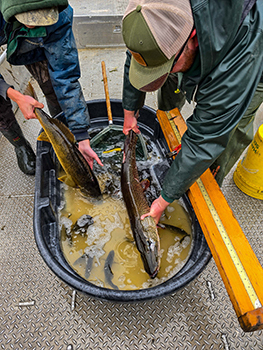
The team will have to investigate that last one further, but it’s safe to say the brown trout symbolizes the movement in and between systems during the lake’s “river era” that kept the fishery alive.
While some may look back at the pre-2020 Four Lakes and think that the good old days are gone, the flooding that changed the fishery is also, through the flood pulse and new reservoir effects, aiding in its recovery.
These lakes are far from being written off with “back in my day …”
For more information on the restoration of the Four Lakes, visit Four-Lakes-Taskforce-MI.com. To reach out to the Southern Lake Huron Management Unit to request a copy of the final reports, when available, visit Michigan.gov/FisheriesUnits.
|
Check out previous Showcasing the DNR stories in our archive at Michigan.gov/DNRStories. To subscribe to upcoming Showcasing articles, sign up for free email delivery at Michigan.gov/DNREmail.
Note to editors: Contact: John Pepin, Showcasing the DNR series editor, 906-226-1352. Accompanying photos and a text-only version of this story are available below for download. Caption information follows. Credit Michigan Department of Natural Resources, unless otherwise noted.
Text-only version of this story.
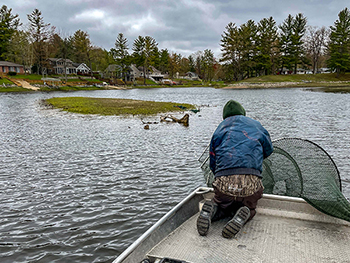
Secord-1: Michigan Department of Natural Resources Southern Lake Huron Management Unit staffers are shown checking a large-mesh fyke net deployed in the upper west arm of Secord Lake on May 13, 2026.
Secord-2: Michigan Department of Natural Resources Southern Lake Huron Management Unit staffers are pictured with a walleye and northern pike captured and released in Secord Lake on May 13, 2026.
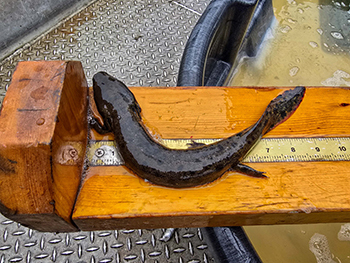
Secord-3: A mudpuppy, Michigan’s largest aquatic salamander, captured in Secord Lake on May 13, 2026. Due to their sensitivity to pollutants, these salamanders are known to symbolize good water quality where present.
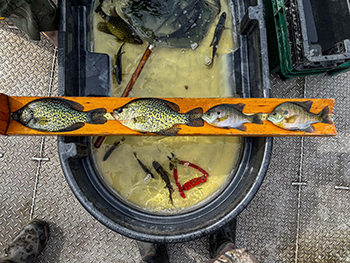
Secord-4: Two black crappies (approximately 13 inches; left) and two bluegills (approximately 8.5 inches; right) captured in a Secord Lake survey on May 12, 2026.
Sanford-1: Michigan Department of Natural Resources Southern Lake Huron Management Unit staffers are shown measuring fish captured during a survey on Sanford Lake.
|