How Michigan can live with black bears
Social acceptance is key to coexistence across state
By ANDY HENION Communications representative
Wildlife Division, Michigan Department of Natural Resources
One early morning in May, as the residents of Carleton slept, a black bear wandered through their yards in the dark, its hulking image picked up by a trail camera.
Not a big deal for many Michigan communities, particularly in the northern part of the state, but this bear happened to be roaming around Monroe and Wayne counties.
And folks in metro Detroit just aren’t used to seeing bears.
Police urged caution.
News reporters flocked to the area.
Concerned residents lit up social media.
“This may be the farthest southeast a black bear sighting has been confirmed in Michigan,” said Michigan Department of Natural Resources wildlife biologist Zach Cooley, who verified the bear’s May 10 visit from camera images. “At this point we are not certain how it made its way here. We assume it is probably a young male, wandering.”
The rare appearance of a black bear in heavily populated southeast Michigan reflects a new reality for a state attempting to live harmoniously with the iconic species.
While bears once occupied the entire state, unregulated killing of the species and development in the early 20th century cut their numbers dramatically, particularly in the Lower Peninsula.
Establishing hunting regulations helped the species recover in many places, and today Michigan has a vibrant black bear population of 12,862 animals, according to the DNR’s latest estimate. That’s one of the top 15 bear populations in the nation.
In the Upper Peninsula, bears are abundant, with an estimated density of one bear every 2 square miles. More than 85% of the state’s bear population lives in the U.P., and the peninsula’s state-managed harvest nets about 1,500 bears every year.
|
In the northern Lower Peninsula, where bear hunting is also legal, the bear population has increased in recent years as residents become more accustomed to the animal’s presence.
Still, in fast-growing and tourist-heavy areas like Grand Traverse County, bears can still cause quite a bit of excitement. In the past six years, the DNR has logged 178 bear complaint reports from Grand Traverse County, by far the most of any county in the northern Lower Peninsula.
And then there’s southern Michigan: home to the state’s largest cities, including Detroit, Grand Rapids, Lansing, Flint and Kalamazoo. Millions of people. Hundreds of miles of crisscrossing highways. Towering buildings. Manufacturing plants.
Bear hunting is not allowed in the bottom half of the Lower Peninsula, and bear complaints generally get rarer the farther south you go. In fact, some southern Michigan counties have never logged a bear complaint with the DNR, or at least since records have been kept starting in 2003.
So, it can be a surprise when a bear shows up.
Resident reaction can run the gamut, illustrated by these two social media responses to the Carleton bear:
“Why hasn’t the bear been caught yet?” said one user. “This is a public safety concern.”
“That bear is not going to approach anyone,” responded another. “Let it be. This is their land.”
The DNR’s Wildlife Division strives to strike a balance between these two disparate lines of thinking. In other words: Maintain a sustainable bear population throughout Michigan while minimizing bear-related conflicts.
|
Jared Duquette, the DNR’s human-wildlife interaction specialist, said bears typically have greater acceptance in communities with long-established bear populations, such as those in the U.P. and areas of the northern Lower Peninsula.
“Acceptance depends on several factors, though, such as familiarity with bear behavior, frequency of sightings and how much control people feel they have in interactions with bears,” Duquette said. “In areas where bears are rare, community culture and media coverage can often sway acceptance of bears by sensationalizing their presence and perceived danger.”
Duquette said managing social perceptions and the extent people and bears become habituated with each other are keys to enhancing human-bear coexistence, especially in areas where bears are expanding.
“Communities with increasing bear sightings should consider proactive communication and strategies to empower residents in safely coexisting with bears,” he said. “Visting the BearWise website is a great place to start.”
Adaptable creatures
The DNR’s approach to bears is driven by the agency’s black bear management plan. The plan was developed in 2008 using the best available science and significant input from bear stakeholder groups and the public.
The plan references a survey showing that a majority of Lower Peninsula residents value the existence of black bears and their important role in nature.
As large omnivores, bears benefit the ecosystem by spreading plant and berry seeds in their droppings and being important predators of insects, deer fawns and other species.
|
When it comes to southern Michigan, the DNR’s strategy is to allow the bear population to expand naturally into the region to the extent social acceptance allows.
That last clause – “to the extent social acceptance allows” – is the tricky part.
What’s socially acceptable for one southern Michigan community may not be for another – at least in the early stages.
When the bear appeared in metro Detroit, many residents unaccustomed to seeing the animal expressed shock and fear. Compare that to areas like Grand Rapids and Lansing, where bear sightings are more common, and reactions generally have become more tempered.
“Bears are likely to become more socially acceptable as they expand south in Michigan,” Duquette said. “However, acceptability will take time and depend on communities building a local culture that understands basic bear behavior and is accepting of bears. Community members should understand that bears are naturally afraid of us and pose little threat to people and pets.”
Black bears – Michigan’s only bear species – are solitary animals, and male bears roam vast areas, with young males dispersing up to 100 miles to find new, unoccupied territory.
While bears thrive in large hardwood and conifer forests with dense underbrush and wetlands, they also seem to be adapting to less woodsy settings around the state.
|
“We’ve been seeing over time that bears continue to survive and persist in habitats that we would not have thought were suitable previously,” said Cody Norton, DNR bear and furbearer specialist. “Bears are extremely adaptable creatures – they are generalists and can make use of a variety of food sources. We’ve been seeing them persist in areas that have very few trees – it may be a little woodlot next to cornfields, for example.”
Norton said it appears a few bears have denned over winter in the Grand Rapids and Lansing areas. Both areas have forested river corridors that bears like to travel along.
Bears have also showed up in the Flint area only to be hit and killed by vehicles.
“There can be extremely high mortality when bears show up in these older urban environments that are heavily developed with highways running through them,” Norton said.
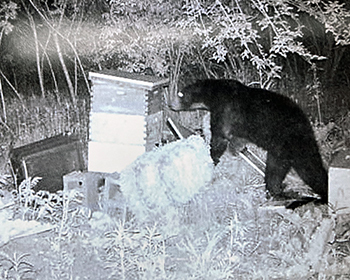
As for the bear first spotted in Carleton on May 10, the animal was caught on a security camera in nearby Flat Rock the next night and again the following week in South Rockwood, where it raided a resident’s beehives at night.
After still another sighting near Carleton, Cooley said he has received no further reports of the animal’s whereabouts.
So, could a bear – or multiple bears – persist in Metro Detroit?
|
“Southeast Michigan contains some of the state’s least-suitable habitat for bears – much of the area is flat and lacks the woodlots and river corridors they favor,” Norton said. “Could there be pockets in southeast Michigan that if multiple bears made it to, they could persist? Yes, there might be, but I think until we see bears do that, it’s really hard for us to predict whether it’s truly suitable.”
Coexisting with bears
From Marquette to Mio to Muskegon, coexisting with black bears in Michigan means accepting two fundamental facts:
- Black bears are wild, powerful animals that should be appreciated from a distance. They may defend themselves when surprised, threatened or protecting their cubs.
- Black bears are naturally timid, cautious animals. They view humans as a threat to avoid rather than as a food source.
Lynn Rogers, founder of the North American Bear Center, notes in his article “How Dangerous Are Black Bears?” that black bears are so timid partly because they evolved alongside such powerful predators as saber-toothed cats and dire wolves, both now extinct.
“Black bears were the only one of these animals that could climb trees, so they survived by staying near trees and developing the attitude: run first and ask questions later,” Rogers explains. “The timid ones passed on their genes to create the black bear of today.”
As many communities with established black bear populations have learned, living with bears takes a certain amount of sacrifice from just about everyone, including bird lovers and pet owners.
Here are some basics:
- Spotting a bear on your trail camera or wandering through your backyard is no reason to panic. You do not need to call local authorities or the DNR. This is natural bear behavior. You can scare the bear off by yelling, blowing an air horn or banging pots and pans.
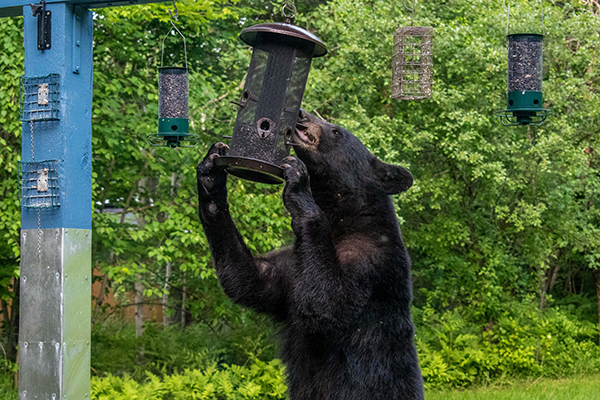
- Bears are drawn to birdfeeders loaded with birdseed or suet, as well as grease-splattered grills and outdoor pet food. They can literally smell the stuff from a mile away. So, you’ll need to remove the temptation – and, once you do, give it a good two weeks for the bear to stop coming around.
- Use electric fencing around chicken coops and apiaries.
- Bears love garbage. Consider waiting to put your garbage cans out until the day of pickup. Folks in high-density bear areas should consider using bear-resistant trash bins or trash lid straps.
- You may need to educate your neighbors. If they have birdfeeders or other outdoor food sources, the bear will be traipsing through everyone else’s yard to get to them. The more available food sources in the neighborhood, the harder it will be to get rid of the bear.
Taking down birdfeeders can be particularly difficult for many residents. Of the 178 bear complaints from Grand Traverse County, roughly half of the reports list bird feeders as the attractants.
But as BearWise points out, you don’t have to choose between watching birds and deterring bears. Consider alternatives such as planting bird-friendly native flowers, trees and bushes; putting out nest boxes and bird baths; and providing simple bird shelters and perches.
The key is ensuring that black bears don’t become habituated with regular access to birdseed and other human-provided food sources.
Duquette said black bears can lose their natural fear of humans after routine close encounters do not scare them away and they are rewarded with food. And once a black bear becomes fully habituated and food-conditioned, it rarely returns to being truly wild.
“Successfully coexisting with bears,” Duquette said, “is just as much about how bears are perceived by people as taking tangible actions such as managing bird feeders and trash disposal.”
Find out more about black bears in Michigan.
|
Check out previous Showcasing the DNR stories in our archive at Michigan.gov/DNRStories. To subscribe to upcoming Showcasing articles, sign up for free email delivery at Michigan.gov/DNREmail.
Note to editors: Contact: John Pepin, Showcasing the DNR series editor, 906-226-1352. Accompanying photos and a text-only version of this story are available below for download. Caption information follows. Credit Michigan Department of Natural Resources, unless otherwise noted.
Text-only version of this story.
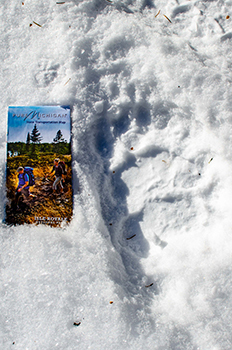
Bear-1: A bear track is shown in the snow, with a state highway map for size comparison, at Craig Lake State Park in Marquette County.
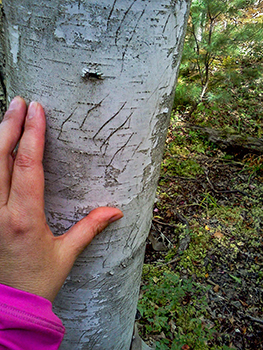
Bear-2: Bear scratch marks are shown on the trunk of a tree.
Bear-3: A hungry black bear invites itself to dinner at a bird feeding station in Marquette County. (Photo courtesy of John Pepin)
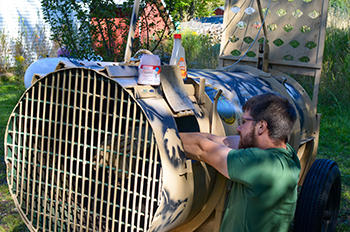
Bear-4: Michigan Department of Natural Resources wildlife technician Caleb Eckloff baits a bear trap in an attempt to relocate a nuisance bear.
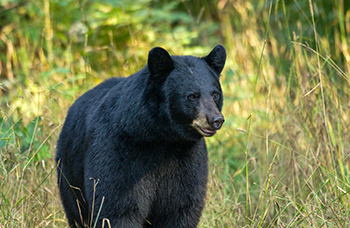
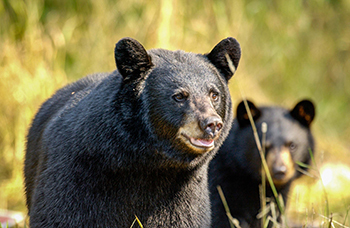
Bear-5: A black bear stands at the edge of a clearing.
Bear-6: A black bear sow and a cub are shown in a grassy opening.
Bear-7: A black bear continued its tour of southeast Michigan by raiding a resident’s bee hives on May 17 in South Rockwood. The bear was first documented on a trail camera in nearby Carleton on May 10. (Photo courtesy of Jennifer Drouillard)
|