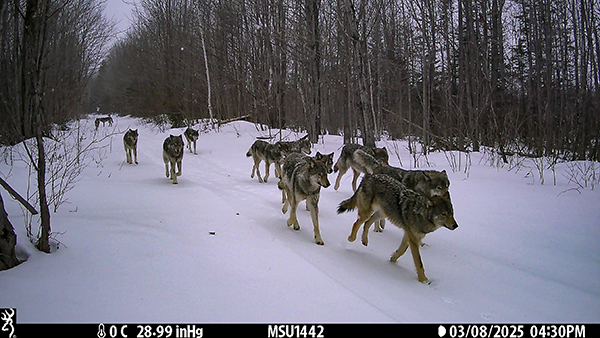
Michigan estimates UP wolf population from remote camera images
Project results align with wolf biology, DNR winter track survey
By ANDY HENION,
Communications representative, Wildlife Division
Michigan Department of Natural Resources
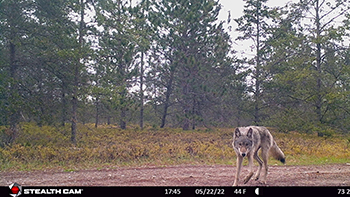
For the first time, researchers from Michigan State University and the Michigan Department of Natural Resources have successfully estimated Michigan’s wolf population using remote cameras deployed throughout the Upper Peninsula.
The camera survey method, which began with a pilot proiect in 2022 and has since expanded, produced monthly estimates that generally align with wolf biology – lower counts during winter when the wolf population is at its lowest due to mortality, then increasing in the spring after pups are born.
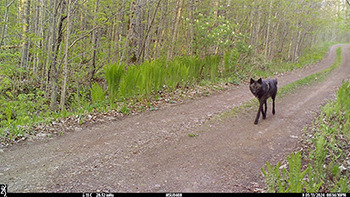
In addition, the camera survey aligned closely with the DNR’s longstanding winter track survey. Both surveys produced a February/March 2024 estimate of just under 800 gray wolves.
While the track survey is limited to producing a minimum estimate during winter, when wolf tracks are clearly visible in the snow, the camera survey provides a first look at how Michigan’s wolf population fluctuates throughout the year.
Camera survey estimates ranged from a low of 525 wolves in March 2025 to a high of 1,198 wolves in October 2024.
“Our winter track survey was doing exactly what it was designed to do, and that is to get a minimum count of wolves in wintertime,” said Tyler Petroelje, the DNR’s northern Michigan research specialist. “And now the camera survey is doing exactly what it’s intended to do, and that is to provide information on changes in total abundance throughout the year.”
In Michigan, the gray wolf is a federally protected endangered species.
However, wolves have surpassed state and federal population recovery goals for more than two decades and no longer warrant endangered status, according to the DNR’s wolf management plan.
The state’s ability to produce data on wolf abundance is important for reclassifying the animal as a recovered species and satisfying post-delisting federal monitoring requirements.
The DNR has monitored the wolf population through winter track surveys every other year since 2014. Because track surveys cover about 60% of the U.P. in any given year, they can be labor-intensive and costly. Staff must not only locate wolf packs multiple times but also follow them, sometimes for miles, to determine the number of wolves in each pack. In addition, track surveys require ideal snow conditions.
|
“If you think back to 2024, that was a very mild winter, and the track survey was difficult to pull off,” said Brian Roell, the DNR’s large carnivore specialist, who has conducted wolf track surveys for more than 25 years. “And then in 2026, we had the opposite – it was snowing every day and covering up the tracks, making it difficult as well.”
Biologists are increasingly using remote cameras across the country to estimate wildlife abundance, according to project researcher Jerrold Belant, Boone and Crockett chairman of wildlife conservation at Michigan State University.
While initial camera purchase costs are high, short- and long-term costs can be less expensive, and the camera surveys are not weather-dependent. Biologists can deploy remote cameras across large survey areas for extended periods, providing abundance estimates throughout the year.
Camera surveys can also be used to document and potentially help manage other wildlife species. The U.P. camera survey produced more than 2 million total images of various species including white-tailed deer, gray wolf, coyote, wild turkey, red fox, black bear and bobcat.
The DNR is currently using remote camera images of the elusive gray fox for another research project.
“There are many applications for remote camera surveys, not just for wolves but other species as well,” Belant said. “When you think of the importance of monitoring wildlife – not only for biodiversity but in relation to harvestable species – having a single tool you can use to monitor multiple species simultaneously can be a real advantage, both in terms of time and cost.”
Belant developed a proposal for the remote camera survey to estimate wolf abundance in 2020 with Dean Beyer, a former wildlife research biologist for the DNR.
|
After the DNR greenlit the project, researchers conducted a pilot camera survey of wolf abundance in 2022 and early 2023. The results were promising, and the U.P.-wide camera survey was launched in mid-2023.
For the U.P.-wide survey, researchers placed 1,311 DNR-owned cameras throughout the peninsula.
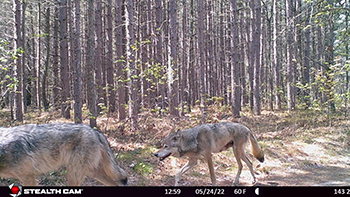
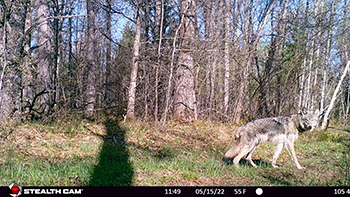
The cameras were positioned on tree trunks about 4 to 5 feet high along low-use roads and trails where wolves were expected to travel. Researchers also posted a notice to passersby about the research purpose of the cameras.
The research team changed out the cameras’ memory cards and batteries every year.
Matt Nelson, an MSU doctoral candidate who is coordinating the fieldwork, said the images were downloaded, run through machine learning programs to identify species and then double-checked by researchers.
Computer software removes all photos of humans and vehicles.
Using a scientific “space-to-event” model, the researchers can estimate the wolf population at specific times throughout the year. Researchers estimated Michigan’s wolf population monthly. By doing so, they could evaluate how mortality, reproduction and provisioning of pups changed the estimates throughout the year.
Results from the first 21 months of the full research project (October 2023-June 2025) show:
- The three highest monthly population estimates were in October 2024 (1,198 wolves), November 2023 (1,084 wolves) and September 2024 (1,061 wolves). During the fall months, wolf detection is greater as pups are now large enough to travel with the pack and young wolves disperse to find a mate and new territory of their own.
- The three lowest monthly population estimates were in March 2025 (525 wolves), February 2025 (538 wolves) and April 2025 (544 wolves). This makes sense, researchers say, because late winter is the lowest point in the annual population cycle for wolves. In addition, denning season typically occurs in early spring, when female wolves give birth. Fewer wolf detections occur when pups remain in the den and pack members spend more time returning to the den to care for the young.
- Camera population estimates from February 2024 (773 wolves) and March 2024 (794 wolves) were very similar to the snow track survey estimate – 768 wolves – conducted during the same timeframe.
|
Researchers said the results support what they expected about Michigan’s wolf population.
“There were no real surprises,” Nelson said. “The camera survey worked really well and aligned with what we know about wolf ecology.”
Nelson said he’ll be in the U.P. until October pulling memory cards from the cameras to collect a third year of data, including an estimate for this past winter. That estimate will be compared to the 2026 winter track survey, which produced an estimated minimum population of 792 wolves.
Gray wolves once roamed the entire state of Michigan but are now known to inhabit only the U.P. Michigan is one of about 14 states with wolves, according to the Wolf Conservation Center.
In Michigan, the gray wolf is currently protected under the federal Endangered Species Act.
The federal government delisted the gray wolf from endangered species status in 2020, but a federal judge struck down that delisting in 2022. Prior to that, the wolf had been reclassified seven times from 2003 to 2014 amid a host of legal challenges involving conservation groups, ranchers, developers and others.
To find out more about wolves in Michigan visit Michigan.gov/Wolves.
|
Check out previous Showcasing the DNR stories in our archive at Michigan.gov/DNRStories. To subscribe to upcoming Showcasing articles, sign up for free email delivery at Michigan.gov/DNREmail.
|