Don ’t put all your (fish) eggs in one basket
Restored reef in Saginaw Bay diversifies spawning habitat and promotes resilience
By JEFFREY JOLLEY, PhD., Southern Lake Huron unit manager
Fisheries Division, Michigan Department of Natural Resources and MARCEE WARDELL, communications specialist, Fisheries Division, Michigan DNR
Imagine a reef: sunlight streaming through the azure water reveals a vibrant underwater community, where fish, large and small, dart into holes and crevices or swim around the reef’s edges while other aquatic creatures make their homes or search for food.
Did you think of a coral reef, covered in pink anemones and surrounded by brightly colored tropical fish like blue tang and clownfish?
Now imagine a reef, with dappled sunlight and teeming with fish, in Lake Huron, in Saginaw Bay.
Surprised?
Maybe you shouldn’t be.
Reefs used to be common in Saginaw Bay, and organizations like the Michigan Department of Natural Resources and others are working to restore reef habitat for the benefit of fish like lake whitefish and walleye, as well as many other aquatic species.
The disappearance of rocky reefs
Though corals did once thrive in the northern Lower Peninsula about 350 million years ago (the remains of which are now Petoskey stones), the reefs that existed in Saginaw Bay were rock reefs. These reefs, mainly comprised of granite and limestone, were formed by the movement of glaciers.
Since Saginaw Bay has an otherwise very flat bottom and a relatively consistent depth (about 25 to 30 feet), the thousands of acres of reef in the bay were important habitat for the bay’s aquatic species, providing places to deposit eggs, hide from predators or find a meal.
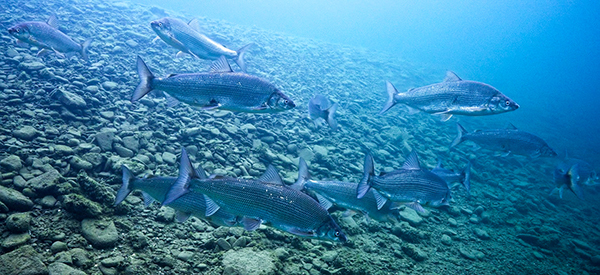
Rock reefs are comprised of cobble – rocks that vary in size from about the size of an orange to the size of a basketball, piled and rising from the lake bottom.
These stones of different sizes create crevices – called interstitial spaces – and ledges perfect for spawning fish to deposit eggs into and for young fry (newly hatched fish) to hide from predators.
Reefs, depending on their location and depth, can get a lot of wave action. The continual movement of water keeps sediment from building up and filling in those useful interstitial spaces. It also washes oxygenated water over fertilized fish eggs, which they need to develop and hatch into healthy fry.
But what happened to the reefs in Saginaw Bay? They were buried.
Logging, industrial and agricultural land uses in the area surrounding the bay exposed sediments, which caused excess erosion and movement of sediment, which washed out into the bay, covering the rocky structures.
Dredging the lake bottom to remove this sediment and resurface the original rock reefs would be incredibly costly and disruptive to the use of the bay by humans and fish, if not economically impossible. It would also likely be ineffective, given current activity in the region causing continued sedimentation.
Check out a video on the project.
The solution researchers have arrived at is to restore reef habitat not by resurrecting remnants of former reefs, but by building new ones. This kind of reef restoration work is gaining traction in the Great Lakes and elsewhere.
Walleye decline and recovery strategies
The reef habitat restoration story in Saginaw Bay begins not with a project, but a problem. Historically, walleye were abundant in Saginaw Bay. But in the 1940s, this fish population collapsed due to declines in water quality and habitat, caused by pollution and sedimentation, along with unrestrained fishing .
The opportunity to recover walleye came after the Clean Water Act took effect in the early 1970s and the negative impacts were better managed around in the bay.
The DNR began stocking walleye, which boosted the population, but the fishery didn’t recover to pre-1940s levels and remained dependent on stocking.
|
DNR researchers attributed that to degraded and ongoing degradation of spawning habitat (particularly rock reefs, but also dams blocking migrating fish), along with walleye fry predation from invasive alewives.
Then suddenly, something shifted.
“Along comes 2003, and we have this big food web change in Lake Huron and invasive alewives disappear,” said Dr. David Fielder, fisheries research biologist with the DNR and one of the authors of the report resulting from the research.
This change, due in part to increased predation on alewife by other fish, but mostly by the invasion of dreissenid mussels – zebra and quagga mussels, which consume much of the phytoplankton that are the base of the food chain – reduced the number of alewives eating walleye fry.
This had a big effect, and reproductive success boomed. Stocking was discontinued in 2006, and by 2009, walleye abundance reached recovery targets.
Even though walleye populations were seemingly back to normal, work remained to be done.
Researchers noted that since rock reef habitat was lost in the bay, the walleye that demonstrated sustained reproduction were primarily spawning in the tributary rivers, among them the Saginaw River.
That’s not ideal, because it makes the walleye population vulnerable to changes in those rivers, like barriers, contamination or natural disasters.
If the river spawning habitat isn’t available, the walleye will be unable to reproduce with much success. According to Fielder, whether fish spawn in a river or on a reef is something they likely inherit from their parents, not something they choose based on environmental conditions.
Without preferred spawning habitat, walleye are left to deposit their eggs wherever they can. In the case of the few reef-spawning walleye still hanging on in the bay, this is often on the bottom of the lake.
But eggs on the bottom have a low chance of hatching out into fry, as the dissolved oxygen they need to develop is low and they’re not hidden from the predators that like to eat them. Plus, sediment can bury the eggs, just like it buried the former rock reefs.
While restoration efforts won’t bring back all the rocky reefs once present in the bay, restoring some of that habitat will still be immensely beneficial.
The metaphor project partners have used to describe this is the portfolio effect: Like diversifying your investment portfolio can help you weather volatility in the market, diversification of spawning habitat can help insulate the species from the effects of big ecosystem changes.
The goal isn’t necessarily more walleye reproduction but more consistent or dependable walleye reproduction. To ensure a resilient walleye population in Saginaw Bay, walleye need various spawning habitats, both reef and river.
Lake whitefish spawning in Saginaw Bay
Lake whitefish are an incredibly important species in the Great Lakes and Saginaw Bay, ecologically and culturally, and they are the mainstay of the bay’s state-licensed commercial fishery.
|
However, lake whitefish populations are in decline across the Great Lakes, including Lake Huron, and have been for years – except for in the central and lower half of Lake Huron, which is something of a stronghold for the species. Researchers believe this is likely supported by Saginaw Bay, as it’s a crucial spawning location.
While the ecological changes brought on by zebra and quagga mussels, in particular the collapse of alewife, seemingly helped walleye populations, they have not had a positive effect on lake whitefish.
These mussels’ voracious consumption of phytoplankton has devastated the zooplankton and benthic macroinvertebrates – small marine animals – that not only alewife but also whitefish fry depend on for early growth. Fry that don’t get enough food grow slowly and fail to survive to older ages.
The proliferation of dreissenid mussels has had another effect on the lakes, noticeable even to nonexperts: The water is much clearer. This is due, again, to their feeding habits, pulling zooplankton and algae out of the water.
Clear water might seem pleasant, but it’s not good for native fishes like lake whitefish. Additional UV light penetration of the water essentially gives lake whitefish eggs and fry extreme sunburns, which reduce their survival.
This effect is magnified by the increase in mild winters as the climate changes. Less ice coverage means even more UV light penetrating the water and harming developing whitefish.
While managing invasive mussels and their impacts on spawning grounds is still experimental (through efforts such as the Great Lakes SWIM project), creating suitable spawning habitats in productive areas like Saginaw Bay should still benefit whitefish.
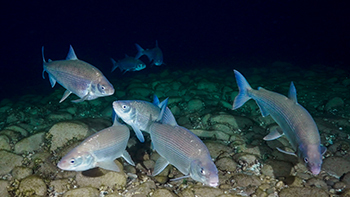
Whitefish also use reefs for spawning, so like walleye, restored reef habitat will likely improve survival for eggs and fry. Coreyon Reef, an earlier offshore reef project in Saginaw Bay, has already seen whitefish and walleye adoption for spawning.
What about yellow perch?
Yellow perch are one of the most popular species among Great Lakes anglers, as demonstrated by DNR creel surveys, and for good reason. They’re a good fish for beginners to target, and they’re fun to ice fish for, too.
But will efforts to bolster lake whitefish and walleye population resilience hurt yellow perch populations, as many anglers fear?
“Perch are really important; we’re working hard to do what we can for perch recovery in Saginaw Bay,” Fielder said.
Yellow perch today are at a fraction of their historical abundance in the bay. Yellow perch spawning is strong, but the yearling perch currently have low survival rates. This can be attributed largely to predation by larger fish, particularly walleye.
In the past, fisheries managers attempted to fix this by reducing the yellow perch harvest limit, reducing commercial licenses targeting yellow perch and increasing harvest opportunity for walleye.
None of these approaches improved perch survival.
Why?
|
While walleye have reached recovery targets, not all ecological functions of the bay are restored.
In the past, abundant pelagic (midwater) prey fish populations likely created a predation buffer to allow for better perch survival. Those used to be invasive alewife, and earlier, the native cisco (lake herring). Both are absent now.
The Michigan DNR has partnered with the U.S. Fish and Wildlife Service to reintroduce cisco into Saginaw Bay to try to help restore that part of the fish community, which could ultimately benefit yellow perch abundance.
The Walleye and Yellow Perch Recreational Management Plan for Saginaw Bay, published by the DNR in 2025, focuses on finding balance between walleye and yellow perch in the bay. While walleye do prey on yellow perch, these species can coexist at desired levels in the bay, and historically, they did.
Restoring reef habitat in the bay
“In that original 2004 plan, we prescribed a lot of different strategies for walleye recovery,” Fielder said. “One of them was to invest in rock reef restoration in Saginaw Bay.”
The plan called for two kinds of reefs, offshore and nearshore, with the intention of seeing which type of reef would be most beneficial. But once initial benchmarks for walleye recovery in Saginaw Bay had been met, there was little momentum (or funding) to pursue reef restoration.
The result was Coryeon Reef, an offshore reef in inner Saginaw Bay completed in 2019.
While a nearshore reef was also considered at the time, further engagement with the local community was needed to find a site that would deliver the intended nearshore habitat to native fishes without impeding use of the bay for boating.
The opportunity to pursue a nearshore reef came in the form of funding from the National Coastal Resilience Fund (a partnership between the National Fish and Wildlife Foundation and National Oceanic and Atmospheric Administration) for a feasibility study on further restoration projects in Saginaw Bay.
Channel Island Reef was one of three projects included in the feasibility study, and it was the one the partners decided to pursue at this time. The other possible projects, focused on reducing sedimentation and attenuating wave action in flood-prone areas, may be considered for future restoration work in the bay.
Using what they’d learned from the feasibility study, public engagement efforts headed up by Michigan Sea Grant and the implementation of Coryeon Reef a few years prior, the team – including DNR, EGLE, GLFC, NOAA, Michigan Sea Grant, and Environmental Consulting and Technology – set about constructing Channel Island Reef to the east of Channel Island (also known as Spoils Island, Shelter Island or U.S. Army Corps Confined Disposal Facility).
|
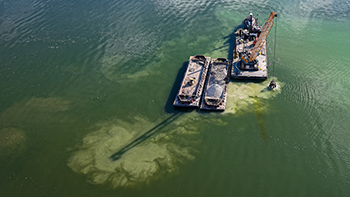
Construction began on Sept. 8, 2025, and was completed on Oct. 10, 2025.
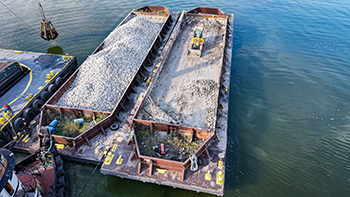
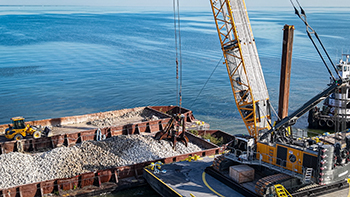
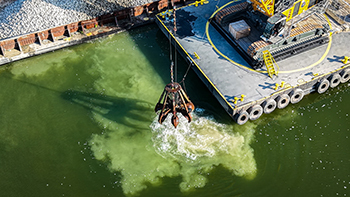
The process for building the reef was straightforward: Pieces of limestone, quarried locally in the Thumb area of Michigan, were moved out to the reef location on barges. A crane, also on a barge, used a claw to pick up the stone cobble and drop it into place.
Channel Island Reef is about 2.5 acres, approximately 190 feet wide and 570 feet long. The reef is located about 2 miles from the mouth of the Saginaw River, a half mile east of Channel Island. It is underwater, sitting 5.5 feet below the surface when water levels are lowest, which ensures that it poses a minimal hazard to navigation.
Funding for construction of the reef came from several sources: the Great Lakes Restoration Initiative, Great Lakes Fish and Wildlife Act, NOAA, and the Natural Resource Damage Assessment and restoration settlement with Dow Chemical.
NRDA funding helps restore ecosystem function and uses of public natural resources that have been compromised by the release of hazardous substances into the environment.
In addition to NRDA funds, grant funding is necessary for getting these kinds of projects off the ground. In times when everyone is feeling the financial pinch, grants allow the DNR and partners to accomplish large projects that would otherwise be financially out of reach for the organizations on their own.
The entire reef construction process was funded through grants or settlement, not by state tax dollars or license fee revenue.
‘We’re going to learn a ton’
What’s exciting about this project for researchers like Dr. Fielder is the learning opportunity that it presents.
Before either reef was constructed, assessment projects were conducted in the area to learn about the species that were using it and the predators that were present, as well as the dissolved oxygen levels, water temperatures and other environmental conditions. Similar assessments were conducted after the installation of Coreyon Reef, for comparison.
“This before and after investigation really helps inform us on what we achieved with this reef reconstruction,” Fielder said.
The assessments found that walleye and lake whitefish both adopted Coryeon Reef for spawning almost immediately. The nearshore Channel Island Reef could have similar results.
“I'm excited for the completion of the Channel Island Reef construction. During my PhD research at Purdue University in collaboration with DNR, we found lake whitefish and walleye were already spawning on Coreyon Reef just a year after its construction,” said Dr. Scott Koenigbauer, fisheries biologist with USFWS working out of the Alpena Fish and Wildlife Conservation Office.
“We found both species were releasing more eggs at the Coreyon Reef site after its restoration than before. We also observed a variety of species there, including yellow perch, lake trout, burbot and cisco, during our surveys.”
Koenigbauer believes that future work will likely demonstrate that spawning reefs in Saginaw Bay support stability for key species.
|
“With the construction of Channel Island Reef, scientists can now compare how these species utilize nearshore and offshore restored reefs in Saginaw Bay,” he said.
Historically, we know that there were both nearshore and offshore reefs in the bay.
“The question is: Offshore, in the open water, will the fish find and use that reef, or will they prefer a more nearshore environment?” Fielder said.
“Success in this rocky habitat requires lots of hydraulic agitation. That keeps the water refreshed, oxygenated and clean of sediment. So, a nearshore reef that’s shallower and has more wave agitation may perform differently – may perform better – than the offshore Coryeon Reef.”
As with Coreyon Reef, Dr. Fielder and staff at the Alpena Fisheries Research Station will be working with Purdue University to conduct assessments on the reef.
Starting in the spring, the researchers will start a two-year evaluation period, monitoring the long-term effects of the reef. Some questions they’ll be investigating are whether the fish are using the reef, whether they’re using it more or less than Coryeon (which will also be evaluated during this period) and whether sediment or dreissenid mussels are affecting the habitat.
Studying the reef could have implications for future projects – if Channel Island and Coreyon Reefs are a success, there could be interest in more reef restoration work, as funding becomes available, both in Saginaw Bay and elsewhere.
Don’t call it a comeback
While Saginaw Bay hasn’t always received the same attention as other parts of the Great Lakes, that’s changing.
The area’s agriculture and industry have contributed significantly to the success of the state’s economy, but current and historical land and water use practices resulting from this hard work have degraded aquatic habitat.
So, while the bay has an excellent fishery, there’s room for improvement and habitat restoration.
This opportunity for improvement has sparked interest in restoring and enhancing the bay’s natural resources. Funding agencies are poised to invest in Saginaw Bay and its watershed, and there’s no shortage of creative thinking when it comes to habitat improvement efforts, from reef restoration to fish passage solutions to stream barrier removal. Channel Island reef is one of many such projects on Saginaw Bay’s recovery arc.
Learn more about the Channel Island Reef project at Rebuilding the Reefs of Saginaw Bay: A Collaborative Effort to Restore Fish Habitat and Coastal Health and Channel Island Reef: Increasing fish spawning habitat and resilience in Saginaw Bay.
|
Check out previous Showcasing the DNR stories in our archive at Michigan.gov/DNRStories. To subscribe to upcoming Showcasing articles, sign up for free email delivery at Michigan.gov/DNREmail.
Note to editors: Contact: John Pepin, Showcasing the DNR series editor, 906-226-1352. Accompanying photos and a text-only version of this story are available below for download. Caption information follows. Credit Michigan Department of Natural Resources, unless otherwise noted.
Text-only version of this story.
Reef-1: During construction of the Channel Island Reef, stone cobble was dropped into place by crane. (Photo: Zak Allan, Great Lakes Fishery Commission)
Reef-2: Pieces of limestone, quarried locally in the Thumb area, were moved out to the reef location on barges. (Photo: Zak Allan, Great Lakes Fishery Commission)
Reef-3: The newly constructed Channel Island Reef is about 2.5 acres, approximately 190 feet wide and 570 feet long. (Photo: Zak Allan, Great Lakes Fishery Commission)
Reef-4: Construction on Channel Island Reef began on Sept. 8, 2025, and was completed on Oct. 10, 2025. (Photo: Zak Allan, Great Lakes Fishery Commission)
Reef-5: Limestone cobble was built up to create a rock reef that sits 5.5 feet below the surface when water levels are lowest. (Photo: Zak Allan, Great Lakes Fishery Commission)
Reef-6: Lake whitefish are shown congregating over rocky cobble. (Photo: Inspired Planet Productions)
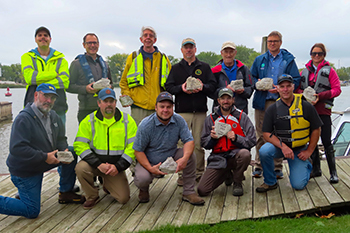
Reef-7: Project partners meeting on-site during reef construction, including Randy Claramunt, Chief of Department of Natural Resources Fisheries Division (back row, center) and Jeff Jolley, Southern Lake Huron unit manager (front row, second from right). (Photo: Jill Wingfield, Great Lakes Fishery Commission)
Reef-8: Lake whitefish are shown over a rock reef. Lake whitefish, an important species in Saginaw Bay and the Great Lakes, use reefs to spawn. (Photo: Inspired Planet Productions)
|